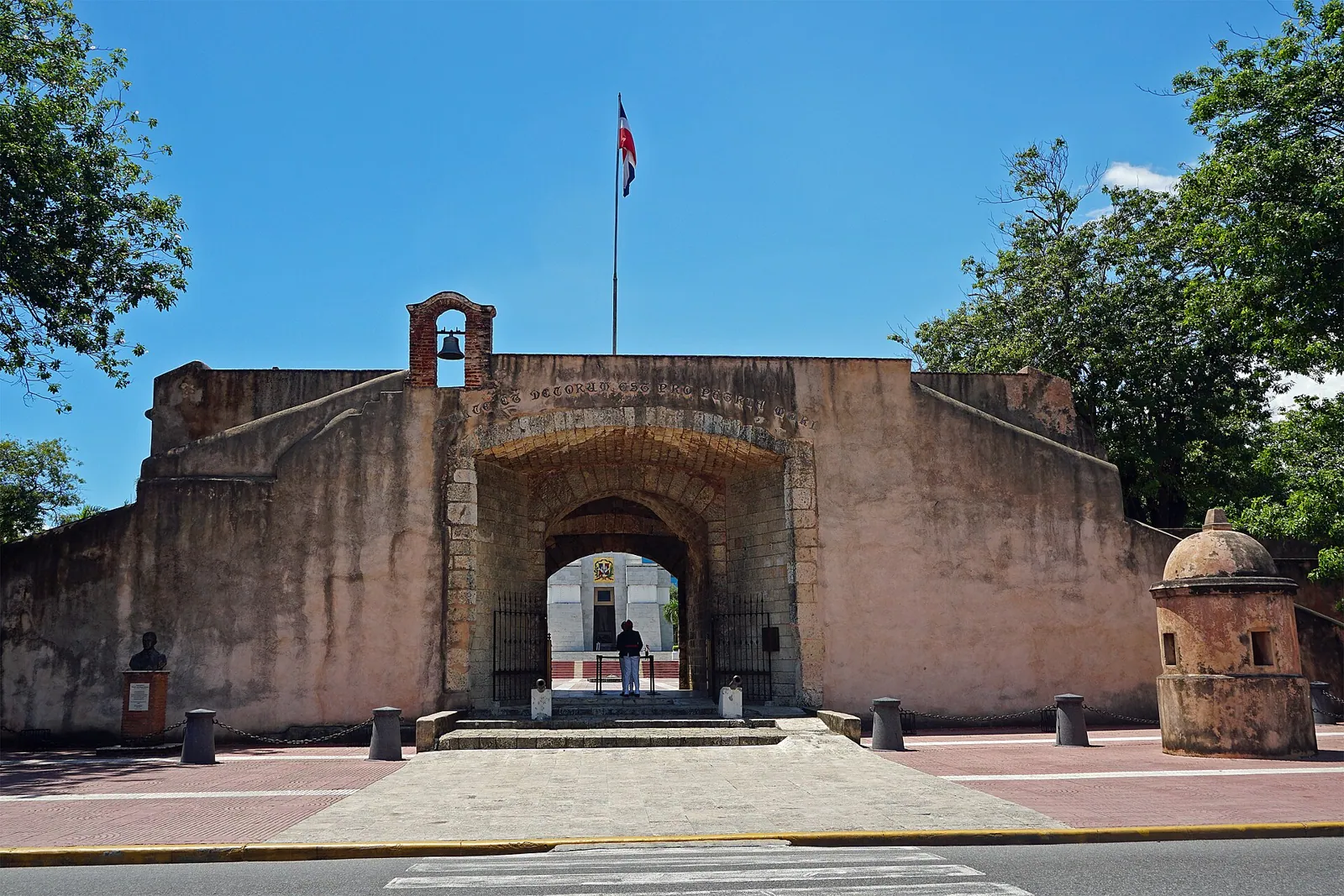
Every country picks a spot where its story is supposed to start, and for the Dominican Republic that spot is a stone arch at the western edge of the old walled city. The Puerta del Conde is a gate in the colonial defenses. On the night of 27 February 1844, a group of conspirators came through it, raised a new flag over its bastion and announced that the eastern part of the island was no longer under Haitian rule. Dominicans still call the gate by its old name, even though several governments have tried to rename it.
The story has more than one setting. The signal shot was fired at a different gate, the Puerta de la Misericordia. The man who gave the name of the movement, Juan Pablo Duarte, was not in the city at all. And the resting place of the three men called the founding fathers is in the park behind the gate, not in the gate itself. This page follows the night as the sources tell it, notes where historians disagree, and then walks you through what is there today.
The founders themselves have a page of their own on this site, Juan Pablo Duarte, and the street that runs from this gate to the cathedral square is covered in Parque Colón and Calle El Conde. This page stays with the gate, the night and the park.
A Gate in the Wall
The city of Santo Domingo got its walls in the sixteenth century. According to an opinion piece in Acento that draws on historians, Alonso de Fuenmayor, president of the Real Audiencia, began the city walls between 1533 and 1544 and built the Puerta Grande, which was also called the Puerta de la Misericordia, along with the gates at San Diego and the Atarazana. A Diario Libre feature gives 1543 as the date the site began as part of the defensive wall, and says that the place where the Puerta del Conde later stood already had a bastion called San Genaro.
The two sources differ on details, and the Acento piece says openly that historians disagree. What it adds is useful: the gate that became the Puerta del Conde was known as the "puerta cerrada," the closed gate, because it was not in use. In 1655 an English force under William Penn and Robert Venables attacked Santo Domingo. The Acento article says the defense centered on other forts and on the Puerta Grande, not on the closed gate. After the victory, the Conde de Peñalba, Bernardino de Meneses y Bracamonte, had the gate reopened and fortified in honor of the win, and the people began to call it the Puerta del Conde. The name then spread to the street and to the bastion. Diario Libre puts it more briefly: troops under the count turned back the English in 1655, and the site was named for him.
The shape you see today is later. Diario Libre says the gate took its present form at the end of the eighteenth century. It has a pentagonal plan, shows Italian influence, is built of cut stone blocks and was protected by a moat. The page on Santo Domingo in the 1700s covers what the city looked like in that century.
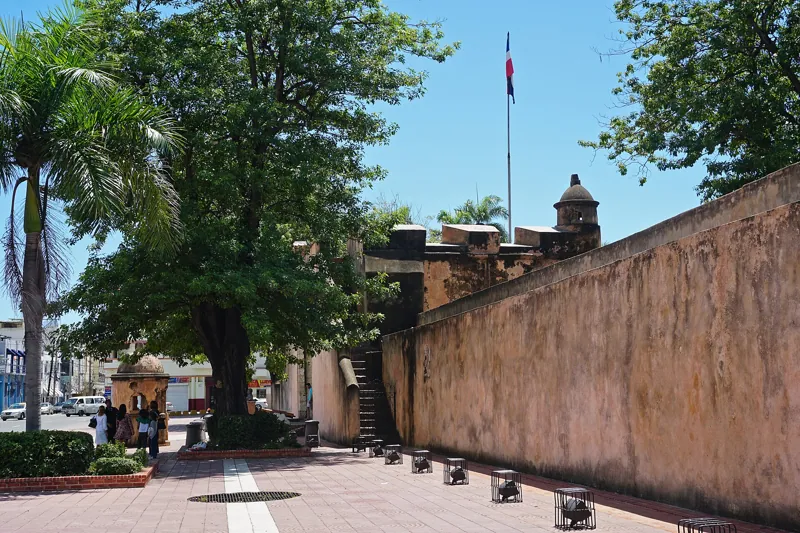
One small clarification helps when you read different guides. The Puerta del Conde is the gate. The Baluarte del Conde is the adjacent bastion, the old San Genaro. The Acento piece describes them as contiguous but different units, with a small barracks and two sentry boxes. Most people use the names as if they were interchangeable, and for a visit that is fine.
Twenty-Two Years Under Haitian Rule
To understand why a gate matters, you need the years that came before. In 1821 José Núñez de Cáceres and the creole elite declared independence from Spain, and then Haiti took the territory. The date given in a Hoy chronology for Haiti taking control of the Spanish part of the island is 9 February 1822. Diario Libre says the Haitian occupation began in 1822 under the government of Jean Pierre Boyer and lasted 22 years, until 1844.
A generation of young Dominicans grew up under that rule. Juan Pablo Duarte, born in 1813, was one of them. On 16 July 1838 he founded La Trinitaria, a secret society whose goal was to free the eastern part of the island. Its early members included Francisco del Rosario Sánchez and Matías Ramón Mella, who joined later according to El Día. When the society was discovered, it continued under other names, among them La Filantrópica, and the movement also used theater groups to spread its ideas.
In 1843 the situation shifted. The Trinitarios joined a Haitian liberal movement that overthrew Boyer. El Día says that Boyer's successor, Charles Rivière-Hérard, jailed some of the Trinitarios and forced Duarte into exile. A Hoy chronology records that Duarte fled to Venezuela on 2 August 1843. In December 1843, the rebels asked Duarte to come back, but, El Día says, illness stopped him. That is why he was absent on the night that made him famous.
The Night of 27 February 1844
The conspirators agreed to act on 27 February. They met first at the Puerta de la Misericordia, around Matías Ramón Mella. The details come from several news features and a historians' summary, and they agree on the main points, though they differ in small ways. This is the sequence.
At the Puerta de la Misericordia, the plan seemed to be in danger. Diario Libre says that when it looked as though the whole project might fall apart, Mella fired his blunderbuss, the trabuco. The shot was the agreed signal to begin the insurrection. Diario Libre quotes Mella as saying there was no way back:
"The die is cast. We cannot turn back."
That sentence is how Diario Libre reports Mella's words that night, not a document from 1844, and the translation from the Spanish "La suerte está echada. No podemos retroceder" is mine. Treat it as the traditional version of what he said. The shot itself is called the trabucazo, and it is one of the best-known events in Dominican history.
After the shot, the group moved to the Puerta del Conde. Diario Libre lists the groups that took the gate and the bastion, led by Francisco del Rosario Sánchez, Tomás Bobadilla, Manuel Jimenes, Remigio del Castillo, José Joaquín Puello and Eduardo Abreu. The Acento opinion piece says the lieutenant in charge handed the bastion to the insurgents and the gate was opened. From the bastion, Sánchez proclaimed the separation and the Dominican Republic, raised the new flag and ordered the reveille sounded, according to Diario Libre. Those present shouted "Viva Juan Pablo Duarte," which recognized him as the main promoter of the break even though he was away.
A Haitian patrol was driven off with gunfire. The garrison at La Fuerza, the fort at the river, fired three alarm cannon shots, and the patriots answered with three volleys. Juan Alejandro Acosta and his group took the military headquarters. The same article says the historiography it cites places María Trinidad Sánchez among the people who carried gunpowder and were present at the proclamation.
The Two Days After
The proclamation was not the end of the military story. At dawn on 28 February, according to Diario Libre, people gathered at the bastion. The Haitian commander, Etienne Desgrotte, sent officers to ask what the rising meant, and the patriots answered in writing that they would not yield. In the afternoon a capitulation was agreed, with the mediation of the French consul, Eustache Juchereau de Saint-Denys. On 29 February the Haitian general handed over the city without a fight, which ended the Haitian occupation in the eastern part of the island.
The Dominican Republic as a state was therefore not made in one night. It was announced on the night of 27 February, defended on the 28th, and handed over on the 29th. The date that Dominicans celebrate is 27 February.
The Acento opinion piece adds a local detail: the letters addressed to the Haitian general were written in a house nearby, and Diario Libre's feature says two women who lived near the bastion made the first flag. That detail is a reminder that the gate was not an isolated fort. It was in a neighborhood where people lived, and the first Dominican flag was sewn by neighbors.
The First Flag
The flag is part of the story of the gate because it was raised here. According to the Dominican Foreign Ministry's page on national symbols, Duarte conceived the flag and described it in the Trinitarian oath, which called for a tricolor banner with a white cross. The first flag was sewn by several women: María Trinidad Sánchez, María de Jesús Pina, Isabel Sosa and Concepción Bona. It was first raised on 27 February 1844.
The design changed shortly afterward. On 6 November 1844, the Constituent Congress, meeting in San Cristóbal, issued the first constitution. It made the flag a national symbol and changed the arrangement so that the blue quarter alternated with red, which the ministry describes as more balanced. The flag today has a white cross whose arms reach the edges and quarters of blue and red alternating, with blue next to the hoist, and the width and length are in a ratio of 2 to 3. The Trinitarian motto was "Dios, Patria y Libertad," which means God, Homeland and Liberty.
Who exactly sewed the first flag is still a matter of tradition. The ministry names María Trinidad Sánchez, María de Jesús Pina, Isabel Sosa and Concepción Bona. One Hoy article says the first flag was embroidered in a hut near the gate by Concepción Bona. The sources do not fully agree, and that is worth saying instead of picking one version.
What Happened to the Founders
The founders did not hold power for long. A provisional government, the Junta Central Gubernativa, was formed with Sánchez, Mella, José Joaquín Puello, Remigio del Castillo, Wenceslao de la Concha, Mariano Echavarría and Pedro de Castro y Castro. But Tomás Bobadilla, who had served the Boyer regime, was elected president over the 27-year-old Sánchez, which Diario Libre says frustrated the Trinitarian plan to keep control. The Trinitarios made a move against Bobadilla, but Pedro Santana opposed it, took the presidency and added Bobadilla to his junta.
On 22 August 1844, Santana banished Duarte, Sánchez, Mella and other patriots. A Hoy chronology says Duarte was exiled to Hamburg on 10 September 1844. On 27 February 1845, María Trinidad Sánchez was executed after a trial for conspiring against the regime. Mella returned in 1848 under an amnesty from President Manuel Jimenes, according to El Día, and in 1861, when Spain annexed the country, he joined the Restoration. He died on 4 June 1864 near Fortaleza San Luis in Santiago, in poverty, according to the same article, and his remains are in the Altar de la Patria. Duarte returned to the country in 1864 and left again; Sánchez was executed on 4 July 1861 at San Juan de la Maguana at age 44, per the Hoy chronology.
In short, the people who made the night of 27 February were pushed aside within months. The nation they proclaimed took shape under men they did not trust. That is a part of the story many visitors do not hear at the gate.
From Gate to Altar
Over the next century the gate went through several names and uses. The Acento opinion piece lists the names: Puerta de la Misericordia and Puerta Grande at first, then the closed gate, then the Puerta del Conde after the count reopened it. A decree of 1883 named it Baluarte 27 de Febrero, though people kept calling it the Baluarte del Conde. In 1891, in a remodeling under Abelardo Nanita, the Latin motto "Dulce et decorum est pro patria mori," meaning it is sweet and fitting to die for one's country, was placed on the facade. The sentry boxes were turned into a school and a police station.
In 1912 the surrounding area became Parque Independencia. A Hoy article says it was designed by Antonio Nechodoma and opened in 1912. Calle Pina, which ran through the site, was named in 1891 for Pedro Alejandrino Pina, one of the founders of La Trinitaria.
The Acento news piece notes that in 1933, under Rafael Trujillo, the gate was renamed Puerta del 27 de Febrero, though ordinary people kept using the older name. The renaming did not take.
The big change came with the centennial. Duarte died in Caracas on 15 July 1876, and his remains were brought to Santo Domingo in 1884, according to Acento. The three founders' remains lay for decades in the Capilla de los Inmortales in the cathedral, a chapel that Diario Libre says was used for distinguished citizens from 1875. On 27 February 1944, a Hoy chronology records, the remains of Duarte, Sánchez and Mella were placed at the Puerta del Conde, which became the Altar de la Patria. The Acento opinion piece says the 1944 centennial restored the name Baluarte del Conde.
What to See Today
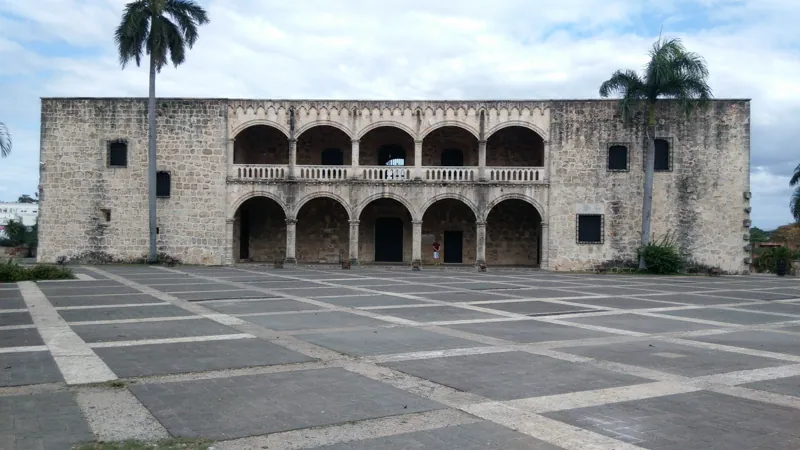
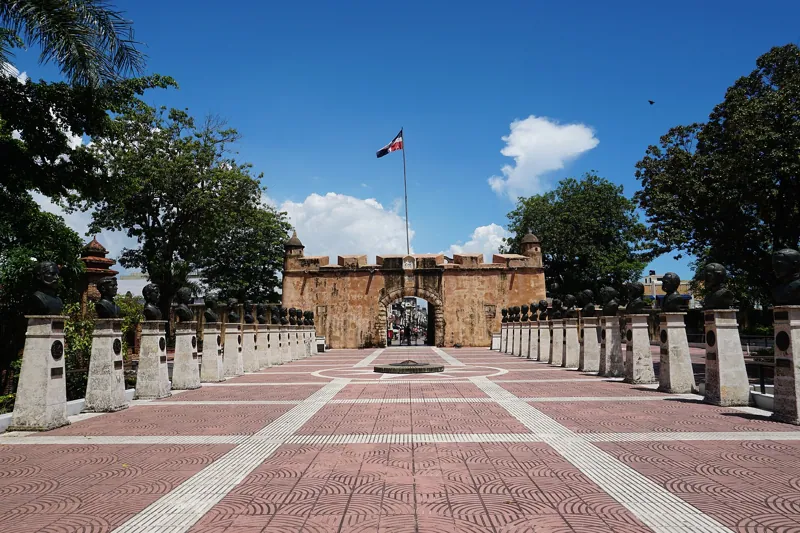
The gate and bastion stand at the west end of Calle El Conde. The ground behind them is Parque Independencia, with the founders' mausoleum at its center. A few things are worth looking for.
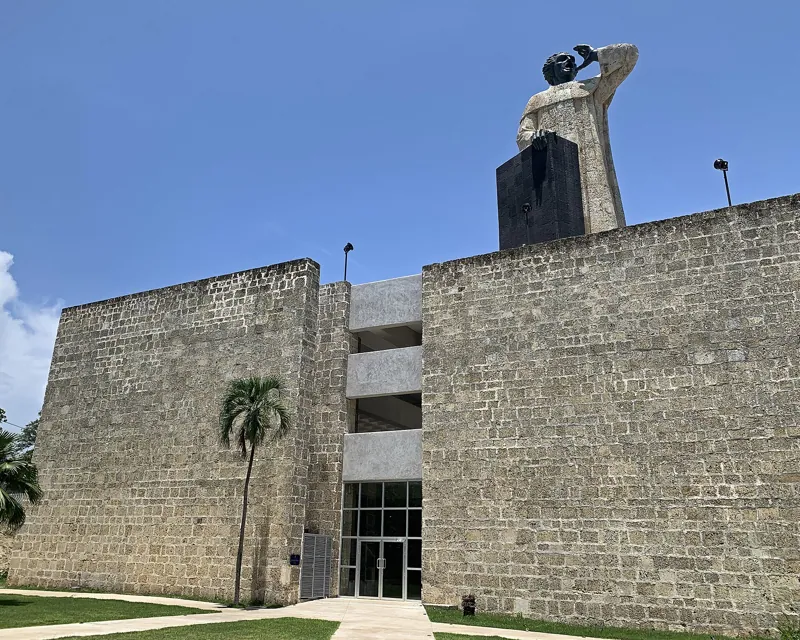
- The gate and bastion. Walk up to it and look at the stone. The pentagonal plan, the cut blocks and the moat line are all visible.
- The Altar de la Patria. The mausoleum holds the remains of Duarte, Sánchez and Mella. Hoy describes it as having severe, sturdy lines. One travel directory gives the opening hours as 8:00 a.m. to 5:30 p.m. daily and notes they can change for services and special events, so check before you go.
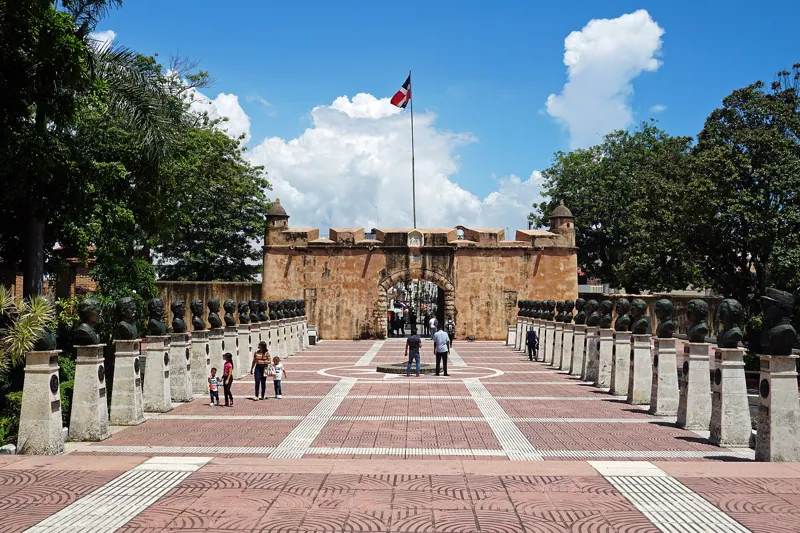
- The walkway of the heroes. A Commons photograph taken in the park is captioned as the Paseo de los Próceres de la Independencia Dominicana.
- Kilómetro cero. The Hoy article says the red paved floor has geometric patterns, and at its center there is a wind rose or the kilometer-zero marker.
- The two bridges and the old canal. Hoy says that centuries ago water from the Ozama River flowed through a canal that separated the area outside the walls, and the park is unusual for having two bridges over the old canal, a curved brick bridge and the esplanade.
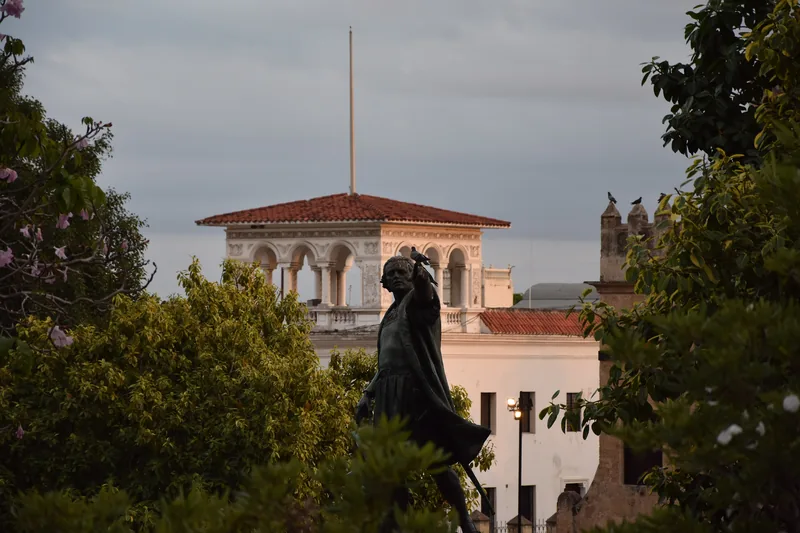
- Monuments to individuals. A marble base holds a statue of Manuela Diez de Duarte, Duarte's mother, and another holds a bust of Pedro Alejandrino Pina.
Two cautions. First, no official page for the Altar's visiting rules is cited, so do not rely on the hours above without checking. Second, national days such as 27 February bring ceremonies and crowds to this park, and parts of it may be closed.
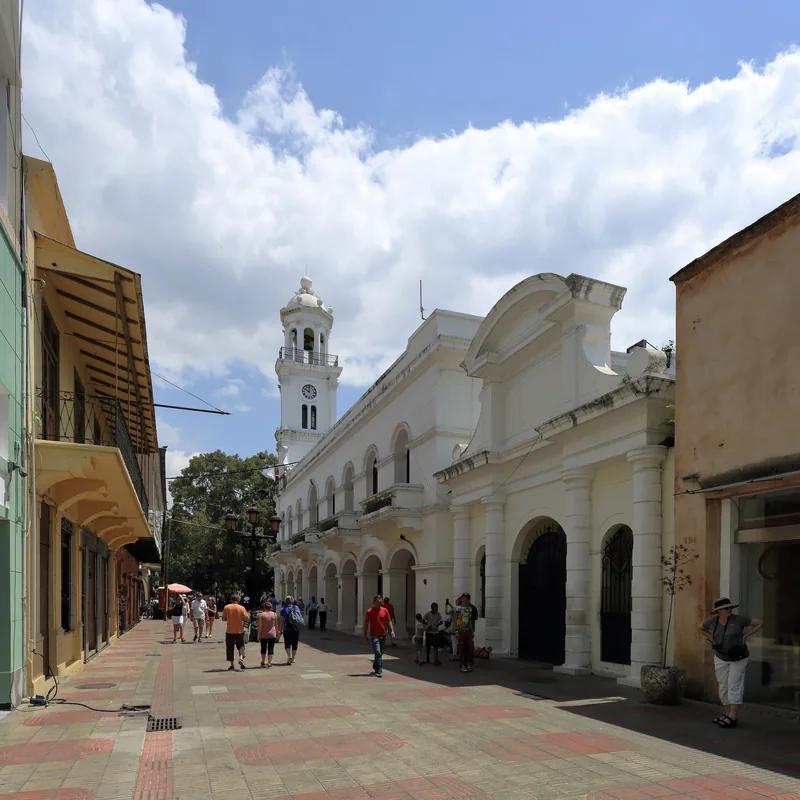
If you like the idea of making this part of a longer walk, the usual route is to start in the cathedral square, walk the length of Calle El Conde to the gate, and then come back by Calle Las Damas. The Santo Domingo 3-day itinerary can help you fit it into a longer plan, and the landmarks guide describes it as a natural end point to a walk across the district.
How the Gate Is Remembered
Dominicans treat 27 February as Independence Day, and the gate is the place the day is tied to. Acento's 2026 piece on the date describes the proclamation as the night when independence was proclaimed for the eastern part of the island after 22 years of Haitian occupation. A lot of national memory sits on that sentence. The Haitian side has its own history of the same events, which this page does not tell, and historians still argue over details of the Dominican version, including why Mella fired when he did.
What is plain from the sources is that the night was a group effort. Mella's shot, Sánchez's proclamation, the women's flag, Acosta's capture of the headquarters and the French consul's role in the surrender are all part of the same event. A visit to the gate is a good moment to hold that in mind, since the statues in the park tend to show the founders as three men standing together, and the real story was more crowded and more tense.
You might also like the page on the history of the Zona Colonial, which sets the walls and gates in the wider arc of the city, and the Panteón de la Patria, where other heroes rest.
Getting there from the penthouse
The gate is at roughly 18.4715, -69.8915 according to OpenStreetMap. From Penthouse Pallazzo, about 150 m north of Playa Montesinos at roughly 18.4697, -69.8851, the straight-line distance is about 705 m. Multiplied by 1.3 for the street grid and divided by 80 m a minute, that comes to about 15 minutes on foot. The easiest route is to walk to the cathedral square and follow the pedestrian Calle El Conde west for the whole length of the street, which takes you straight to the gate. Go early or late in the day to avoid the midday heat.
Frequently asked questions
Where was independence actually proclaimed in 1844?
At the Puerta del Conde, on the night of 27 February 1844. The signal shot, the trabucazo, was fired earlier that night at the Puerta de la Misericordia, another gate in the same wall.
Who proclaimed it, and where was Duarte?
Francisco del Rosario Sánchez proclaimed the separation and raised the flag, and Matías Ramón Mella fired the signal shot. Juan Pablo Duarte, who had founded La Trinitaria in 1838, was in exile and could not return in time because of illness, according to El Día.
Why is it called the Puerta del Conde?
Sources say it was named for Bernardino de Meneses y Bracamonte, the Conde de Peñalba, who led the defense against the English attack of 1655 and had the closed gate reopened and fortified afterward. Historians disagree on some of the timing.
Who is buried at the Altar de la Patria?
The remains of Juan Pablo Duarte, Francisco del Rosario Sánchez and Matías Ramón Mella. They were placed at the Puerta del Conde on 27 February 1944, per a Hoy chronology. Other national heroes are in the Panteón de la Patria on Calle Las Damas.
Did the gate ever have a different official name?
Yes. A decree of 1883 named it Baluarte 27 de Febrero, and in 1933 it was renamed Puerta del 27 de Febrero. Ordinary people kept saying Puerta del Conde.
Is it free to visit?
No official statement of the entry rules is cited. A travel guide lists daily hours of 8:00 a.m. to 5:30 p.m., but check before you go.
Sources
- https://acento.com.do/actualidad/efemerides-27-de-febrero-una-de-las-efemerides-mas-importantes-de-la-historia-dominicana-9629405.html
- https://www.diariolibre.com/especiales/el-grito-que-cambio-el-derrotero-de-la-historia-dominicana-BY9274298
- https://www.diariolibre.com/revista/el-baluarte-del-conde-LJDL234348
- https://acento.com.do/opinion/puerta-del-conde-y-o-baluarte-del-conde-9168666.html
- https://eldia.com.do/matias-ramon-mella-valiente-estratega-en-la-lucha-por-la-independencia-nacional/
- https://acento.com.do/actualidad/quien-fue-matias-ramon-mella-republica-dominicana-se-prepara-para-conmemorar-el-dia-del-procer-de-la-patria-9628400.html
- https://hoy.com.do/suplementos/areito/cronologia-de-la-vida-del-patricio-juan-pablo-duarte_900780.html
- http://hoy.com.do/un-recorrido-historico-por-el-parque-independencia/
- https://mirex.gob.do/simbolos-patrios/
- https://acento.com.do/especiales/cual-es-el-legado-de-juan-pablo-duarte-a-150-anos-de-la-muerte-del-padre-de-la-patria-9719350.html
- https://www.diariolibre.com/opinion/columnistas/2024/03/26/notas-para-una-historia-del-panteon-de-la-patria/2655356
- https://evendo.com/locations/dominican-republic/santo-domingo/attraction/altar-de-la-patria
- https://www.newworldencyclopedia.org/entry/Juan_Pablo_Duarte
- https://hoy.com.do/el-pais/del-conde_231102.html
- https://nominatim.openstreetmap.org/search?q=Puerta+del+Conde+Santo+Domingo&format=json&limit=3
- https://commons.wikimedia.org/wiki/Category:Puerta_del_Conde,_Santo_Domingo