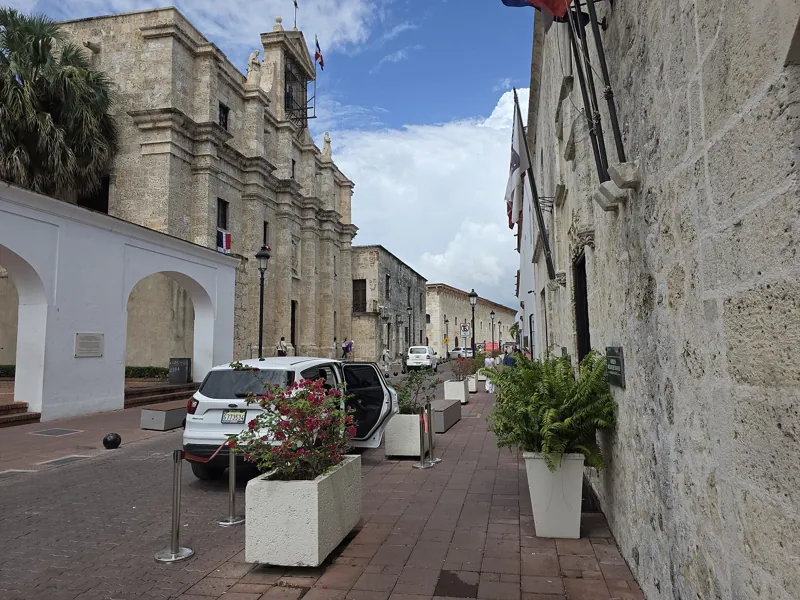
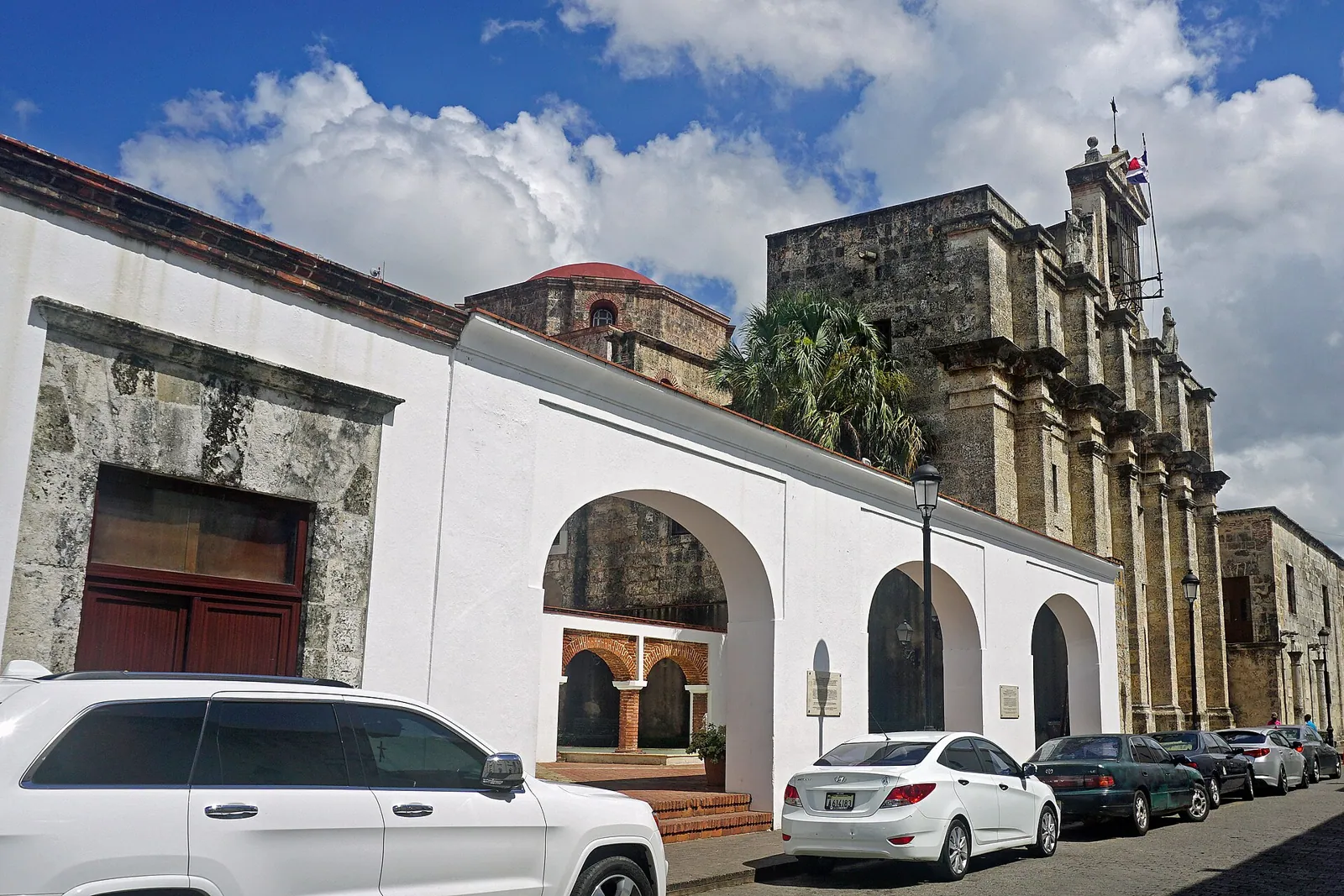
The gray limestone building at the north end of Calle Las Damas has had more lives than almost any other roof in the Zona Colonial. It was built by the Jesuits as a church in the first half of the 1700s. After the order was expelled it held tobacco, then seminarians, then theater audiences, then government clerks. Today it holds the remains of about 45 people the Dominican state has chosen to honor, and a flame that is supposed to stay lit around the clock.
Most visitors know it as the Panteón Nacional. Its official name is Panteón de la Patria, and that is the name this page uses. It sits a few minutes on foot from Parque Colón and from the Alcázar de Colón, so it often gets squeezed into a walking tour as a ten-minute stop. That is a pity, because the story of the building is also a compact version of the story of the country: a colonial church, a long stretch of reuse, a law passed under a dictator and not carried out, and a mausoleum that finally opened in the 1970s with a very different set of politics around it.
This page covers the building, the law that changed it, the people inside and the practical side of a visit. The founding fathers, Duarte, Sánchez and Mella, are not here, and the page explains where they are. Other buildings on the same street have their own pages in this series, linked where they come up.
The Jesuit Church
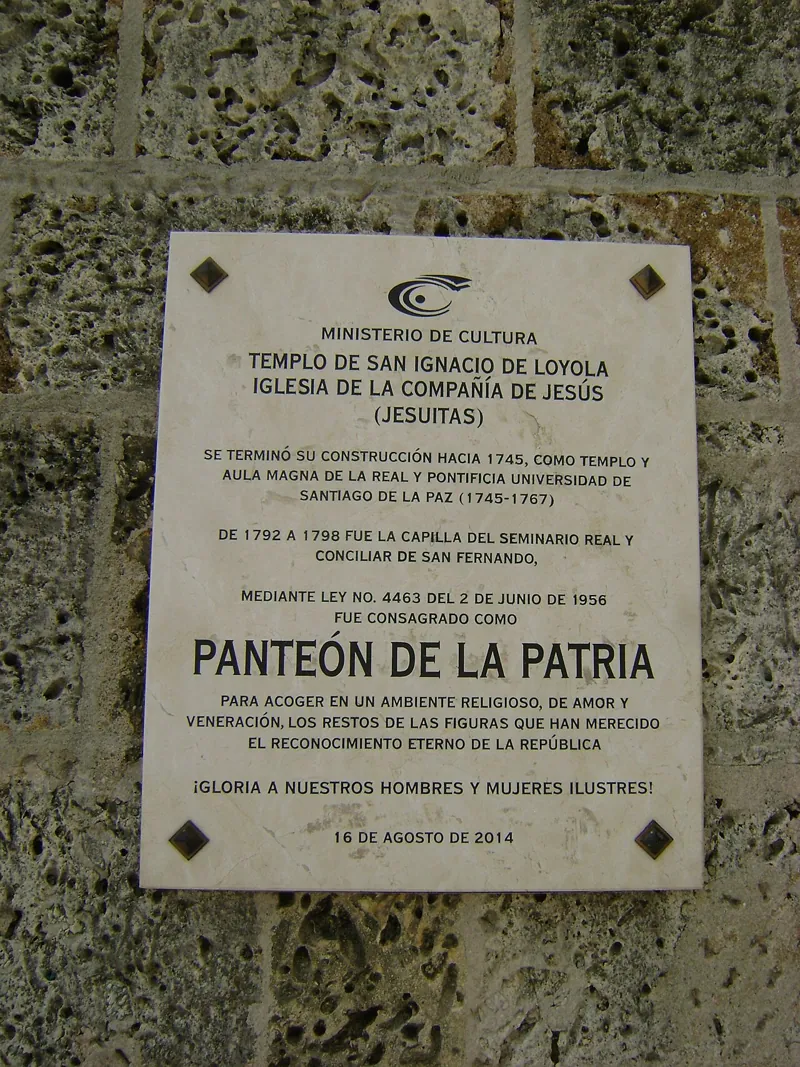
The building began as the church of the Jesuits, the Compañía de Jesús. The sources agree on the builder and roughly agree on the dates. The architect or master builder is given as Gerónimo Quezada y Garçon, and construction is dated 1714 to 1746 in one reference entry, with the church opened for worship in 1715 and its sober facade finished around 1743 to 1745 according to a Listín Diario feature. A Ministry of Culture plaque, as quoted in the same feature, says the church also served as the main hall of the Real y Pontificia Universidad de Santiago de la Paz from 1745 to 1767. Dates for a building that took decades to finish will always wobble a little depending on what a writer counts as "finished," and the 1714 to 1746 span is the one most often repeated.
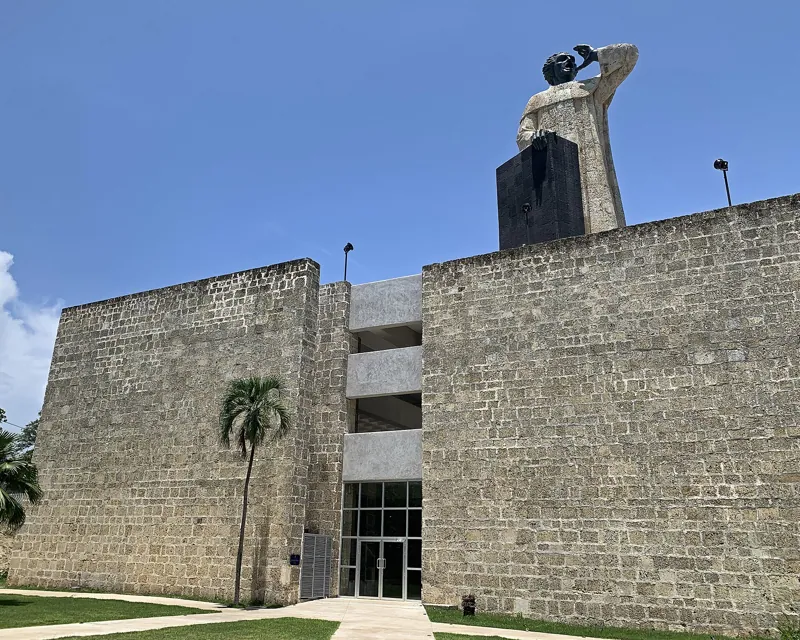
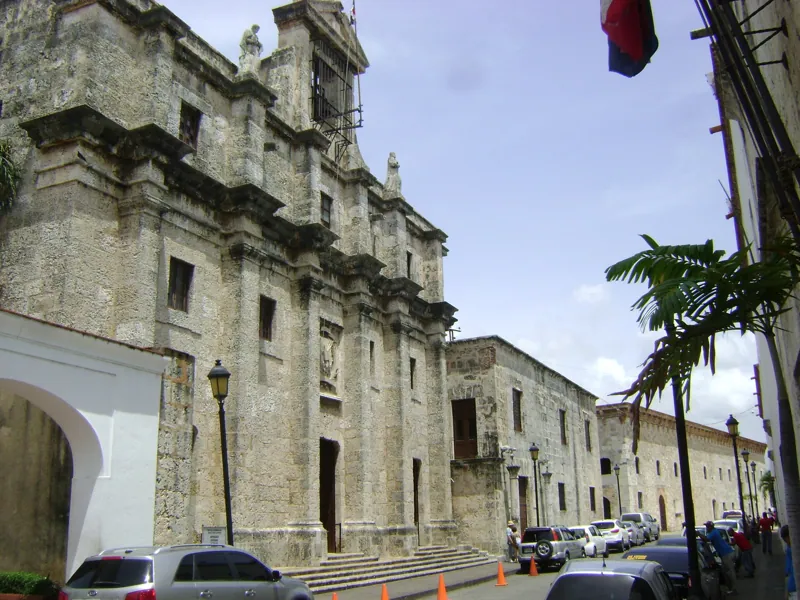
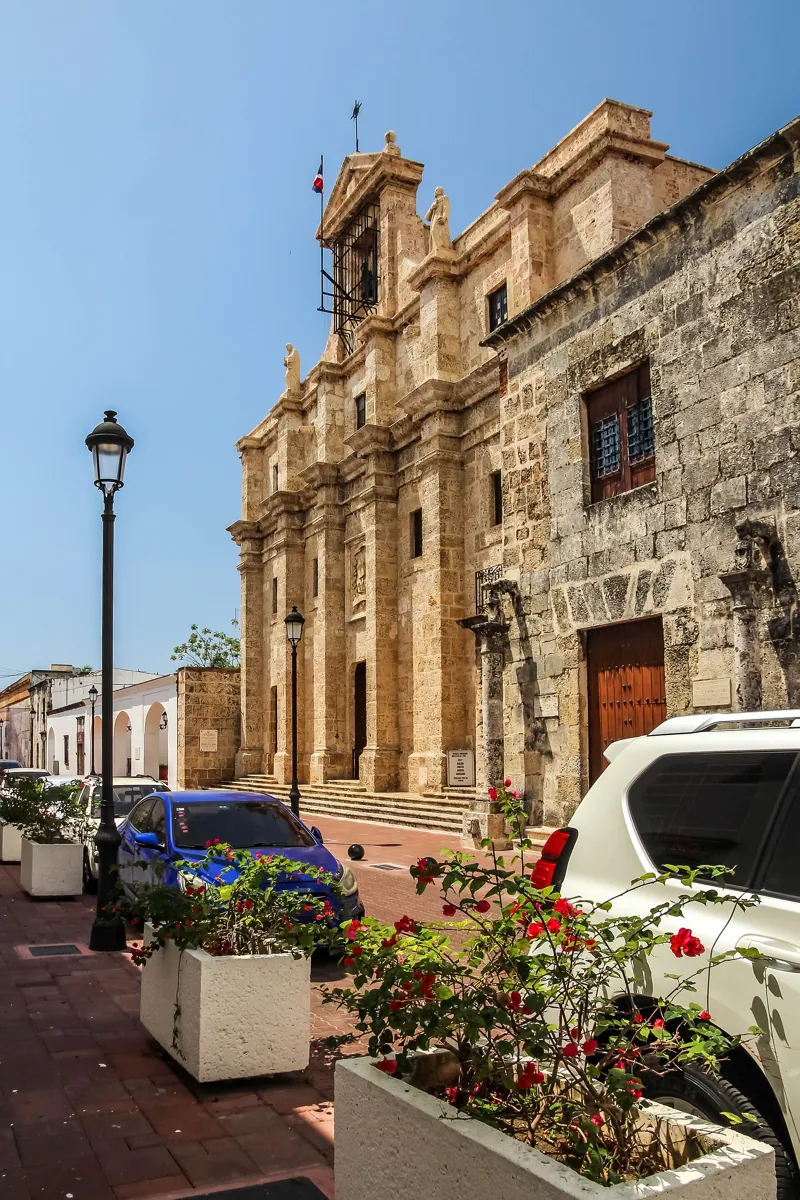
One reference describes it as among the last buildings the Spanish put up in the country, which fits the date: by the 1700s the great building campaign of the early 1500s was long over, and the colony had been shrinking for generations. What the Jesuits built was a church with three naves, in gray limestone, in a restrained style. The same reference calls the outside neoclassical-Renaissance and the inside baroque. Those labels can sound contradictory, but anyone who stands in the square in front of it will see what they mean: a flat, plain, almost severe front, with very little carving compared with the cathedral at the other end of the street.
For the story of the university claims in Santo Domingo, including the dispute about which institution deserves the title of first in the Americas, see the page on the Convento de los Dominicos. This page only notes the plaque, because it explains why a church was also a lecture hall.
After the Jesuits
In 1767 the Jesuits were expelled from Santo Domingo. The church was emptied of its original purpose, and what happened next reads like a list of everything a large roofed space can be used for.
First it became a warehouse for tobacco. After that, according to Listín Diario, it was linked to the San Fernando seminary, and from 1792 to 1798 it served as the chapel of the Seminario Real y Conciliar de San Fernando. In the 1800s and early 1900s it was used as a theater and for public offices. Another reference says it was used as a school and a theater and stood empty for a time after 1767. The sources differ on the order and the exact years, and this page keeps to what the Listín article states. The general picture is clear enough: for nearly two centuries nobody treated this as a monument. It was a big, solid building and the city used it.
If you want the wider context for these decades, the page on Santo Domingo in the 1700s covers the years when the Jesuit church was going up and then lost its Jesuits.
The 1956 Law
The change of purpose came by statute. Law 4463, dated 2 June 1956, turned the old church of San Ignacio de Loyola into the Panteón de la Patria and dedicated it to keeping the remains of heroes and distinguished Dominicans. The executive branch was given the power to order remains moved there from the cathedral. A Diario Libre column on the history of the Panteón sets this out and adds a detail that surprises people: in the last years of the Trujillo dictatorship the law was not carried out, for reasons the author says he does not know.
So the building was converted in the 1950s, but it did not yet receive anyone. Listín Diario says it was modified in the late 1950s and early 1960s, including the second level and the bell tower, to adapt it as a pantheon. A reference entry says a costly remodel was led by a Spanish architect named Javier Borroso, and that the building was restored in 1955. Other tourism sources say 1956 or 1958. These dates do not agree, and no source settles it. If you read one date on a plaque or in a guidebook and another somewhere else, that is why.
One furnishing from this phase is easy to see. The big bronze chandelier hanging in the central nave, decorated with vestal figures, was a gift from the Spanish dictator Francisco Franco to Rafael Trujillo, according to Listín Diario and the reference entries. It is a good example of how the building was dressed in the mid-twentieth century: heavy, formal, and meant to be looked at from below.
Why It Opened in 1974
The law of 1956 did not empty the cathedral chapel. For that, a different president was needed. Since 1875, the Altagracia chapel inside the Catedral Primada de América had been used for the remains of distinguished citizens, and it was known as the Capilla de los Inmortales. Heroes, founders and martyrs rested there for almost a century. The cathedral has its own page in this series, Catedral Primada de América, and the chapel comes up there.
In 1972, at the start of what Dominicans call the twelve years of Joaquín Balaguer, Decree 2140 ordered the remains in the Capilla de los Inmortales moved to the Panteón. The same decree listed more than 70 people who should enter eventually, according to the Diario Libre column, including some who would prove controversial. The Panteón was inaugurated on 16 August 1974, on Calle Las Damas, with the transfer of those remains. A news item about the 50th anniversary in 2024 gives the same opening date, and says the Ministry of Culture and the postal institute marked the five decades with a commemorative stamp issue of 15,000 copies.
That means the building has been a working pantheon for roughly half a century, not for the seventy years since the law. It is worth keeping the two dates apart: the law and the remodeling belong to the 1950s, while the opening, the actual moving in of the heroes, belongs to 1974.
A third date matters for the name. The place is popularly called the Panteón Nacional, but a news piece in Hoy says Decree 25-2000, dated 26 January 2000, restored the original name set by Law 4463 of 1956, which is Panteón de la Patria.
Inside the Building
Because the building began as a church, the plan is a church plan. There are three naves, and the central one is where you stand under the chandelier. The reference entry mentions an interior mural of the Ascension and the Last Judgment and a modern painting on the dome. The walls and the austere structure give the place a hushed, serious feel even when the room is full of school groups.
The details worth looking for are these.
- The chandelier. Bronze, hanging from the dome, with vestal figures. It is the Franco gift described above.
- The flame. A flame burns under the chandelier. A reference entry says it burns 24 hours a day, and the Hoy article says it is fed with coconut oil and stands for the nation.
- The tombs and niches. Sarcophagi, tombs and niches hold the remains.
- The grilles on the upper level. A Listín Diario writer noticed that the grilles resemble swastikas and repeated an unconfirmed claim that they came from a prison in Nazi Germany and were donated by the German government. The writer flags the story as unconfirmed, and so should anyone else. Treat it as a rumor you may hear on a tour, not a fact.
- The honor guard. The Panteón has an honor guard from the presidential guard battalion in dress uniform, according to a reference entry.
- The empty space. One space has no plaque and is dedicated to the unknown soldier, the same entry says.
It is worth knowing that Listín Diario's author wrote in 2020 that the interior was closed to visitors at the time she visited, and described the chandelier from an earlier visit. Buildings like this open and close depending on ceremonies and maintenance, which is one more reason to check before you go.
Who Rests Here
Counts differ. A 2022 article in Hoy says about 45 remains rest in the Panteón, and a reference entry lists 47 names. The Panteón itself, more than the lists, is the place to read the plaques. What the lists agree on is the shape of the group: soldiers, presidents, writers, poets, educators and a few women of the independence period.
The Hoy article sorts them into periods. A few examples from each, as the article names them:
- Before the republic. José Núñez de Cáceres and Juan Sánchez Ramírez.
- The First Republic, 1844 to 1861. Antonio Duvergé, Concepción Bona, María Trinidad Sánchez, Pedro Santana, José María Cabral and Juan Bautista Cambiaso, among others.
- The Restoration. Gregorio Luperón, Gaspar Polanco, Santiago Rodríguez and Ulises Francisco Espaillat.
- The later republics, writers and educators. Pedro Francisco Bonó, José Gabriel García, Salomé Ureña de Henríquez, Francisco Henríquez y Carvajal, Federico Henríquez y Carvajal, Eugenio María de Hostos, Américo Lugo, Fabio Fiallo, Pedro Henríquez Ureña and Francisco Alberto Caamaño Deñó.
A few stories behind those names are worth knowing before you go in.
Gregorio Luperón
Luperón was born in Puerto Plata in 1839 and became a general in the Restoration War of 1863 to 1865 against Spain. He served as president from October 1879 to September 1880, and during that time reorganized the army and local administration, paid government workers three years of back pay and settled foreign claims, according to a reference entry. He died in 1897.
Salomé Ureña and Pedro Henríquez Ureña
Salomé Ureña de Henríquez and her son Pedro Henríquez Ureña lie together. Pedro was born in Santo Domingo on 29 June 1884 and died on 11 May 1946 on a train near Buenos Aires, on his way to his teaching post in La Plata. He was cremated and buried at La Chacarita in Buenos Aires. A decree of 7 April 1972 ordered his remains moved to Santo Domingo, and they arrived on 8 May 1981. They were placed first in his mother's crypt in the Iglesia de Las Mercedes. On 24 August 1988 the remains of Pedro and Salomé were placed together in the Panteón, as he had wished. That is why the church of Las Mercedes comes up in the page on colonial churches.
María Trinidad Sánchez
María Trinidad Sánchez is one of the few women on the list of the independence period. Historiography cited by Diario Libre says she carried gunpowder and was present at the proclamation of 27 February 1844. A year later she was executed after a trial for conspiring against the government of Pedro Santana. Acento's chronology puts the executions of María Trinidad Sánchez and two others in 1845. She now rests in the same building as Santana, the man whose government tried her.
Pedro Santana
That proximity is a long-running argument. Santana, the first president of the republic, is in the Panteón, and in 2017 the vice president of the Instituto Duartiano, Wilson Gómez, laid a wreath on Restoration Day and publicly lamented that Santana's remains still rest alongside national heroes. He said Santana had killed many people, expelled the Duarte family and persecuted Duarte. Diario Libre's history of the Panteón says that Balaguer had Santana enter on 16 August 1978, days before the end of his third constitutional term, and that Santana and Tomás Bobadilla were bitter opponents of Duarte's independence project. Whatever you think of Santana, the fact that he is here tells you something about how the Panteón was built: it was a state project assembled by a political order, not a list chosen by historians.
Francisco Alberto Caamaño Deñó
The most unusual tomb is a cenotaph. Caamaño was born in Santo Domingo in 1932, led the constitutionalist forces after the 1963 coup against Juan Bosch, and headed the constitutionalist government during the 1965 revolution. In 1973 he landed with an expedition at Playa Caracoles in Azua and died. Diario Libre reported that the ceremony to honor him at the Panteón was set for 24 April 2013, and that only his name would be placed, because DNA tests on remains attributed to him were still pending. The planned inscription was "A la espera de sus restos," which means "awaiting his remains." That is a rare thing in a pantheon: a tomb whose point is that someone is missing.
What You Won't Find Here
Three people are often assumed to be in the Panteón, and they are not. Juan Pablo Duarte, Francisco del Rosario Sánchez and Matías Ramón Mella rest at the Altar de la Patria in Parque Independencia, by the Puerta del Conde. Their remains were once in the Capilla de los Inmortales in the cathedral and were moved in the 1940s. That story belongs to the page on the Puerta del Conde and independence in 1844, and to the page on Juan Pablo Duarte.
Rafael Trujillo is not here either, although the building was converted under his government. A tourism source states he was never interred in the Panteón.
Visiting Today
These are the points visitors ask about most. Hours and rules change, and none of what follows comes from an official site, so treat it as a guide and check before you go.
- Hours. Two sources, a reference entry and a tourism guide, give Tuesday to Sunday, 9:00 a.m. to 5:00 p.m., closed Mondays. State ceremonies can close it. The tourism guide names 27 February, 16 August and 26 January as days when the building may be closed to general visitors.
- Price. The guide says admission is free and a small donation is appreciated.
- Dress. The guide calls the dress code the strictest in the Zona Colonial: shoulders and knees covered, no hats, no flip-flops. Guards may turn away people who are underdressed.
- Behavior. Keep your voice down and silence your phone. No flash. The same guide says not to photograph the soldiers' faces directly, as it is considered disrespectful.
- Time. Fifteen to thirty minutes is enough for most visitors, longer if you want to read the plaques.
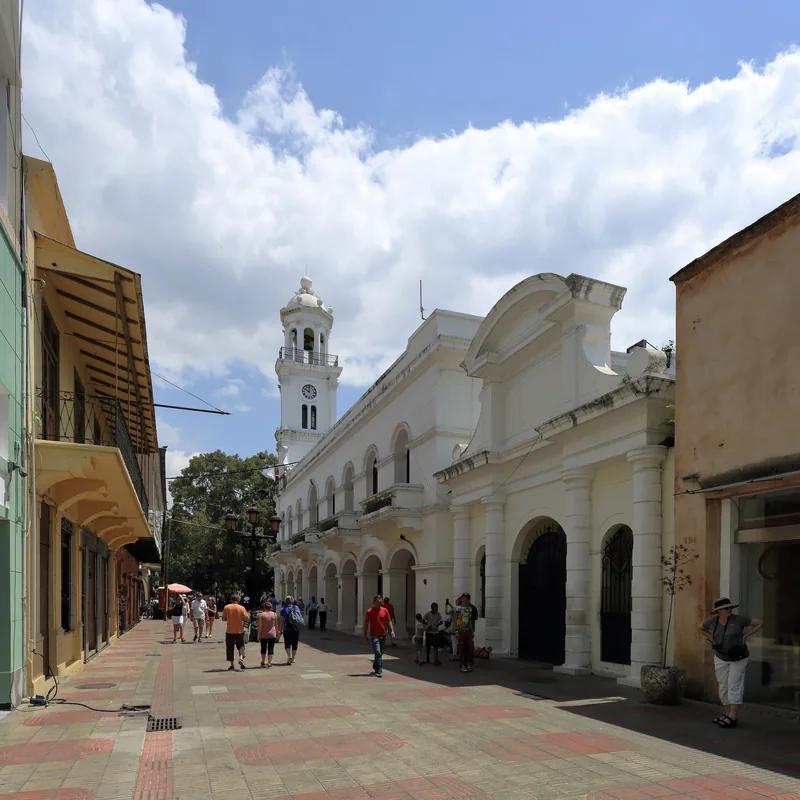
The street itself is part of the visit. Calle Las Damas has its own page, Calle Las Damas, and the museum across the way is covered on the page for the Museo de las Casas Reales. If you are planning a full walk, the Santo Domingo landmarks guide puts the Panteón in a sensible order with the other sites, and the Zona Colonial complete guide shows the wider district.
How to Read the Building
One useful way to look at the Panteón is to ask who each layer was for. The original church was built for a religious order and a university. The warehouse and the theater were built over with whatever the city needed. The 1950s conversion was for a regime that wanted a monument. The 1974 opening was for a government that wanted a place for the dead of the independence wars and the Restoration. The 2013 cenotaph was for a country that still has questions about the 1960s and 1970s.
None of that makes the building less of a church. The nave is still a nave, and the light still comes in over the same stone. Even so, the plaques and the guard and the flame make it a different kind of room from the cathedral, which was also built for a mix of religious and civic reasons but is still a working church.
For the rest of the street, the first city of the Americas history walk covers how the pieces fit together on foot, and the page on the history of the Zona Colonial places the Panteón in the long arc of the district from 1496 to UNESCO listing in 1990.
Getting there from the penthouse
The Panteón stands at the north end of Calle Las Damas, at roughly 18.4751, -69.8831 according to OpenStreetMap. From Penthouse Pallazzo, about 150 m north of Playa Montesinos at roughly 18.4697, -69.8851, the straight-line distance is about 635 m. With the usual allowance for corners, that is about 15 minutes on foot. The walk is flat. Go in the morning, before the heat, and bring a shawl or a light shirt in your bag if you are in shorts, because the guards enforce the dress code at the door.
Frequently asked questions
Is the Panteón de la Patria the same as the Panteón Nacional?
Yes. The popular name is Panteón Nacional. A Hoy article says Decree 25-2000, dated 26 January 2000, restored the original name set by Law 4463 of 1956, Panteón de la Patria. You will see both names on signs, maps and in guidebooks.
Are Duarte, Sánchez and Mella buried in the Panteón?
No. Their remains are in the Altar de la Patria in Parque Independencia, next to the Puerta del Conde. The Panteón holds other heroes, presidents, writers and educators. See the page on the Puerta del Conde for the founding fathers.
Who built the building, and when?
It was built as a Jesuit church. Sources name Gerónimo Quezada y Garçon as the builder and give construction as 1714 to 1746, with the church open for worship by 1715 and the facade finished around 1743 to 1745. The Jesuits were expelled in 1767.
When did it become a national pantheon?
Law 4463 of 2 June 1956 turned it into the Panteón de la Patria, but the law was not carried out at first. Decree 2140 of 1972 ordered the move of remains from the cathedral chapel, and the Panteón was inaugurated on 16 August 1974.
Is it free to enter, and what should I wear?
A tourism guide says it is free, with a donation welcome, and strict on dress: shoulders and knees covered, no hats, no flip-flops. Hours are given as Tuesday to Sunday, 9:00 a.m. to 5:00 p.m., but check before you go, because ceremonies can close it.
Is Francisco Alberto Caamaño really buried there?
No body is. His place is a cenotaph, with the inscription "awaiting his remains," because his remains have never been identified. The ceremony for it was planned for 24 April 2013.
Sources
- https://www.diariolibre.com/opinion/columnistas/2024/03/26/notas-para-una-historia-del-panteon-de-la-patria/2655356
- https://listindiario.com/la-vida/2020/11/18/644616/panteon-nacional-el-edificio-fue-iglesia-almacen-teatro.html
- https://www.ecured.cu/Pante%C3%B3n_Nacional_(Rep%C3%BAblica_Dominicana
- https://hoy.com.do/independencia-nacional-quienes-estan-en-el-panteon-de-la-patria/
- https://www.prensa-latina.cu/2024/08/20/emision-postal-rinde-tributo-al-panteon-de-la-patria-en-dominicana/
- https://listindiario.com/la-republica/2017/08/17/478453/instituto-duartiano-lamenta-que-restos-de-pedro-santana-aun-esten-en-panteon-de-la-patria
- https://acento.com.do/opinion/de-haber-estado-vivo-hoy-el-humanista-pedro-henriquez-urena-9076965.html
- https://www.diariolibre.com/actualidad/caamao-exaltado-hoy-al-panten-de-la-patria-DDDL380524
- https://www.encyclopedia.com/humanities/encyclopedias-almanacs-transcripts-and-maps/luperon-gregorio-1839-1897
- https://drrevealed.com/explore/south-coast/panteon-nacional
- https://acento.com.do/actualidad/efemerides-27-de-febrero-una-de-las-efemerides-mas-importantes-de-la-historia-dominicana-9629405.html
- https://www.diariolibre.com/especiales/el-grito-que-cambio-el-derrotero-de-la-historia-dominicana-BY9274298
- https://mirex.gob.do/simbolos-patrios/
- https://nominatim.openstreetmap.org/search?q=Panteón+Nacional+Santo+Domingo&format=json&limit=3
- https://commons.wikimedia.org/wiki/Category:National_Pantheon,_Santo_Domingo