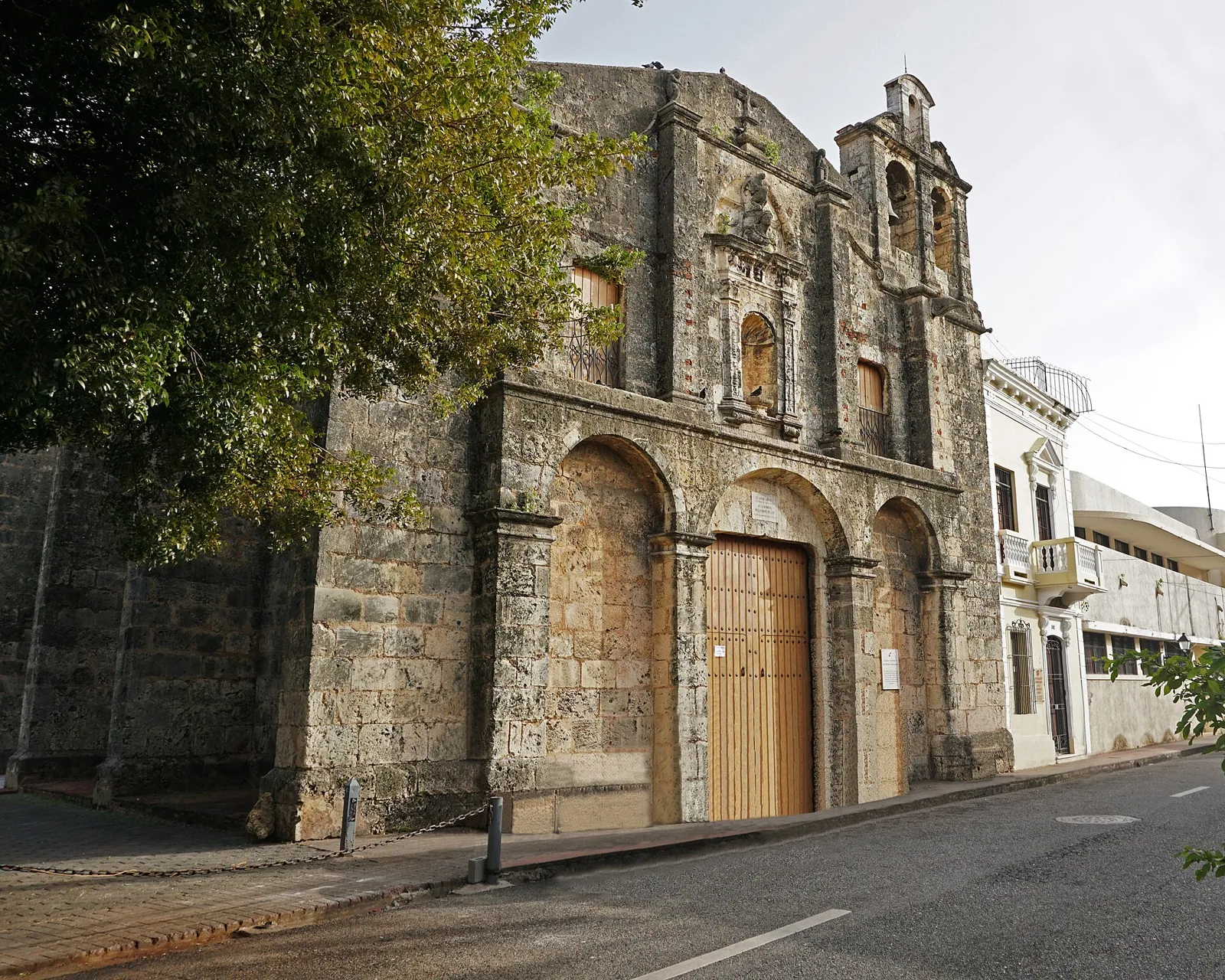
The cathedral and the Dominican convent get the attention, but the Zona Colonial is full of smaller churches, and several of them are better places to be alone with a building. They were put up by religious orders, by neighborhood brotherhoods, by hospital founders and by stonecutters' parishes, and between them they cover most of the colonial centuries. They also show how the city was built: by pieces, over generations, with each earthquake and each raid leaving a repair.
This page takes seven of them in a rough walking order. Each has its own section, and the page says where the record is thin. A newspaper columnist for El Día, writing in 2014, listed seven colonial churches that "compete with one another in beauty," and named San Lázaro, San Miguel, Regina Angelorum, Las Mercedes, Santa Bárbara and Altagracia among them. Santa Clara belongs in the same group. The two biggest churches have their own pages, so they are left out here: read Catedral Primada de América and Convento de los Dominicos for those.
One thing runs through almost every section. In January 1586 an English fleet under Francis Drake took the city, and the raid damaged or burned several religious houses. Earthquakes in the 1670s and in 1751 finished some of the work. If a church in this list has a rebuilt roof or a repaired tower, the date of the repair tells you which disaster came first. The raid itself is told at Francis Drake's Raid on Santo Domingo in 1586.
Regina Angelorum
Regina Angelorum means Queen of the Angels. It stands on Calle Padre Billini, and it began as the chapel of a convent of Dominican nuns. El Día's 2020 article explains where it fits. The religious orders that came to Spain's colonies relied on women's branches to keep monasteries and churches running, to prepare food and to care for the poor and sick. Three women's branches reached the island: the Poor Clares, who are Franciscan, the Mercedarians and the Dominicans. The Dominican convent stood on today's Calle Padre Billini, on the site of the Instituto de Señoritas Salomé Ureña, and the church was its original chapel. Women of this congregation wrote and published poetry, the article says, and it names Leonor de Ovando in particular.
Construction began in the middle of the 16th century and was interrupted by two things the article lists: the 1586 occupation by Drake and the partial abandonment of the colony by Spain, when the government moved first to Havana and then to Mexico. The building was finished over a long stretch.
What you see is a compact church with a lot going on. The article calls the design and structure pure Gothic Isabelline, with a dome that marks the transition from Renaissance to Baroque. It uses three of the best building materials the country offers: cut stone for the walls, brick for the dome and wood for the choir loft. The plan is a single rectangular nave ending in a raised semicircular presbytery, with ribbed vaults resting on large stone buttresses. The dome sits on pendentives, has four small round windows at its base and is topped by a lantern. The article says it may have been inspired by the dome of the old San Ignacio church, which is today the Panteón Nacional. That link between two buildings a short walk apart is worth looking for, and the Panteón has its own page at Panteón de la Patria.
Inside, look for the choir loft, held up by large carved wooden beams. Its lattice railing recalls Mudéjar work, the style of Spanish craftsmen who worked under Christian rule with Islamic geometric traditions, and it gave the cloistered nuns privacy while they followed services beside lay worshippers. The main retable is Baroque wood dedicated to Mary, Queen of the Angels. On the west wall is a smaller retable with a 17th-century wooden carving of Jesús Pacientísimo from the Andalusian school, framed by gilded, painted Solomonic columns. The altar front is repoussé silver.
The outside differs from face to face. The main facade, on the north, is an eclectic mix of Renaissance elements treated in a Baroque manner, with three round arches and a bell gable at the west. The east portal is Plateresque Renaissance, with a classical pediment, and the article mentions a theory that it was originally made for the cathedral and moved here later. That is a theory, not a documented fact, and it is the kind of story that makes old churches fun to read.
Part of the newer convent today is shared by a seminary for late vocations and by the national committee of the Sovereign Military Order of Malta, which holds meetings and celebrations of the Eucharist there, according to El Día.
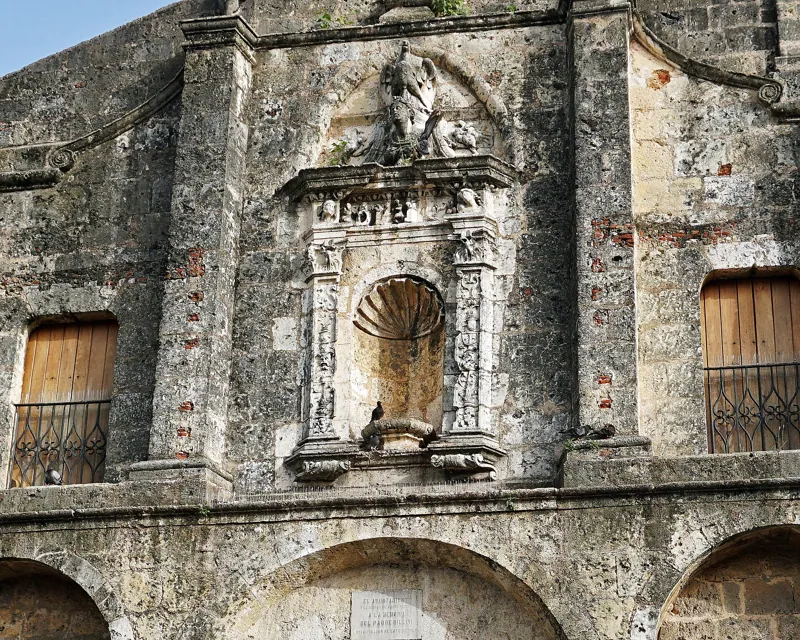
Santa Bárbara
Santa Bárbara sits at the north end of the old city, away from the main tourist streets, and the neighborhood around it has its own story. Its proper name, El Día says, is Iglesia Santa Bárbara de los Hombres del Mar, the Church of Saint Barbara of the Men of the Sea. A feature in the Acento newspaper describes the district as the former Barrio de Los Canteros, the stonecutters' quarter. After Nicolás de Ovando laid out the city's grid, the land northwest of the wall was left unallotted. It sloped toward the Ozama River, and stonecutters who quarried limestone for the cathedral and other colonial buildings lived there. The church was built over a mine that supplied stone for the city walls, according to another Acento piece, which also describes the area as a maintenance zone for the ships that brought goods from Europe, unloaded at the Atarazanas.
Two forts flank the area, the Acento article says: Fuerte Santa Bárbara at the northwest end and Fuerte del Ángulo, also called Fuerte de La Carena, at the northeast end. A fort behind the church shares its name.
The church has been through everything. The same article says Drake set it on fire in 1586, earthquakes devastated it in 1673 and 1684, and a hurricane destroyed it in the 18th century. In 2019 the state engineers' office restored it. El Día reported in December 2019 that the church had reopened to the religious community and was being presented as an asset for religious tourism in the old city. A photo caption dated December 2017 notes that the west wall had been stabilized with temporary buttresses, which gives you a sense of how fragile the building had become.
The church has a place in the national story. Juan Pablo Duarte, the founding father, was baptized here. El Día says he was born on January 26, 1813, and a neighborhood article in a real-estate outlet gives his baptism as February 4, 1813, at the barrio's church, now called the Catedral Castrense Santa Bárbara. Church chroniclers cited in that piece say the baptismal font survives. More on Duarte's life is at Juan Pablo Duarte.
The surrounding streets have another recent chapter. According to the real-estate article, in the 19th and early 20th centuries a rising middle class built mansions on Calle España and nearby streets, with wrought-iron balconies and French-influenced decoration. In the 20th century many were abandoned and later used as print shops and workshops and as homes for families pushed to the margins. The painter Silvano Lora launched the Bienal Marginal in 1992, a street-based alternative to the state's art biennial, and the collective MODOFOCA continues the spirit by painting murals on many facades. The article also gives a darker piece of the neighborhood's past: according to filmmaker Oscar Grullón, the area behind the Alcázar de Colón was where enslaved people were held before being taken to the plaza for sale.
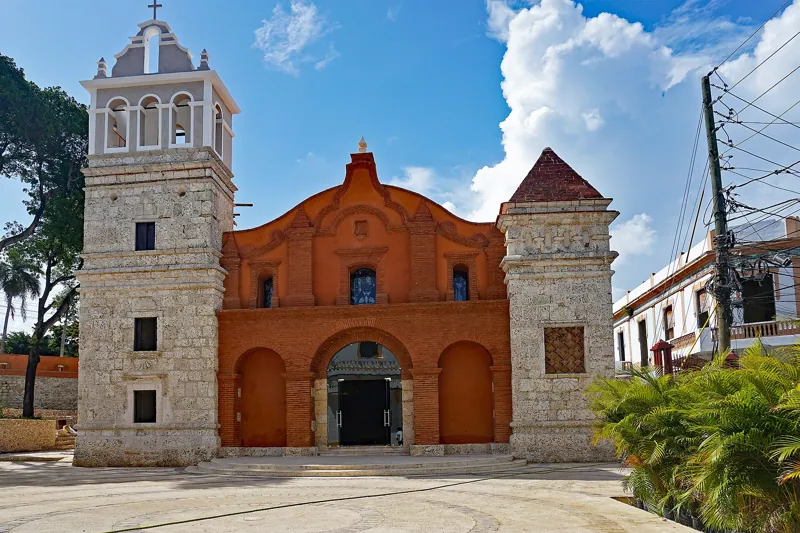
Las Mercedes
Las Mercedes is the church with a bell tower you can pick out from several streets. It stands at the corner of Calle Las Mercedes and Calle José Reyes. A real-estate article says construction began around 1527 and finished in 1555, under the master builder Rodrigo de Liendo. During the colonial period it was known as the Church of the Mother of God. The same source says the Mercedarians had a monastery in the city from 1514 and that Friar Francisco de Bobadilla arrived in March 1527 to organize the community. The Mercedarian Order was founded on August 10, 1218, in Barcelona, according to Diario Libre.
The church originally had a single vaulted nave, an eight-sided apse, a high choir and side chapels between the buttresses. The building you see is the result of many later repairs. Here is the sequence of damage, as the real-estate article gives it.
- 1586: Drake's attack on Santo Domingo left the convent badly damaged.
- 1591 to 1599: a cyclone damaged the main door and part of the dome.
- 1615: an earthquake damaged the high choir and the main arch.
- 1672 and 1673: earthquakes forced the church to be rebuilt.
- October 18, 1751: an earthquake damaged the choir and the vault. An inscription inside says the rebuilding ended in 1752.
- During the Haitian occupation the church stayed closed, and an earthquake in 1842 caused serious damage.
- From 1861 to 1865, during the annexation to Spain, it served as a barracks.
- In 1859 the convent was divided on the orders of Pedro Santana, and part of it passed to a Masonic lodge, the Logia Cuna de América number 2.
- Restorations in 1968 and 1972 aimed to recover the church's historic character.
The tower is square, three levels high and about 27 meters tall, topped by the bell level. Nine of the bell arches are semicircular. One is lobed, with Mudéjar echoes, and a Dominican historian quoted in the article says it is not repeated in any other colonial church inside the old walls.
The bells have a story of their own. One came from the American cruiser USS Memphis, which was wrecked off the city on August 29, 1916, with the loss of 43 sailors. Its origin is disputed. The most widely told version, from the American naval historian Edward L. Beach Jr., says the bell was a thank-you gift. Documents in the General Archive of the Nation indicate it was bought at public auction and placed in 1917. The bell cracked in the late 1920s, was recast in Spain and returned in 1930. According to two researchers cited in the article, there are three large bells cast in Valencia in 1930, two with the inscription "Campana del Memfis," though no one has shown that they are the originals.
Another thread is literary. The Mercedarian playwright Friar Gabriel Téllez, known as Tirso de Molina, lived in the convent between 1616 and 1618, the article says. He sailed from Sanlúcar de Barrameda on April 10, 1616, and in 1617 took part in poetry contests devoted to the Immaculate Conception. On the north face of the tower is a high relief of his likeness, and tradition holds that he read his plays from the balcony there. In 1948 the Spanish writer Blanca de los Ríos suggested that the voyage influenced the character of Don Juan. The article is clear that this is a hypothesis, not a proven fact.
Each September 24 the church celebrates the Virgin of Mercy with masses and a procession through the old city. A royal decree of Philip V of August 14, 1740 fixed that date, according to the real-estate article. Diario Libre adds the earlier history: after the 1615 earthquake the city council of Santo Domingo declared the Virgin patron of Hispaniola, and the feast was then held on September 8. After independence in 1844 she was declared patron of the Dominican Republic.
Santa Clara
Santa Clara stands at the corner of Calle Padre Billini and Calle Isabel la Católica. It is a plain whitewashed church, according to the French edition of Lonely Planet, with a Renaissance portal and a bust of Saint Clare above it. That guide says it was built in 1552, that it belonged to what it calls the very first convent founded in the New World, that Drake's forces sacked it, and that Spanish Crown funds later paid for its reconstruction.
Treat the "first convent" line with care. It comes from a single travel guide, and the other sources opened for this page do not repeat it. What the sources do establish is the order: the Poor Clares were one of the three women's branches that came to the island, El Día says, and Regina Angelorum, a few blocks away, belonged to the Dominican nuns. A school named Colegio Santa Clara stands on Calle Padre Billini today, a few steps from the church, though no source opened for this page spells out its link to the old convent.
The best thing to do here is the simplest. Stand on the corner, look at the portal, and note how little decoration the rest of the facade has. Santa Clara is a good reminder that colonial Santo Domingo built simply and spent its ornament where it counted.
San Lázaro
San Lázaro belongs to a different group of buildings: churches tied to hospitals. El Día's article on colonial illnesses says leprosy affected the population of Santo Domingo by the end of the 16th century and was treated in the lazaretto, whose exact founding date is unknown. The leprosarium had a chapel dedicated to Saint Lazarus. Colonists believed leprosy spread through the air, so the hospital was built on a hilltop to avoid contagion. The article points readers to José Luis Sáez's 1996 book on the colonial hospitals of Santo Domingo for the full story.
A directory of Dominican churches says the church housed the third hospital in the city and that it treated lepers. Another El Día piece describes San Lázaro as a neighborhood church in the northern part of the old city and notes its original bell gable, a small wall-top frame for bells, shaped like a pyramid. A 2014 El Día column adds that the colonial church no longer functions as a church. The sources opened for this page give no building date, so do not rely on a number from a guide that does not name its source.
What you can do is see it from the street, in the part of the old city where houses are smaller and quieter. It is among the places where the lines between hospital, chapel and neighborhood were thin, and it makes a good short detour on a morning walk.
Nuestra Señora de la Altagracia
The Altagracia church sits next to the ruins of the Hospital San Nicolás de Bari, and the two are best read together. The hospital has its own page, Hospital San Nicolás de Bari. For this page only the church matters. According to El Día, the church of Nuestra Señora de la Altagracia was designed by the engineer Oswaldo Báez in the first half of the 20th century and built on part of the hospital's site. Two chapel spaces from the original hospital were built into it. Those chapels have Gothic ribbed vaults in brick, and the Sagrario, the chapel where the sacrament is kept, holds a Baroque altarpiece.
That makes Altagracia unusual. Most of the churches in this list are colonial buildings with later repairs. This one is a 20th-century church that took the old hospital's chapels into itself, so the colonial vaults survive inside a modern plan. It is worth a look for that mix alone.
San Miguel
San Miguel is the least documented church on this list, and it is better to say so than to fill the gap. A 2021 El Día article describes the exterior of another neighborhood chapel as restrained, "in the style of San Miguel and El Carmen," and calls San Miguel and San Lázaro neighborhood churches. The 2014 El Día column lists San Miguel among its seven colonial churches and says it has the architectural rigor of the period. OpenStreetMap puts the church on Calle José Reyes, close to Las Mercedes.
No source opened for this page gives a founding date or a building history for it. If a plaque or a sign is posted at the door, it will tell you more than this page can. The church is worth a look as part of the Las Mercedes visit, since the two stand close together, and as an example of the plain style the El Día writers describe.
A Walking Order
The churches fall into two clusters. The first lies in the middle of the old city. Regina Angelorum and Santa Clara are both on Calle Padre Billini. Las Mercedes and San Miguel are close to each other near Calle José Reyes. The second lies at the edges. Santa Bárbara is at the north end by the old forts, San Lázaro is on the far west side, and Altagracia is next to the hospital ruins.
A sensible morning starts with Regina Angelorum and Santa Clara, continues to Las Mercedes and San Miguel, and ends at the Altagracia church and the hospital ruins. Santa Bárbara and San Lázaro suit a separate, longer walk. Hours vary and most of these are working churches, so check before you go, dress for worship and expect closures during services. For a wider route, see the Zona Colonial complete guide or the Santo Domingo landmarks guide.
Getting there from the penthouse
Penthouse Pallazzo sits at roughly 18.4697, -69.8851. Using OpenStreetMap coordinates for each church, straight-line distance multiplied by 1.3 and divided by 80 meters a minute, here are the walking times, each rounded up to the next five minutes.
- Regina Angelorum: about 5 minutes on foot.
- Santa Clara: about 10 minutes on foot.
- Las Mercedes: about 10 minutes on foot.
- San Miguel: about 15 minutes on foot.
- San Lázaro: about 15 minutes on foot.
- Santa Bárbara: about 20 minutes on foot.
- Altagracia: OpenStreetMap did not return a point for it. A church directory puts it about 520 meters from Regina Angelorum, so a walk of about 15 minutes on foot is a safe allowance from the house.
A short loop works well from the house: Regina Angelorum first, then Santa Clara, then Las Mercedes, and back by the cathedral. Santa Bárbara is the farthest, and it is best done in the morning when the north end of the old city is quiet.
Frequently asked questions
Which colonial church in the Zona Colonial is best if I only have time for one?
Las Mercedes gives you the most to look at, with its tower, its bell story and its long repair history. Regina Angelorum is the better choice for architecture, with its dome, carved choir and two different portals, and it is the closest to the house.
Where was Juan Pablo Duarte baptized?
Sources say he was baptized at Santa Bárbara. El Día gives his birth date as January 26, 1813, and a real-estate article gives his baptism as February 4, 1813. The church is now called the Catedral Castrense Santa Bárbara.
What is the story of the Memphis bell at Las Mercedes?
A bell at Las Mercedes is tied to the USS Memphis, wrecked off the city on August 29, 1916. One version says it was a gift of thanks, and archive documents suggest it was bought at auction. The bell cracked, was recast in Spain and returned in 1930, and researchers have not shown that today's bells are the originals.
Did Francis Drake damage these churches?
Sources say he burned Santa Bárbara in 1586, badly damaged the Mercedes convent and sacked Santa Clara. Regina Angelorum's building was slowed by the occupation. The raid is the subject of its own page on this site.
Are the churches open every day?
They are working churches, so hours follow services. No single schedule covers all of them. Check before you go and dress for worship, with shoulders and knees covered.
Why is so little known about San Miguel and San Lázaro?
The sources available for this page give no founding dates for either. Colonial neighborhood churches were often rebuilt after earthquakes, which blurs their early histories. A local parish office or the church door may have more.
Sources
- https://eldia.com.do/regina-angelorum-una-joya-arquitectonica/
- https://eldia.com.do/santa-barbara-restaurada/
- https://acento.com.do/cultura/santa-barbara-el-enclave-de-los-artistas-8787036.html
- https://inmobiliario.do/el-barrio-que-la-ciudad-dejo-afuera-y-que-despues-se-lleno-de-arte/
- https://inmobiliario.do/templo-de-las-mercedes-el-fascinante-campanario-y-el-paso-de-tirso-de-molina/
- https://www.diariolibre.com/revista/cultura/dia-de-nuestra-senora-de-las-mercedes-antigua-advocacion-de-gran-vigencia-CG14301322
- https://www.lonelyplanet.fr/poi/republique-dominicaine-saintdominguesantodomingorepubliquedominicainecg-iglesia-de-santa-clara
- https://eldia.com.do/apuntes-sobre-las-enfermedades-en-santo-domingo-de-la-epoca-colonial/
- https://eldia.com.do/la-ermita-y-la-plazoleta-de-san-anton-legado-religioso-colonial/
- https://eldia.com.do/joyas-de-la-ciudad-colonial/
- https://abbeyclock.com/iglesias.html
- https://eldia.com.do/san-nicolas-de-bari-fue-el-primer-hospital-de-america/
- https://gcatholic.org/churches/caribbean/54806
- https://www.ebsco.com/research-starters/history/francis-drakes-expedition-west-indies
- https://nominatim.openstreetmap.org/search?q=Iglesia+Regina+Angelorum+Santo+Domingo&format=json&limit=2
- https://nominatim.openstreetmap.org/search?q=Iglesia+de+las+Mercedes+Santo+Domingo&format=json&limit=2
- https://nominatim.openstreetmap.org/search?q=Iglesia+Santa+Barbara+Santo+Domingo+Zona+Colonial&format=json&limit=2
- https://nominatim.openstreetmap.org/search?q=Iglesia+San+Lazaro+Santo+Domingo+Zona+Colonial&format=json&limit=2
- https://nominatim.openstreetmap.org/search?q=Iglesia+San+Miguel+Santo+Domingo+Zona+Colonial&format=json&limit=2
- https://nominatim.openstreetmap.org/search?q=Santa+Clara+Padre+Billini+Santo+Domingo&format=json&limit=3