
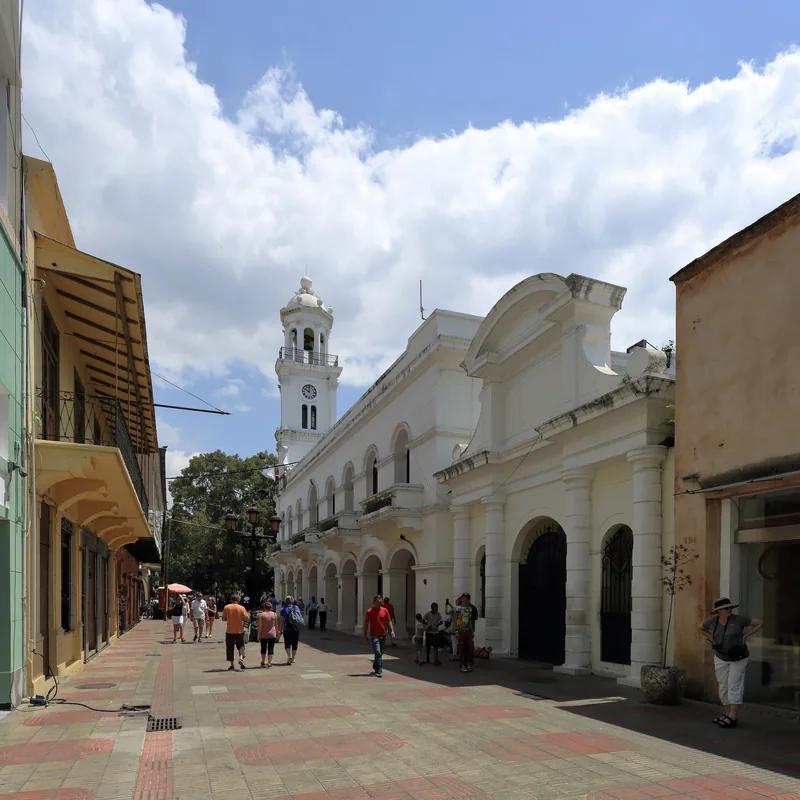
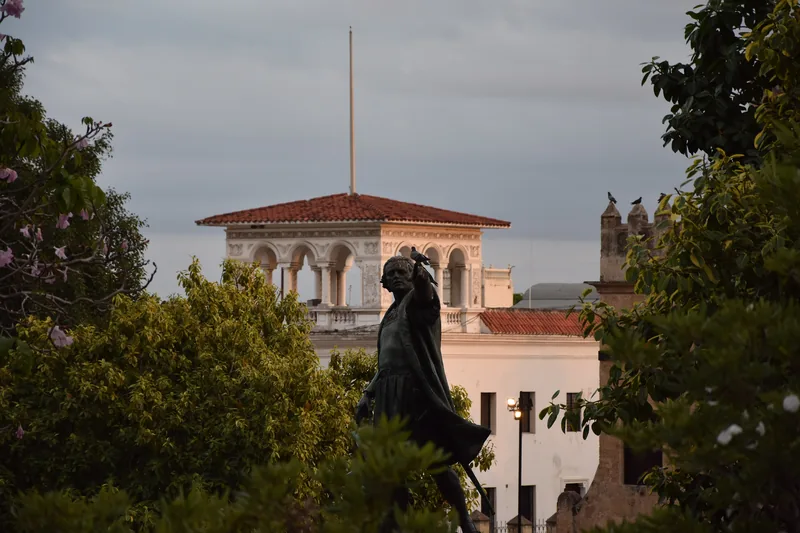
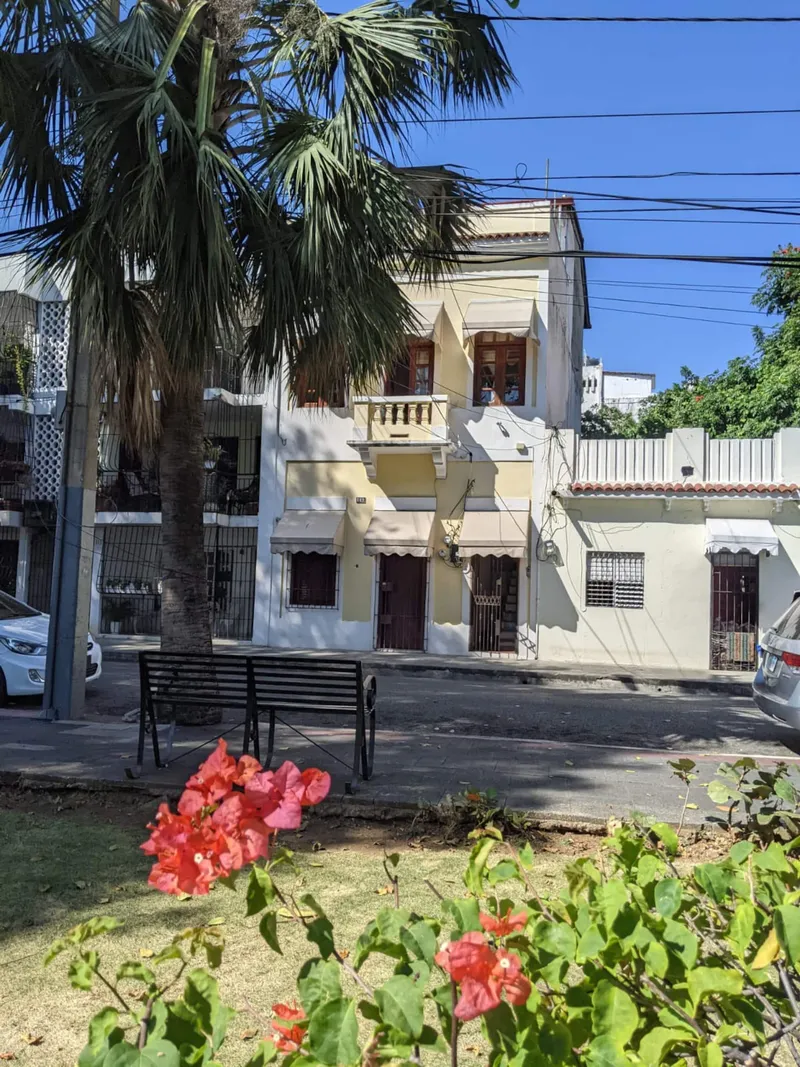
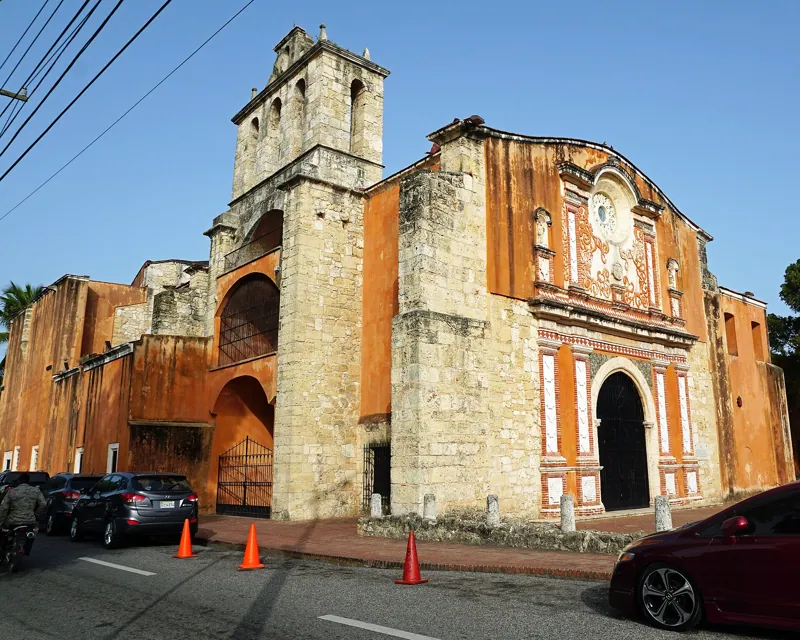
Most visitors walk past the Dominican convent on the way to somewhere else. It sits on Calle Padre Billini, a few minutes from the cathedral and from Parque Duarte, and from the street it can look like one more weathered church front among many. Inside, it holds two stories that matter to this city. One is a chapel vault painted with the signs of the zodiac. The other is a long argument about whether a school run by friars in this building, in the 1530s, was the first university in the Americas.
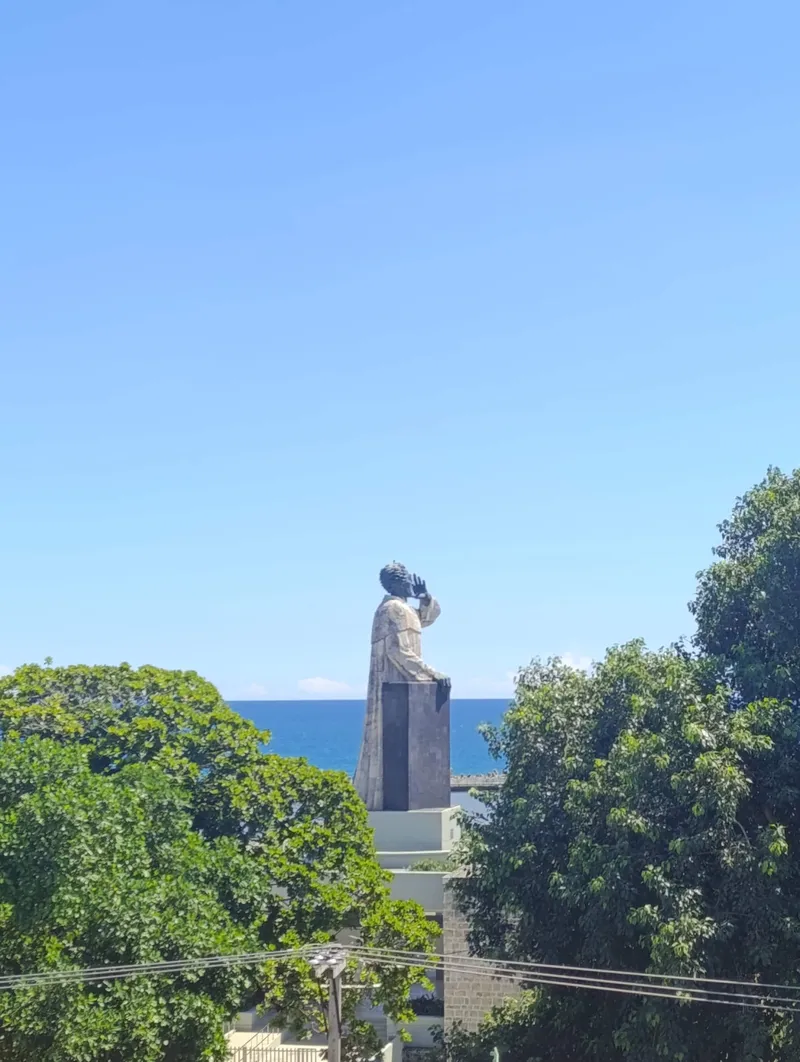
The second story is a good example of how history claims work. A pope signed a document, a king signed a different one years later, and three cities in the Spanish empire have each said, at one time or another, "we were first." This page lays out what is documented, who disputes it, and what you can see when you go in. The sermon that made the Dominicans famous in the Americas, the 1511 speech of Fray Antón de Montesinos, has its own page at Fray Antón de Montesinos and His 1511 Sermon, so this one concentrates on the building and its school.
The Friars Arrive
The Dominican Order was founded in 1216 in Toulouse, France, by Saint Dominic, Domingo de Guzmán. The newspaper El Día, in a 2019 feature on the church, says the Dominicans reached Santo Domingo in 1510. Work on the convent and the church began in 1517, on lots donated by the town's residents.
That sequence matters. The friars were among the earliest religious communities on the island, and the people of the young city gave land for their house. The convent became a base for preaching and teaching, and El Día's headline calls the church the oldest living church on the continent, meaning one that has stayed in use. Treat that phrase as the newspaper's claim rather than a ruling, because several early buildings in the city have a case for being the oldest in some sense, and the Colonial Churches of the Zona Colonial page looks at a few of them.
The same article places the Montesinos sermon in the early colonial period, before Diego Colón, who was viceroy of the island at the time, and calls it a forerunner of the idea of the law of nations. A second El Día article, about the restored church of Santa Bárbara, also ties the Advent sermon against the mistreatment of Indigenous people to the Dominican convent. Whether the sermon was given in an earlier, simpler building on this site or in the stone church you see today is a question for the Montesinos page. What you can say here is that the Dominicans stood for that argument, and this is their house.
What the Church Looks Like
El Día's description of the church is the most detailed source in Spanish that is easy to read, and it gives you a way to look at the building.
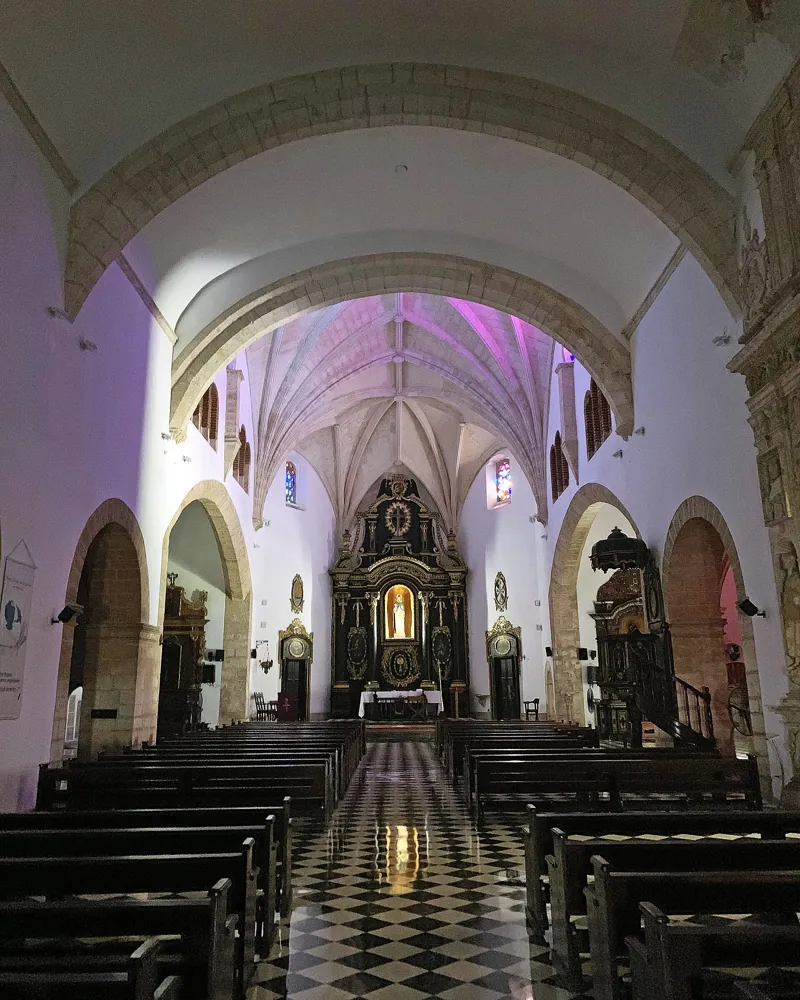
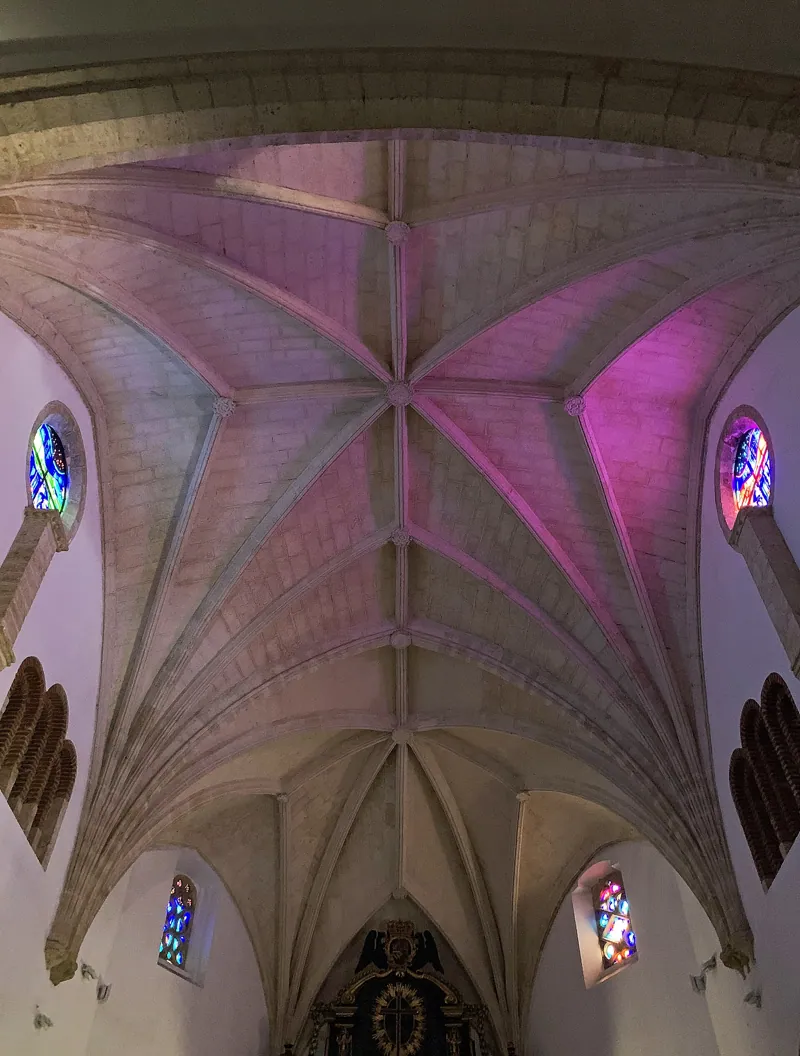
The plan is a Latin cross, with chapels set between the buttresses and a high choir for the canons. The oldest parts, the sacristy vault, the presbytery and the transept, are in the Gothic Isabelline style, the late Gothic that Spain used under Ferdinand and Isabella. The nave roof was destroyed in an earthquake and rebuilt as a barrel vault held up by stone arches. The article calls that vault one of the great structural achievements of colonial American architecture. A barrel vault is a continuous half-cylinder of masonry, and holding one up over a wide nave takes strong arches and thick supports, which is why the walls look so heavy.
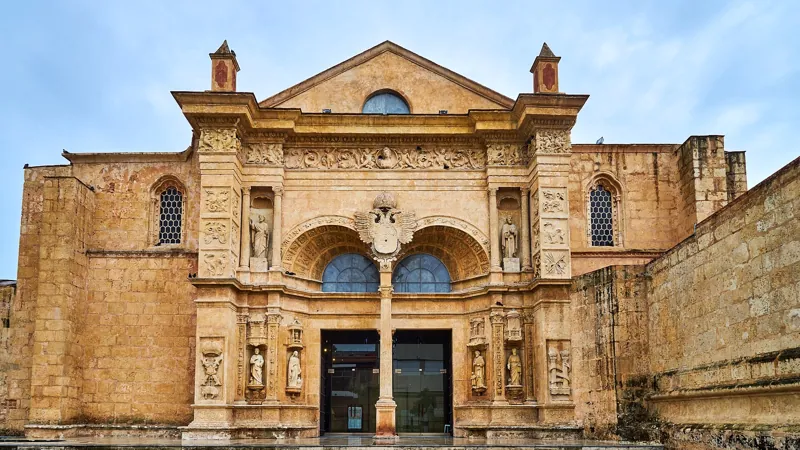
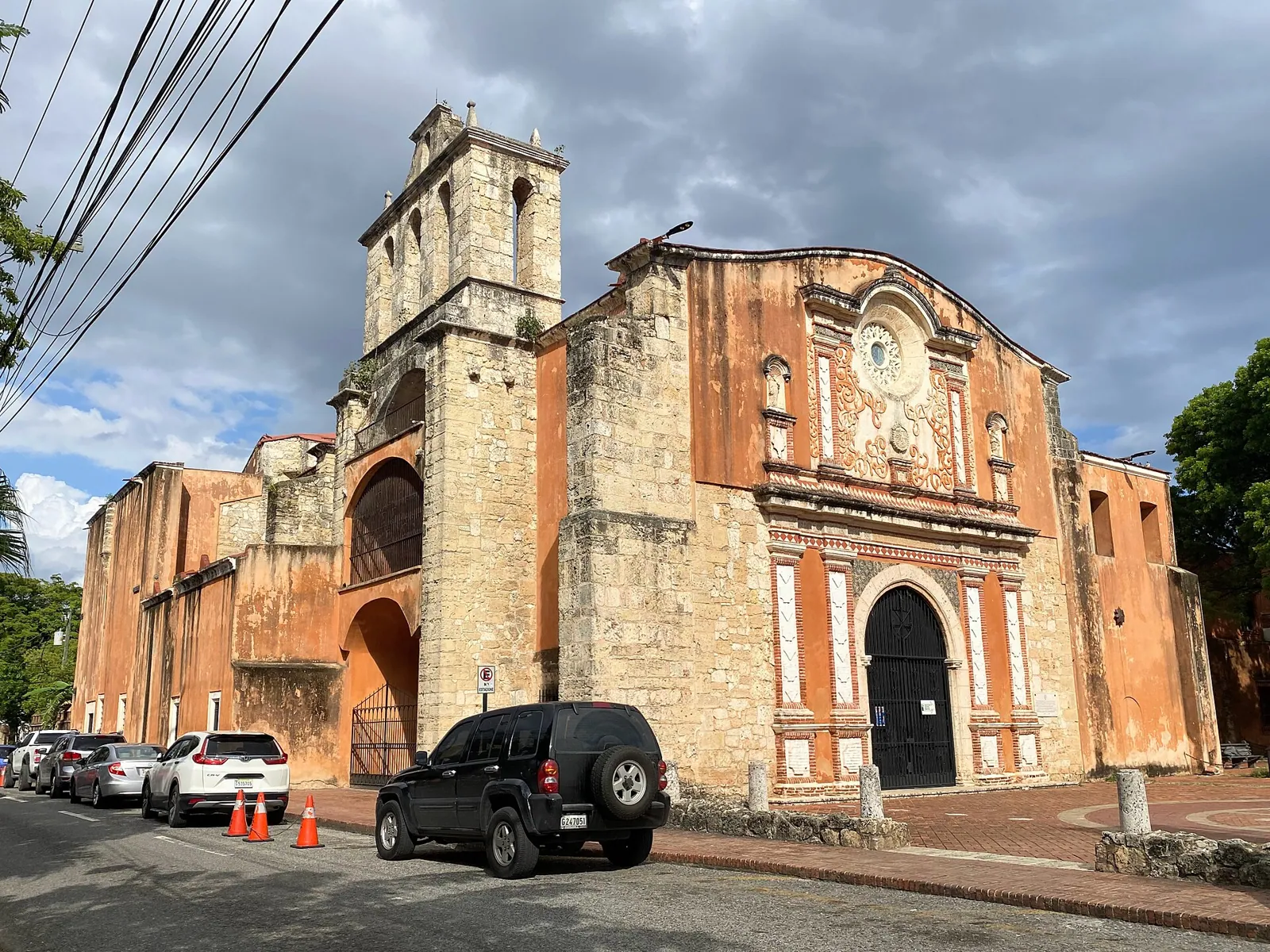
The article also says the church was rebuilt in the late 17th century and that a major intervention in the 18th century repaired earthquake damage to the facade. You can read the layers on the front of the building. According to El Día, the facade combines work from the late 16th to the 18th century. The original rose window and a Gothic pointed arch survive. Statues of Saint Dominic and Saint Thomas Aquinas stand in niches, and the surface carries 18th-century sgraffito, which is decoration scratched into plaster in layers of color.
The Zodiac Vault
The detail that people remember is the ceiling. In the Rosary chapel, the third chapel on the south side of the nave, the vault carries a painted zodiac. El Día says the vault is divided by a pair of classical telamones, the carved male figures that hold up a structure like columns. Across it run the twelve signs of the zodiac, and at the center is the sun.
The article reads the whole scheme as a Christian one. In its account the twelve signs stand for the twelve tribes of Israel, the prophets of the Hebrew Bible and the twelve apostles, and the sun at the center represents Jesus Christ. That is a way of reading astrological imagery that church builders used for centuries, treating the heavens as a clock that points to the divine order. Visitors often find it surprising to see zodiac signs in a church, and the explanation is that the image is meant to be read as theology.
The chapel itself belonged to the Rosary confraternity, which El Día calls the most powerful in Santo Domingo because of its ties to seafarers. The article connects the confraternity to the Christian victory over the Ottoman fleet at Lepanto, though it gives no date for it. In a port city, a brotherhood that prayed for sailors had a natural following. The chapel's stone portal retable blends Spanish Plateresque and Baroque styles, according to the same source.
Be careful with details if you read other guides. Sources do not agree on which chapel holds the zodiac vault, and different accounts describe different chapels and different decorative schemes. El Día, which is the source used here, places the vault in the Rosary chapel. The best test is to look at the ceiling on the day and read any sign beside it.
Altars, Carving and the Pulpit
Beyond the vault, El Día lists several things worth finding.
- The main altarpiece. The presbytery retable is dedicated to Saint Dominic and dates from the transition between Baroque and Mannerism. The top of the main retable shows the imperial coat of arms of Charles V, restored with gold leaf.
- The Crucifixion retable. In the south transept stands a Plateresque retable in coral stone dedicated to the Crucifixion. The article attributes its carving to a 17th-century Andalusian workshop, probably that of Martínez Montañés.
- The pulpit. It is a Baroque work, which the article describes as one of the most beautiful of the colonial period.
- Martín de Porres. The church has a statue of the saint, whom the article calls the first Black saint of the Americas.
The convent next door has been fully restored, according to the same feature. If the church is open and you have time, the details above are a reason to walk around the walls and not stop at the nave.
The 1538 Bull
Now the university. The dates and documents are the interesting part, so here they are in order.
According to an Acento article on the Universidad Autónoma de Santo Domingo, the university was created on October 28, 1538, by the bull "In Apostolatus Culmine," issued by Pope Paul III. The institution was the Pontificia Universidad Santo Tomás de Aquino, named for the Dominican theologian whose statue stands in a niche on the church facade. It operated in the Dominican convent. A bull is a formal papal document, and this one raised the friars' school to the rank of a university with the power to grant degrees.
A history magazine article on the university says it began as a seminary for Roman Catholic monks and was made a university by papal bull. It taught Arts and Theology, although the article warns that those categories did not mean what they mean now. In other words, this was a school of the Church, run by friars, for a small colonial society, and its programs were shaped by the needs of the order and the diocese. That context helps when you stand in the nave and try to imagine classes held in the same compound.
Then the problems begin. The same Acento article says the original bull was lost. It reports that Drake's men burned the Dominican convent's library in 1586, and that a copy was lost when Napoleon moved volumes of Vatican bulls. That is how some historians came to question the document's authenticity and legal value. The article adds the answer from the archives: the Spanish Dominican historian Vicente Beltrán de Heredia found the bull's record in the Vatican archive in 1951, and César Herrera found a legalized copy dated 1542 in Seville in 1959. So the bull is documented, but the survival of its text is a story of recovery, not of a pristine original in a drawer.
Royal recognition came later. The Acento article gives a royal decree, a Real Cédula, dated February 23, 1558. The history magazine article says Spain officially recognized it by Royal Provision in 1558 and that degrees awarded before that year were declared unofficial. The same article says Spain issued a decree barring the university from calling itself a "primate of America." A university that depends on its pope for existence and its king for recognition is a body in two jurisdictions, and the gap between 1538 and 1558 is the heart of the quarrel.
Who Else Says They Were First
Two other universities in Spanish America give the other side.
The Universidad Nacional Mayor de San Marcos in Lima bases its claim on a royal decree. The online encyclopedia entry on San Marcos gives the date as May 12, 1551, when Charles V issued the decree in Valladolid. Mexico's royal decree is dated September 21, 1551, about four months later, so each of the two has a reason to argue about priority between them. The entry adds that San Marcos opened at the Dominican convent of the Rosary in Lima in 1553, and it adds a sentence that is useful for the whole dispute: colonial institutions could be dated by the sanction of the Church, the granting of a royal charter, or the actual start of studies.
That sentence explains the argument. If the Church's sanction counts, Santo Domingo wins with 1538. If a royal charter counts, Lima wins with 1551, because the Santo Domingo school was not recognized by the Crown until 1558. If the start of teaching counts, the answer depends on what you count as teaching and where the records are. The Acento article says Spanish, Peruvian and Mexican historians have disputed Santo Domingo's primacy, and that the universities of San Marcos and Mexico have claimed the title of first.
Where does that leave a visitor? An opinion piece in El Debate by Luis Antequera, published in January 2026, calls the Santo Domingo foundation the first university on the continent and treats all three as Spanish achievements, though the piece cites no sources for the claim. A history magazine is more careful and says it is arguably the first higher-education institution in the Americas. It adds a comparison: Harvard, the first in North America, was founded in 1636, about a century later. The careful phrase, then, is the one the sources themselves keep reaching for. Santo Domingo has the earliest claim, the papal bull of 1538, and its status as a university in the full legal sense came later. In Spanish and Dominican sources the claim is stated more boldly, and in Peruvian and Mexican sources it is contested.
The university's later life is also short to tell. The same article says it closed in 1823 and that the autonomous Universidad de Santo Domingo, founded in 1914, is its successor. It calls the university one of the foundational institutions of Santo Domingo, alongside the cathedral, the hospital and the first customs office. For the first of those, read Catedral Primada de América.
What Is Documented and What Is Not
It helps to separate three layers, because guides often blur them. The habit is useful far beyond this church. In the Zona Colonial nearly every old building comes with a "first" attached, and a visitor who learns to ask what kind of first is meant, a papal act, a royal charter or the day work started, can read the signs and the guidebooks with more confidence and less frustration.
The documented layer is short and solid. The Dominicans arrived in 1510 and began the convent and church in 1517. A bull of Paul III dated October 28, 1538 made their school a university, and a royal cédula of 1558 recognized it. A Vatican record of the bull turned up in 1951, and a legalized copy turned up in Seville in 1959.
The disputed layer is the word "first." It depends on which you give weight to: the Church's act, the Crown's act or the day classes began. Historians in Peru and Mexico have contested it, and the quarrel is about definitions as much as dates.
The legend layer is the set of claims that attach to any old church: that this is the oldest church in continuous use in the Americas, that the sermon of 1511 was given on this very spot, that a certain chapel is a particular age. Some of these may be true. This page treats them as the claims of the writers who make them, and it suggests you look at what the building itself tells you in stone and paint.
Reading the Church Against the City
It helps to know where this church sits in the sequence of the old city's buildings. The Dominicans arrived in 1510, and their convent was under way by 1517, before the cathedral's main body was finished. So when you stand in the nave you are in one of the oldest religious spaces in the city, shaped by the same earthquakes and the same repairs as its neighbors. The late 17th-century rebuilding and the 18th-century facade work that El Día describes are the kind of repairs you will find across the district, and they are why so few colonial churches here are pure in style. Think of the building as a conversation between its builders and its disasters.
Visiting the Dominican Church
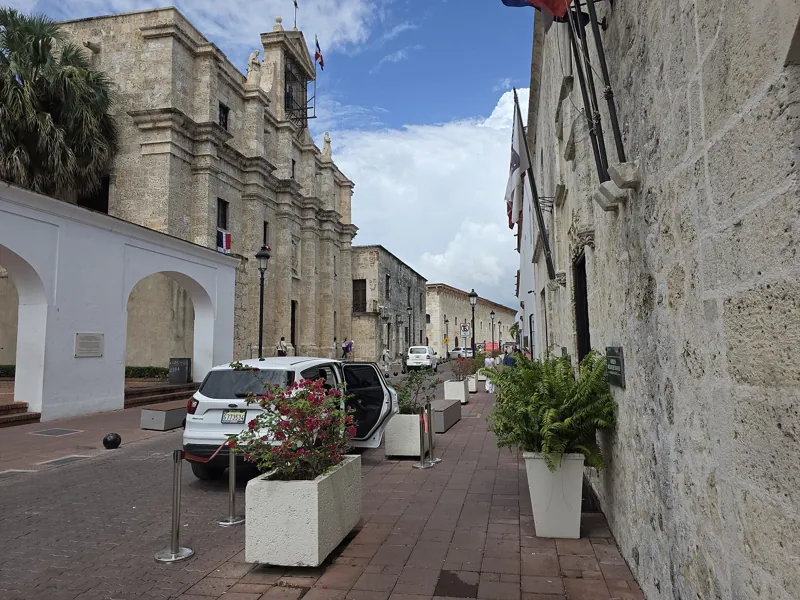
The church stands on Calle Padre Billini and is still a working Dominican church. That means its hours follow the life of the parish. No official schedule turned up in the research for this page, so check on the day, and expect that the church may close to sightseers during Mass.
Some things are worth doing when it is open.
- Stand under the nave vault first and look at how the arches carry the weight. It is the structural achievement El Día singles out.
- Find the Rosary chapel on the south side and look up. Read the zodiac as the article does, as a Christian scheme with the sun at its center.
- Look at the front of the church from the street. The rose window, the pointed arch, the two saints in niches and the sgraffito belong to different centuries.
- Dress for a church, with shoulders and knees covered.
The convent and the church are a short walk from the other great pieces of the old city. The Franciscan ruins uphill are covered in The Ruins of the Monasterio de San Francisco, and the smaller churches around them are in Colonial Churches of the Zona Colonial. For a longer walk that links the major landmarks, use the Santo Domingo landmarks guide or the Zona Colonial complete guide.
Getting there from the penthouse
The convent church stands beside Parque Duarte on Calle Padre Billini. OpenStreetMap places the park at about 18.4717, -69.8853, and Penthouse Pallazzo sits at roughly 18.4697, -69.8851, which is a straight-line distance of about 225 meters. Allow 1.3 times that for the real streets, at 80 meters a minute, and the walk is about 5 minutes on foot. The route heads inland from the sea wall and into the street grid, and you do not need a map once you can see the park.
Since the church is so close, it works as a quiet first stop before the cathedral. If you walk in the morning, you can see the facade with few other people around and then continue to Parque Colón, which is a few minutes further on. A ride is not worth the trouble for this distance, because the streets around the church are narrow and the walk is shorter than the wait for a car.
Frequently asked questions
Was this really the first university in the Americas?
It has the earliest claim, based on a papal bull of Paul III dated October 28, 1538, which made the Dominican school a university. Spain gave royal recognition in 1558. The universities of San Marcos in Lima and Mexico, both founded by royal decree in 1551, have also claimed the title, so historians do not all agree.
What is the zodiac ceiling?
It is a painted vault in the Rosary chapel. According to El Día it is divided by two carved figures called telamones and shows the twelve signs of the zodiac around a central sun. The article reads the signs as the twelve tribes of Israel, the prophets and the twelve apostles, and the sun as Christ. Other guides describe the chapels differently, so look at the ceiling yourself.
When did the Dominicans arrive in Santo Domingo?
El Día gives 1510 for their arrival and 1517 for the start of work on the convent and church, on lots that local residents donated.
What happened to the original bull?
The original was lost. Acento reports that Drake's men burned the convent library in 1586 and that a copy was lost when Napoleon moved volumes of Vatican bulls. Beltrán de Heredia found a record in the Vatican archive in 1951, and Herrera found a legalized copy from 1542 in Seville in 1959.
Is the university still running?
The old university closed in 1823. The history magazine article says the Universidad Autónoma de Santo Domingo, established in 1914, is its successor.
Can I go inside?
Yes, when the church is open. It is a working church, so hours follow services and you should check before you go. Dress for worship.
Sources
- https://eldia.com.do/la-iglesia-viva-mas-antigua-del-continente-americano/
- https://eldia.com.do/santa-barbara-restaurada/
- https://acento.com.do/cultura/la-uasd-faro-de-luz-de-america-y-centro-de-vida-intelectual-en-la-republica-dominicana-1-de-2-9565705.html
- https://thebristorian.co.uk/the-past-today/universidad-santo-toms-de-aquino
- https://encyclopedia.com/religion/encyclopedias-almanacs-transcripts-and-maps/san-marcos-main-national-university
- https://www.eldebate.com/historia/20260129/cuando-imperio-espanol-fundo-primeras-universidades-america-asia-europa_379238.html
- https://gcatholic.org/churches/caribbean/54806
- https://commons.wikimedia.org/wiki/Category:Convento_de_los_Dominicos,_Santo_Domingo
- https://nominatim.openstreetmap.org/search?q=Parque+Duarte+Santo+Domingo&format=json&limit=3