


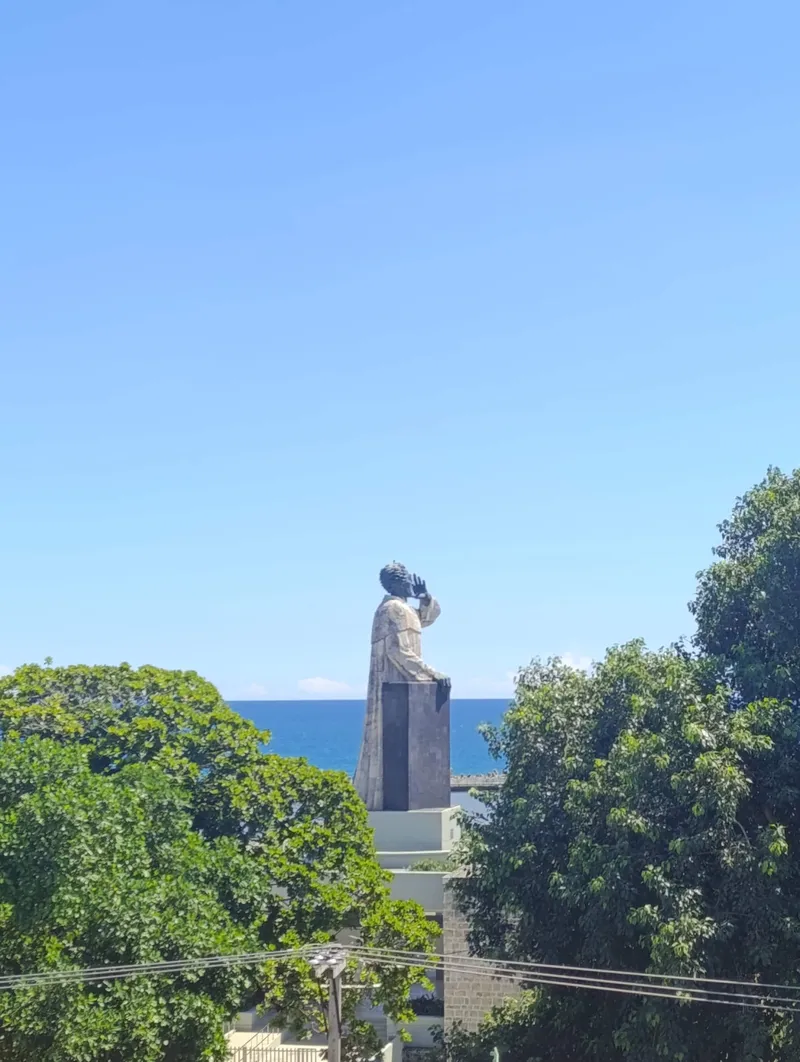

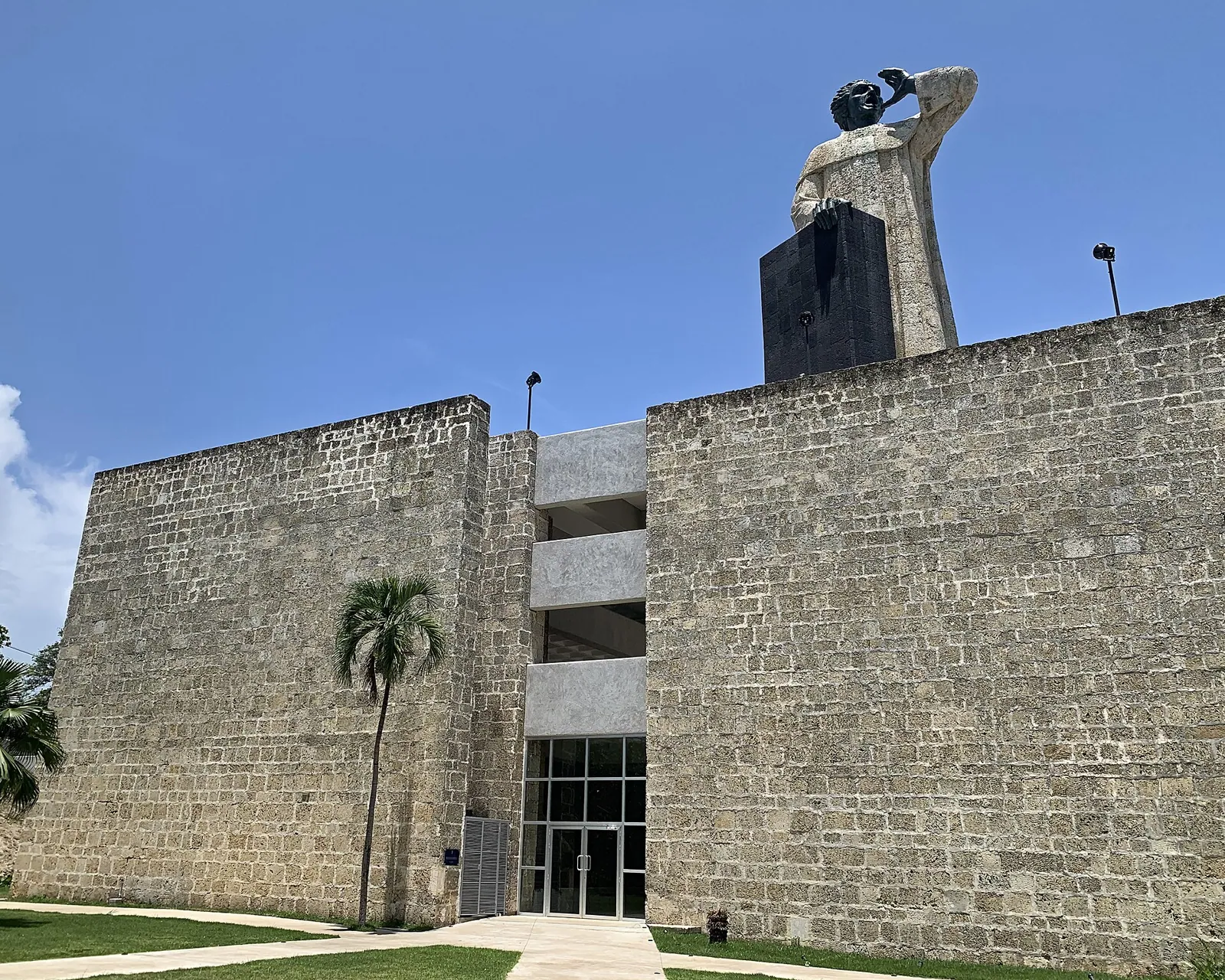
Walk to the eastern end of the Malecón, where the Ozama River reaches the Caribbean, and you come to a very large bronze friar standing above the water with one hand raised toward his mouth. He is Fray Antón de Montesinos, a Dominican who preached a sermon in Santo Domingo on the fourth Sunday of Advent in 1511. Dominican commentators call it the country's first stand on human rights, and a Louisiana State University thesis abstract credits Montesinos as the first historical figure to denounce Indian slavery in the Americas.
The sermon is worth knowing for what it said, but also for what it did not achieve. It angered the governor and the royal officials, it sent a friar across the Atlantic to argue with a king, and it helped produce the Laws of Burgos of 1512. Those laws were the first written code on how Spaniards were to treat the native people of the Caribbean, and by most accounts they changed very little on the ground. The sermon also changed the mind of one listener, a young landowner named Bartolomé de las Casas, who spent the rest of a very long life arguing the same case.
This article follows the story in order: the colony Montesinos preached to, the sermon itself and the week after it, the laws, Las Casas, what happened to the friar, and the monument you can visit today. The people he spoke for have their own article, The Taíno of Hispaniola. The wider story of the walled city is in A History of the Zona Colonial, and the other pieces in this series are collected on the history hub.
The Colony in 1511
By 1511 Santo Domingo was about fifteen years old, and the Spanish had already built a system for getting work out of the island's people. In 1503 the Crown introduced the encomienda, which handed groups of Indigenous people to Spanish settlers, the encomenderos, who took their labor in exchange for tribute and a promise of Christian instruction. A Library of Congress country study says weak enforcement made the system largely unworkable as written. In practice it meant gold mines and farms worked by people who had no say in the matter.
The numbers show what that cost. One encyclopedia entry on the Taíno reports that Miguel de Pasamonte counted 60,000 Taíno on Hispaniola in 1508, and that Diego Colón reported 33,523 in 1510. Estimates of the population when Columbus arrived in 1492 are very uncertain, from 100,000 to over a million depending on the scholar, and the Taíno article in this series covers that argument. What nobody disputes is that the count was falling fast while the colony was growing. African slaves were also being imported from 1503, and by about 1520 enslaved African labor was used almost exclusively.
The people in charge were Diego Colón, the Admiral's son, and the royal officials around him. A royal court of appeal, the Audiencia, was created in 1511 to check the governor's power. Those were the men Montesinos would face from the pulpit.
The Dominicans Reach Hispaniola
The Dominican order arrived in the island in the early 1510s. Montesino, as the name is often spelled, had reached Hispaniola by April 1510, and El Día describes him as one of the first Dominicans on the island. The community's vicar was Pedro de Córdoba.
What the friars saw in the first year or two is the background to everything that followed. El Día reports that they gathered their own evidence about the treatment of Indigenous workers in the gold mines, and that they came to judge the encomienda contrary to divine, natural and human law. They did not stop at private opinions. They wrote a sermon together, every friar signed it, and Córdoba chose Montesinos to preach it. That detail matters, because it means the sermon was the stated position of a whole community of friars and not one man's outburst.
The Dominicans' convent in the colonial city still stands and has its own article here, Convento de los Dominicos. The church where the sermon was preached was, according to El Día, the Dominican church of Santo Domingo.
The Sermon of 21 December 1511
The sermon was preached on the fourth Sunday of Advent, which in 1511 fell on 21 December, according to El Día and the Dominican paper Acento. Montesinos took as his text the Latin line Ego vox clamantis in deserto, the voice of one crying in the wilderness. Las Casas, who recorded the sermon in his History of the Indies, writes that Montesinos opened by saying he was the voice of Christ in the desert of this island.
What He Said
We know the words from Las Casas, who wrote them down some years afterward, so they come to us through his memory and his purposes. Even so, the Spanish versions that Dominican newspapers still quote are consistent with the English translation in the classic text. The sermon's central question was this:
Tell me, by what right and by what justice do you keep these Indians in such cruel and horrible servitude? Montesinos, Santo Domingo, December 1511, as recorded by Bartolomé de las Casas (translated from the Spanish quoted by El Día)
He followed it with the charges. The colonists, he said, were in mortal sin, and they lived and died in it because of the cruelty and tyranny they used on these innocent people. He asked whether the Indigenous people were not men, and whether they did not have rational souls. He asked whether the colonists were not bound to love them as themselves. And he warned them, in an English translation of the sermon, that in the state in which they were living they could not be saved.
Two of those questions, whether the Taíno were men and whether they had souls, may sound strange now. They were real questions in 1511, because Spain had not settled in law what the people of the new islands were. Montesinos answered them as directly as he could: they were men, they had souls, and the colonists owed them what any Christian owed a neighbor.
Who Heard It
El Día's account says the church was full. The senior colonial authorities sat at the front, among them Diego Colón. It also places Las Casas in the congregation, at that point a landowner holding an encomienda himself. Another reference entry is more careful and says only that the message was not lost on him. Either way, Las Casas heard the argument, wrote it down, and eventually acted on it.
According to Las Casas, as quoted in an English translation, the sermon left the congregation overwhelmed. Some were hardened and some were remorseful, but none, as far as he later learned, was converted. The church, he adds, was filled with murmuring as Montesinos left.
The Week That Followed
The colonists answered quickly. After Mass, El Día reports, Diego Colón and the royal officials confronted the Dominicans, accused the preacher of disservice to the Crown, and demanded a public retraction. Las Casas, in his own account, says the whole city gathered at the Admiral's house that afternoon, and the officials decided to reprimand the friars. They called Montesinos a scandalous man and a sower of new doctrine who spoke against the king's rights over the Indians.
The Dominicans did not retract. A week later, according to El Día, Montesinos preached again and repeated his charges, adding that encomenderos who kept exploiting the Indigenous people would go to hell. The second sermon caused a larger uproar, and the royal officials sent letters of protest to the king. One reference entry adds that Montesinos refused communion to the Spaniards he held most responsible.
Spain answered in March 1512. On 20 March, King Ferdinand ordered Diego Colón to silence Montesinos and the other Dominicans. Three days later a reprimand arrived from the Dominican superior, Alonso de Loaysa, ordering Montesinos to stop speaking publicly and warning that he would be sent back to Spain if he refused, and that no more Dominicans would be sent to the New World. So both the Crown and his own order told him to stop.
Montesinos in Spain
Montesinos did go back to Spain, and it turned out to be the best thing that could have happened to his cause. He made four trips in all, in 1511 to 1512, in 1515, in 1522 to 1524 and in late 1527. El Día says he eventually met the aging king and put a written account of the colonists' abuses in front of him.
Ferdinand, whose officials had just complained about the preacher, convened a commission. A thesis abstract from Louisiana State University describes it as the Junta of Burgos of 1512, made up of jurists, theologians and royal officers, and says the sermon had raised two large questions: whether the Crown could justly wage war on the Indigenous peoples of the Caribbean, and whether the papal grants gave Spain legal title to the islands. The junta did not answer those questions the way Montesinos would have. It did write down rules.
The Laws of Burgos
The Laws of Burgos were promulgated on 27 December 1512. One reference entry calls them the first comprehensive legislation governing relations between Spaniards and the Indigenous population of the Caribbean, and says the complaints of the Dominicans helped prompt them.
The provisions are a mixture of protection and regulation. Encomenderos were told to gather the native people into new villages near the Spanish settlements, to give them religious instruction, and to supply food and clothing. At least a third of the native workers would keep working in the gold mines, but their conditions were to be set out in detail. Certain abuses were banned outright, including whipping the workers and calling them "dog." The LSU abstract adds that the laws contained protective measures for women and children. A year later, in 1513, the laws were clarified and amended as the Laws of Valladolid, and the entry on Montesino credits his advocacy with influencing both rounds.
Now the hard part. The same encyclopedia entry concludes that, despite their intent, the laws produced no real improvement in the natives' living or working conditions. The LSU abstract agrees that they were never fully enforced. And the design itself shows the limit of what the Crown was prepared to do, since it kept the encomienda and kept the mines running. The Laws of Burgos regulated forced labor. They did not end it.
That is the fair reading of what Montesinos achieved. He did not stop the abuse in 1511, and Spain did not stop it in 1512. What he did was force the Crown, for the first time, to put its position on paper, which is why historians of human rights still start the story here. The LSU abstract credits him as the first historical figure to denounce Indian slavery in the Americas, which is the author's claim and the kind of "first" that is hard to prove. What the sources support is that he was a very early voice, and that he spoke with the colony's own officials in the pews.
Las Casas
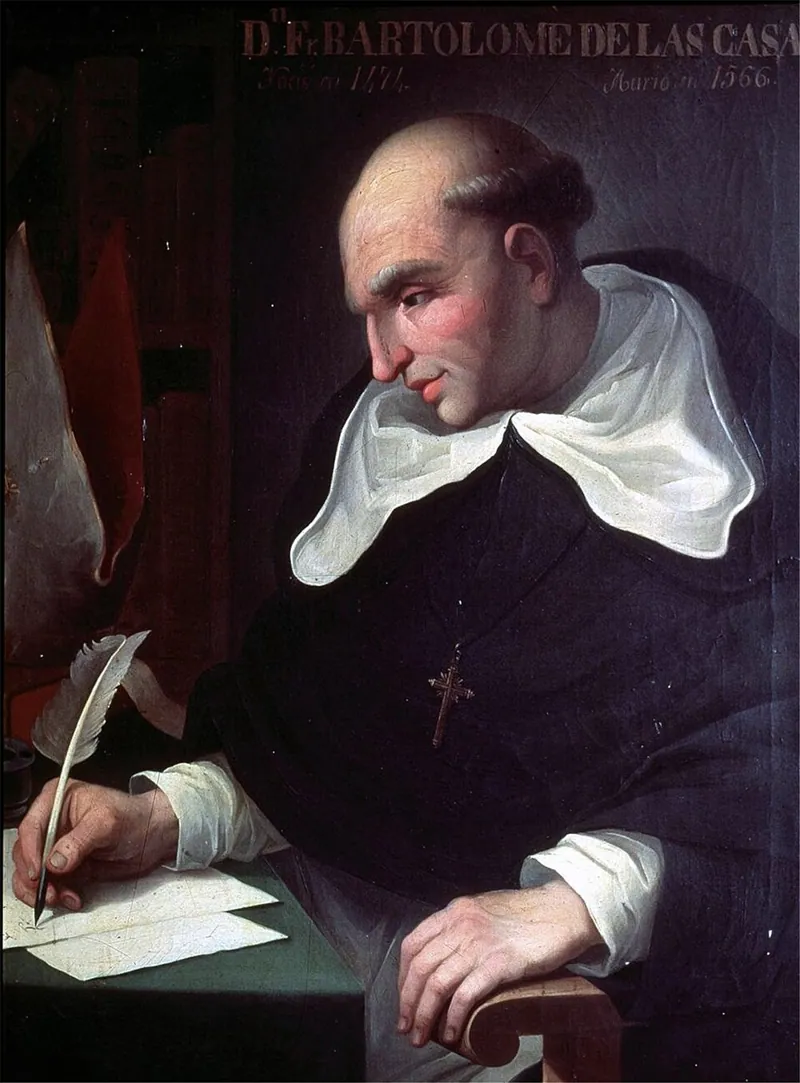
Bartolomé de las Casas is the reason we have the sermon at all. He sailed to Hispaniola in 1502 and helped his father manage land that Columbus had granted him. He received land and Indigenous laborers under the encomienda and at first did not question it. In 1513 and 1514 he served as a chaplain during the conquest of Cuba, and received more land and workers there.
In 1514 he gave up his holdings, freed the people who worked them, and began publicly condemning the encomienda. Accounts of exactly how that happened differ, but the year is steady, and El Día connects it directly to Montesinos, describing a renunciation three years after the sermon. In 1515 he went to Spain to plead the case before the Crown.
The rest of his life is its own large story. A Venezuelan settlement he tried to found around 1520 failed. He joined the Dominicans in the early 1520s, and in 1544 he was named bishop of Chiapas. He resigned in 1547 and went back to Spain. In 1550 he debated Juan Ginés de Sepúlveda at Valladolid, in 1552 he published A Brief Account of the Destruction of the Indies, and he spent his last years writing the History of the Indies, in which the sermon appears. He died in Madrid in 1566, at about 92. Even his birth year is disputed, with 1474 and 1484 both in circulation.
Las Casas is not a neutral witness. One encyclopedia entry on the Taíno cautions that his accounts of Spanish brutality were likely exaggerated for legal purposes. He is still our best source for what Montesinos said, and the reason the sermon did not disappear into the colonial archives.
What Became of Montesinos
The friar's own later life is much less certain than the sermon. Around 1516 he wrote a legal defense of the Indigenous peoples, and in mid-1526 he joined Lucas Vázquez de Ayllón's failed colonization attempt near modern Jamestown, Virginia, according to one reference entry. The accounts of his death disagree. One entry says he died in the West Indies around 1530, and the only evidence is a marginal note in the chronicle of his order, reading "Obiit Martyr in Indiis," which suggests he died a martyr. Another entry says he died in Venezuela, around 1530, while protecting Indigenous people there. Treat the exact year and place as open.
That uncertainty is one reason the monument matters. The friar is remembered where he preached, and not where he died.
The Monument
The sculpture on the Malecón is a modern work, made in the early 1980s, and it is worth understanding before you walk up to it.
Who Made It
The sculptor is Antonio Castellanos Basich, a Mexican artist born in Mexico City in 1946, the son of the painter Julio Castellanos. His own website says he trained in the studio of the sculptor Federico Canessi from the age of eighteen and went on to make monuments in Mexico, including figures of Juan Diego and Fray Juan de Zumárraga at the Basilica of Guadalupe. That makes him about 36 when the monument was made. The architect of the monument was the Mexican Pedro Ramírez Vázquez, according to an Acento column.
Mexico gave the monument to the Dominican people. Sources agree on the gift, which one article says was funded through the San José Accord, but they differ on the date. Acento places the inauguration in 1982, with a speech by Mexican President José López Portillo. A second Acento article, a real estate magazine and the Dominican Ministry of Foreign Affairs' own visitor guide give 1983, with the donation a year earlier. If you need one date, say that it was given in 1982 and opened in 1982 or 1983.
What It Shows
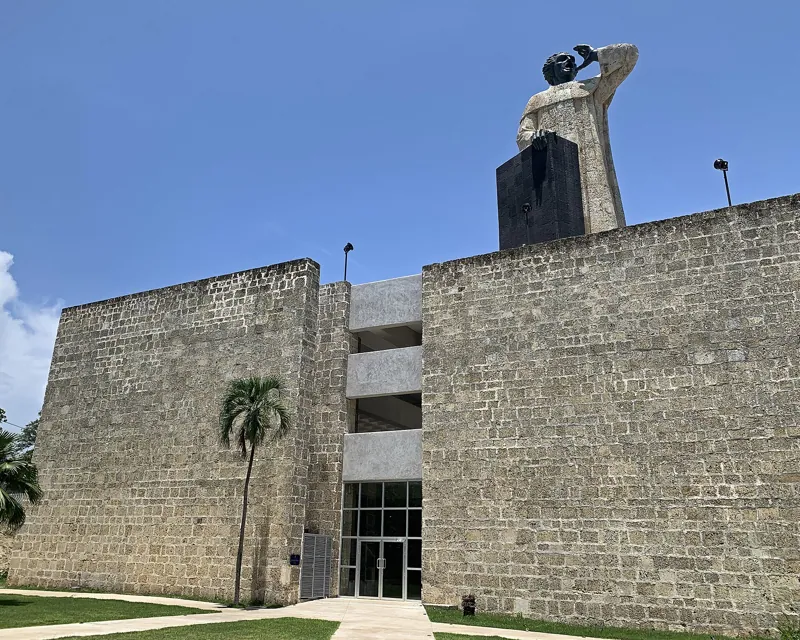
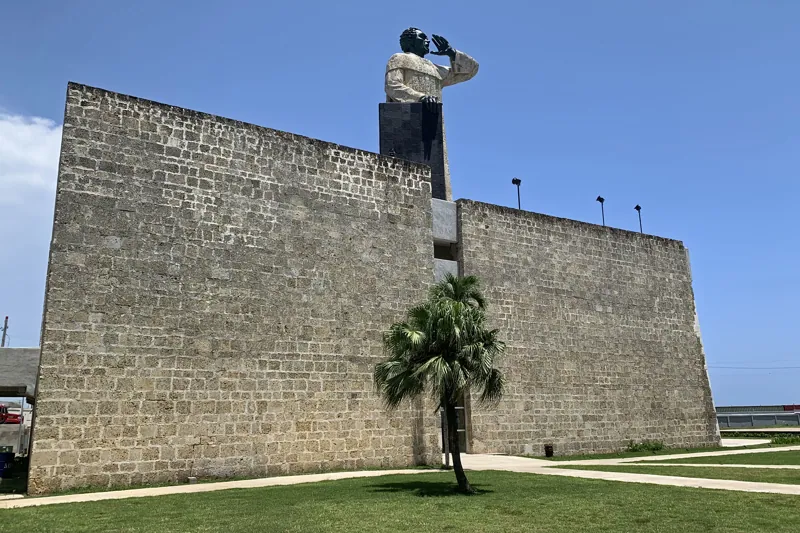
The statue is about 15 meters tall, in bronze and limestone. It shows Montesinos standing as he delivers the Advent sermon, one hand near his mouth so that his voice carries farther, and above the ambón, the raised pulpit. The bronze sits on a larger structure of reinforced concrete faced with limestone, with the sculpture on the upper terrace. A large plaque with a fragment of the Advent sermon sits on a water mirror in front. At night, the monument is lit in the blue, white and red of the Dominican flag.
The 2019 Restoration and Visiting Inside
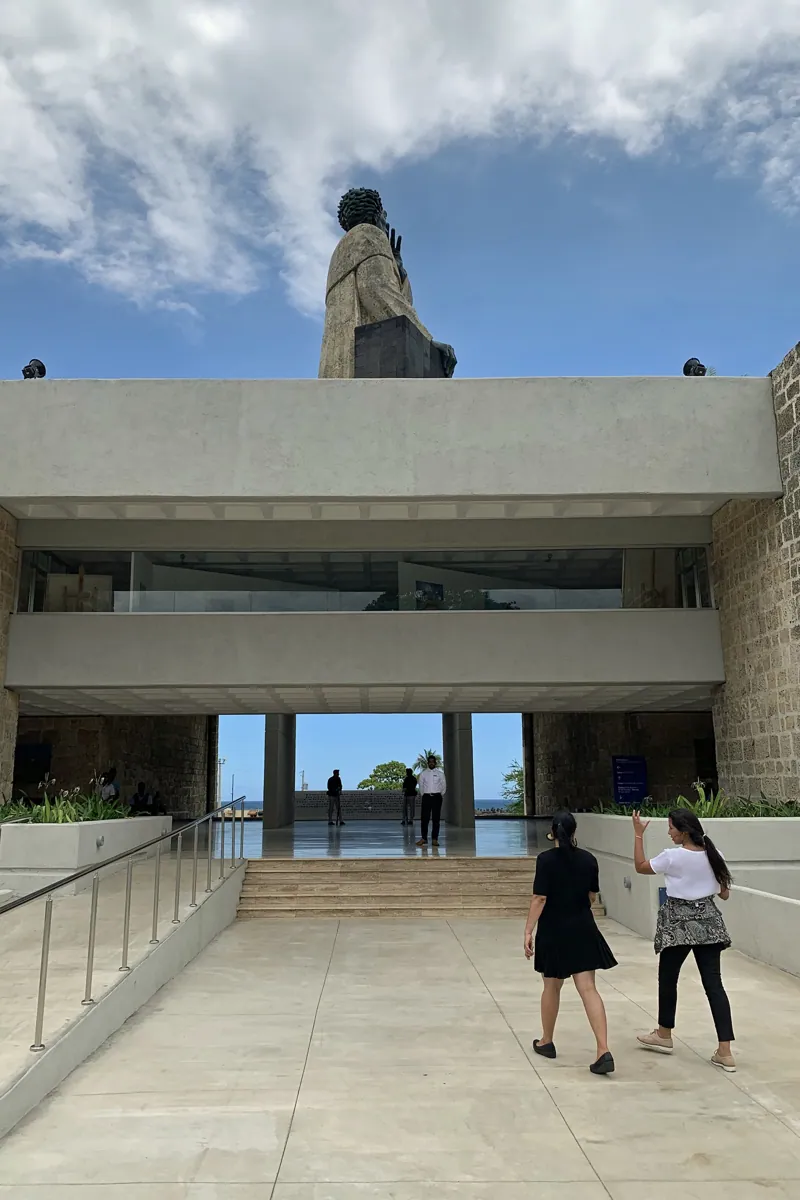
For more than twenty years the monument was neglected. El Día reports that it had become a shelter for beggars and for illicit activity. The rehabilitation was inaugurated in June 2019 under the Distrito Nacional mayor, David Collado, with the support of the Ministry of Culture and the Mexican Embassy. El Día puts the cost at about 40 million pesos. The work repaired the sculpture and the paving and walls, added wheelchair ramps and renewed the electrical and plumbing systems, along with new landscaping and a new lighting design for the interior and exterior.
The inside is no longer just a base. On the first level there is a hall for about 300 people, used for mid-sized cultural events, plus two smaller rooms for exhibits, lectures and book launches. A second level opens onto the Malecón with space for temporary exhibitions and views of the sea. The best part, El Día says, is that visitors can climb to the base of the statue and stand beneath the figure. El Día describes the focus of the space as human rights.
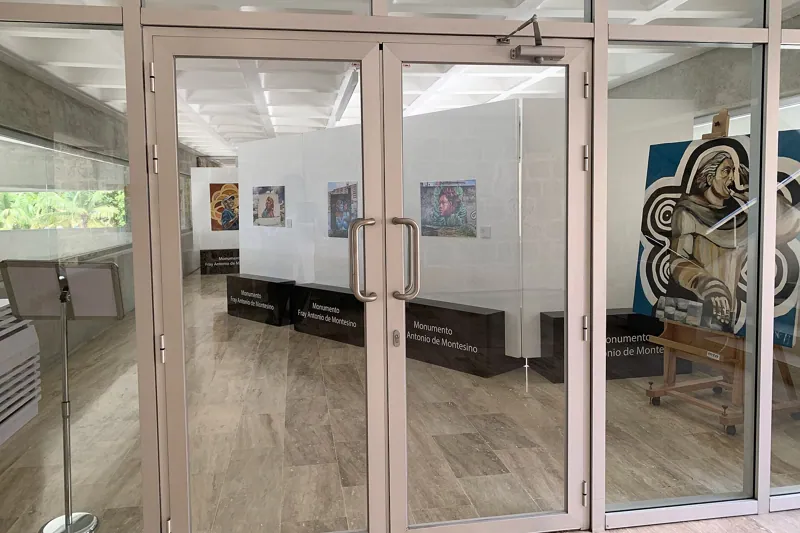
The Dominican Ministry of Foreign Affairs' visitor guide lists opening hours for the monument of 9:00 a.m. to 6:00 p.m. on Monday, Wednesday, Thursday and Friday, and 9:00 a.m. to 8:00 p.m. on Saturday and Sunday, with no Tuesday listed. That guide was published in 2024, and monument hours and exhibits change, so check before you go. Events held inside can also close it for the day.
Why the Sermon Still Matters Here
Most colonial monuments in Santo Domingo celebrate founders, builders and rulers. This one celebrates a man who stood up in a church full of the colony's most powerful people and told them they were wrong. That is an unusual thing to have as a landmark, and it is a good reason to visit it with the sermon in mind rather than just as a photograph.
It is also a place to keep in proportion. The sermon did not stop the encomienda, which lasted for decades. It did not save the Taíno, whose numbers kept falling. The Laws of Burgos were weak. What the story shows is that the argument about what Spain was entitled to do began in this city, in the first years of the colony, and that it began among the Spaniards themselves.
For the people the sermon was about, read The Taíno of Hispaniola. For the Dominican convent that sent him into the pulpit, read Convento de los Dominicos. And for a walk that puts the monument alongside the fortress, the cathedral and the palace of the Columbus family, the site's first city of the Americas walk and landmarks guide cover the route. The seafront itself is in the Malecón guide.
Getting there from the penthouse
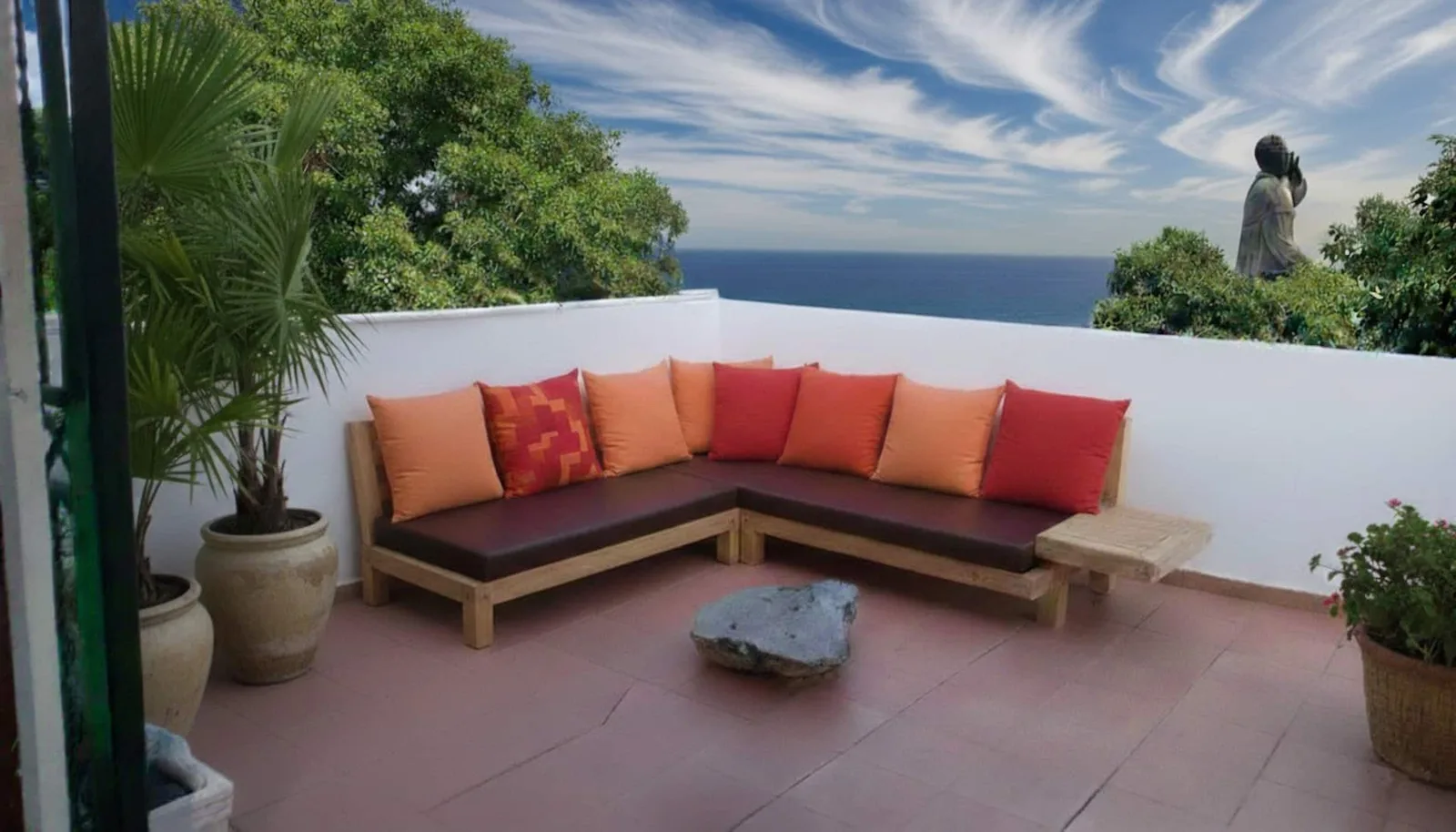
The monument stands on the Malecón at roughly 18.4689, -69.8852, and Penthouse Pallazzo sits at roughly 18.4697, -69.8851, facing it. The straight-line distance is under 100 meters. Multiplied by 1.3 for the real route and divided by 80 meters a minute, the walk is about 5 minutes on foot. Check the opening hours above before you set out. The location page shows the house and the seafront on a map, and the Zona Colonial complete guide covers the streets in the other direction.
Frequently asked questions
When did Montesinos preach the sermon?
On the fourth Sunday of Advent in 1511, which was 21 December, in the Dominican church of Santo Domingo. El Día and Acento both give that date. A second sermon followed a week later, on 28 December by El Día's count of seven days.
Did Montesinos stop the mistreatment of the Taíno?
No. The sermon led the Crown to convene a commission and issue the Laws of Burgos on 27 December 1512, but one reference entry concludes that the laws produced no real improvement in the natives' living or working conditions, and the LSU abstract says they were never fully enforced. The encomienda continued.
What is the monument and who made it?
It is a bronze and limestone statue of Montesinos about 15 meters tall, on the Malecón in Santo Domingo. The sculptor was Antonio Castellanos Basich, the architect was Pedro Ramírez Vázquez, and Mexico gave it to the Dominican people. It was donated in 1982 and opened in 1982 or 1983, depending on the source. It was restored and reopened in June 2019.
Was Bartolomé de las Casas really there?
Sources differ. El Día places Las Casas in the congregation as an encomendero, while another entry says only that the message was not lost on him. What is certain is that he recorded the sermon in his History of the Indies and gave up his own encomienda in 1514.
How and when did Montesinos die?
Nobody knows for sure. One encyclopedia entry says around 1530 in the West Indies, with only a marginal note in his order's chronicle calling him a martyr. Another says around 1530 in Venezuela. Neither gives a precise date.
Can you go inside the monument?
Yes. After the 2019 restoration it has a hall, smaller rooms and an upper level on the Malecón side, and visitors can climb to the base of the statue. A Dominican government visitor guide lists daily opening hours that differ by day, so check before you go.
Sources
- https://eldia.com.do/el-sermon-de-fray-anton-montesinos/
- https://www.oikonomia.it/?p=1561
- https://firstthings.com/advent-sermon/
- https://encyclopedia.com/humanities/encyclopedias-almanacs-transcripts-and-maps/burgos-laws
- https://repository.lsu.edu/gradschool_disstheses/8374
- https://www.encyclopedia.com/people/history/latin-american-history-biographies/bartolome-de-las-casas
- https://www.encyclopedia.com:443/religion/encyclopedias-almanacs-transcripts-and-maps/montesino-antonio
- https://encyclopedia.com/humanities/encyclopedias-almanacs-transcripts-and-maps/montesinos-antonio-de-c-1530
- https://encyclopedia.com/international/encyclopedias-almanacs-transcripts-and-maps/taino-arawak-indians
- https://countrystudies.us/dominican-republic/3.htm
- https://www.floridamuseum.ufl.edu/histarch/research/haiti/en-bas-saline/taino-culture/
- https://acento.com.do/opinion/tlaloc-adviento-y-montesinos-8762142.html
- https://acento.com.do/cultura/de-fray-anton-de-montesinos-a-tokisha-9435718.html
- https://inmobiliario.do/monumento-fray-antonio-de-montesino-a-cinco-anos-de-su-restructuracion-brilla-con-mas-fuerza/
- https://eldia.com.do/monumento-montesinos-sera-el-nuevo-icono-de-santo-domingo/
- https://antoniocastellanos.com/about.html
- https://mirex.gob.do/wp-content/uploads/2024/01/Un-Paseo-por-la-Ciudad-Colonial.pdf
- https://commons.wikimedia.org/wiki/File:Monumento_Fray_Antonio_de_Montesinos_SD_08_2019_7872.jpg
- https://commons.wikimedia.org/wiki/File:Monumento_Fray_Antonio_de_Montesinos_SD_08_2019_7880.jpg