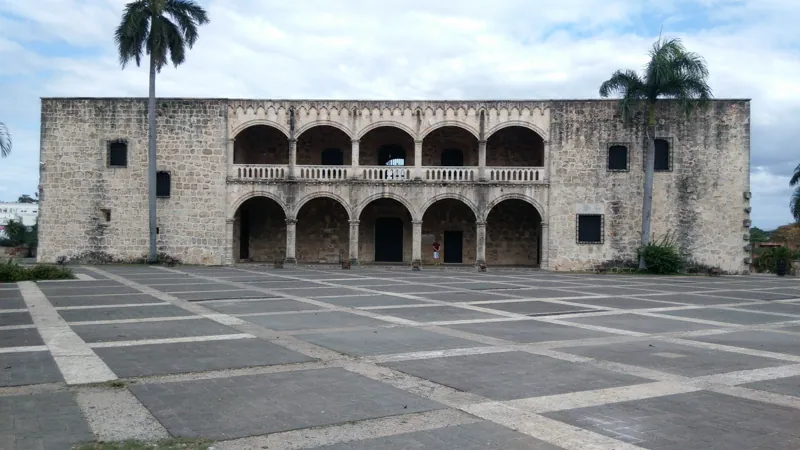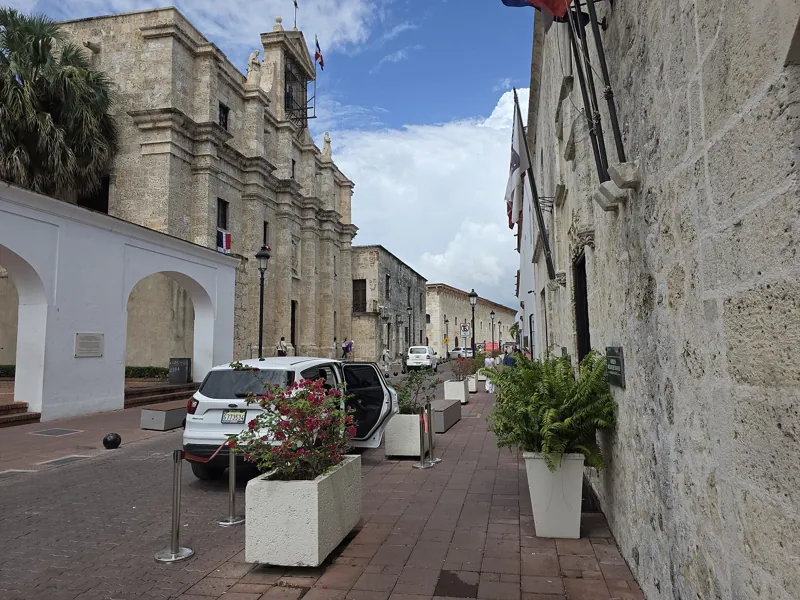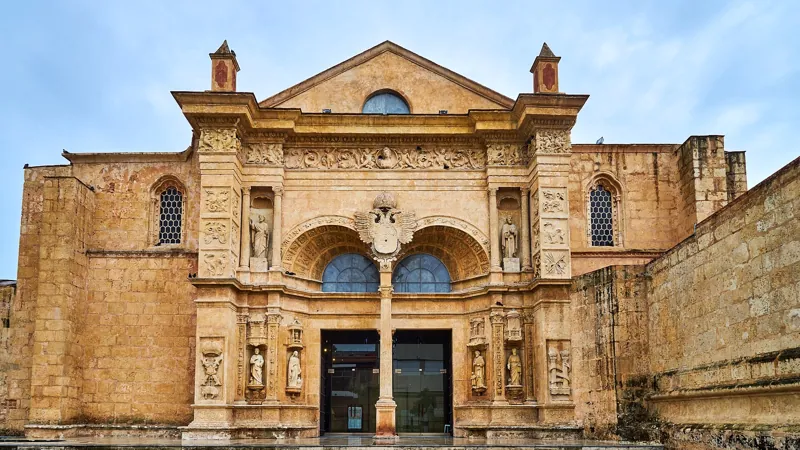




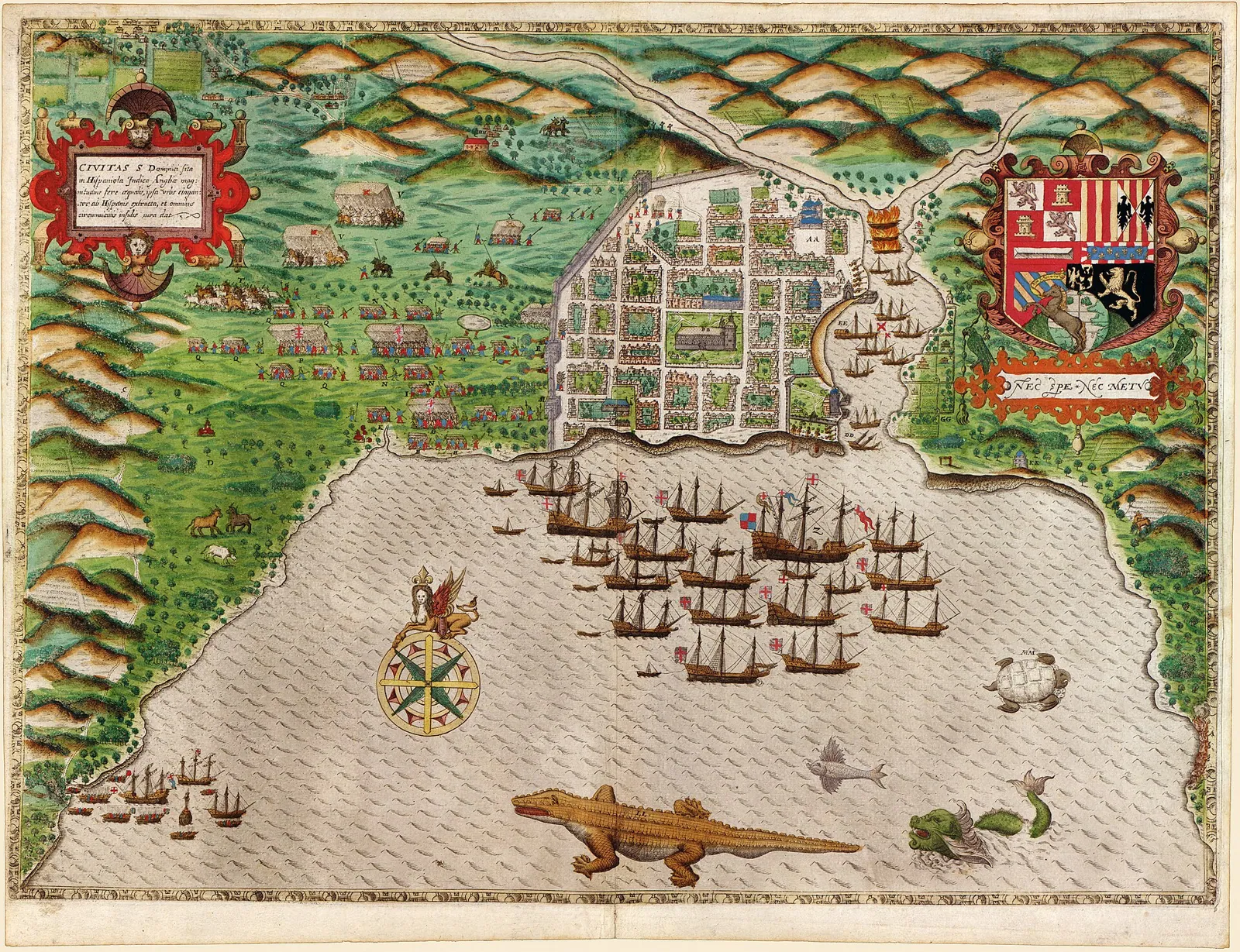
For one month in the winter of 1586, Santo Domingo belonged to the English. The oldest European city in the Americas, the colony's capital, was taken in an afternoon by a landing force of a thousand or more men who had come ashore before dawn, and then it was held for ransom while its outer houses burned. Visitors who walk the Zona Colonial meet Francis Drake in small ways: a guide who points at the cathedral and says he used it as a headquarters, a visitor guide that blames him for a ruin.
This article tells the raid from several sources. Those include the 1589 account of the expedition credited to Walter Bigges, which tells the story from the English side, and Dominican newspaper and research accounts written from the city's side. They agree on the broad shape and disagree on dates, numbers and how much was lost. The disagreements are kept in. The raid matters to the penthouse's neighborhood in a practical way, because the walls and forts you see today were reshaped because of it. The buildings Drake's men damaged have their own pages, and they are linked where they come up.
The Expedition
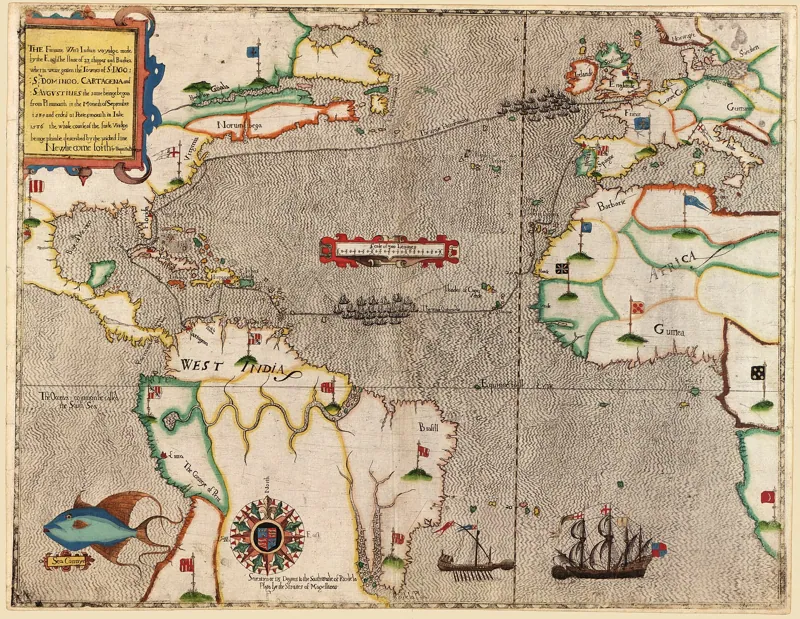
Drake left Plymouth on 14 September 1585, according to El Día, a Dominican newspaper, with 23 ships and more than 2,000 men. A research summary of the expedition gives a range, about 23 to 25 ships and a crew of roughly 1,600 to 1,900. The numbers shift with the way a writer counts supply vessels and small craft. Santo Domingo was one stop on a longer voyage. The Boazio engravings described below cover four cities the expedition attacked: Santiago in the Cape Verde Islands, Santo Domingo, Cartagena in Colombia and Saint Augustine in Florida. Acento's article on the city's founding explains why Santo Domingo was worth the trip. The west bank held the audiencia, the town council and the port as one administrative system, with the Alcázar de Colón and the Casas Reales facing the harbor.
The City Drake Found
It was smaller than its reputation. El Día says Santo Domingo had just over 2,500 inhabitants inside and near the walls, and that the whole island of Hispaniola had about 6,000 residents and about 8,000 enslaved people. That is a small population for a capital. Its weight came from what it held: the audiencia, the cathedral, the governor's offices, the port and the Fortaleza Ozama.
The English noticed the buildings. The Bigges account says the houses were "built very magnificently of stone, with high lofts," and that the city was "far too spacious for so small and weary a troop" to guard. In the king's house they saw a painted coat of arms of the King of Spain, with a horse rearing within a globe and a scroll beneath it that read NON SUFFICIT ORBIS, which the author translates as "The world sufficeth not."
By the time of the raid the city's best years were behind it. The research book The Italian Legacy in the Dominican Republic says Santo Domingo had lost much of its political and commercial importance by 1589, and that the plan for the walls assumed a growth that never came. For the longer arc of how it got there, see A History of the Zona Colonial.
The Landing and the Assault
The fleet arrived off the coast at the end of December. The research summary says it reached Santo Domingo on 31 December 1585 and launched a two-pronged assault on 1 January 1586. The Bigges account agrees on New Year's Day and says the soldiers were put ashore "nine or ten miles to the westwards" of the city, before sunrise. El Día says they landed on a beach near Haina, about 20 kilometers from the seat of government, with about 1,500 soldiers. The research summary puts the force that went ashore at about 1,000 men under Christopher Carleill, landing at night. These are the same event described by different people, and the figures differ.
El Día gives other January dates, saying a Dominican ship warned the capital on 10 January and that the assault began on 14 January. That conflicts with the Bigges account, a research summary of the voyage and the other sources, which put the capture on 1 January. This page follows 1 January. Both dates are given so a visitor who meets either is not surprised.
The defenders were not ready. El Día says about 150 Dominican men, untrained but determined, tried to stop the invaders at Güibia beach, lost, and then left the city with the main authorities. They warned the towns inland and asked Puerto Rico and Cuba for military help, without success. The colonial militias lacked weapons and ammunition. The Bigges account describes about 150 horsemen coming out of the city around noon and says the English musketeers and pikes drove them back toward the gates.
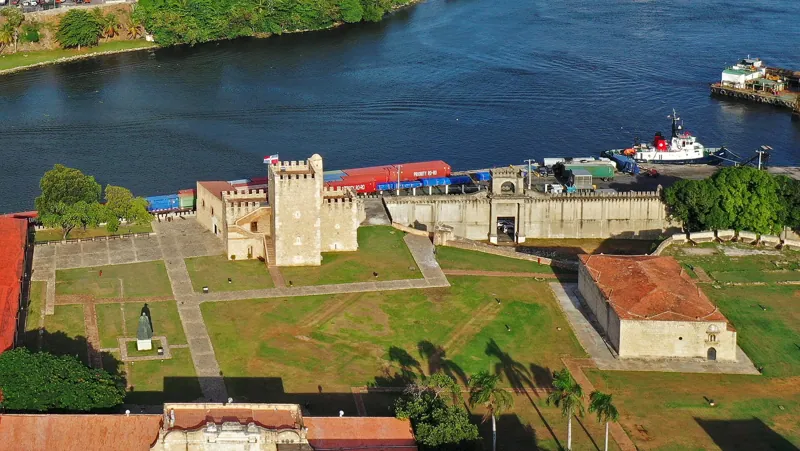
The English split into two columns and attacked the two seaward gates at once. Once inside they reached the market place, which Bigges calls "a very spacious square ground," and fortified it with barricades. The castle, the Fortaleza Ozama, was furnished with a great store of artillery, but the guards fled, some by boat, and the garrison left it after midnight. One visitor guide says the fort was never taken by force. The English account says it was abandoned. The fort has its own article: Fortaleza Ozama.
A Month in the City
After the capture the English dug in. Bigges says they made "substantial trenches" and placed their guns so each part of the camp covered the others, and held the town for one month. Their problem was size. The city was too large for the troops to guard, and they could not afford to scatter.
El Día says the cathedral, the Catedral Primada de América, was used as headquarters, warehouse and prison. The newspaper says works of art and the treasure of the church were taken, and that other churches and convents were destroyed and their furnishings and official archives burned. The Bigges account does not mention the cathedral at all. The cathedral's own story is covered in Catedral Primada de América.
One visitor guide says the English burned the Hospital San Nicolás de Bari and took its contents, including documents and church treasures. That ruin is described in Hospital San Nicolás de Bari. Diario Libre adds that the English carried off goods stored at the port and in other warehouses, along with the ships that had not been burned. The research summary says the men took money, brass cannon and church bells.
The Burning
The burning was a way to press the ransom talks, and Bigges explains the method. Each morning, from daybreak until about nine o'clock, around 200 mariners set fire to the outer houses while soldiers guarded them. They did this for days together while the Spanish and the English argued about the ransom. Even so, Bigges says, the English could not consume "so much as one-third part of the town."
That sentence is a useful check on the picture of a razed capital. The English writer himself says the burning was incomplete. A guide may tell you the raid destroyed the city. The more careful statement is that it damaged a large share of it, burned churches, convents and houses on the edges, and left much of the stone core standing. The Bigges account, written by the burners, is not a neutral witness, and the city's own tally of the damage is thin.
The Boy and the Friars
The Bigges account describes one episode that shows how tense the month was. Spanish officers from the captured galley struck a boy who was carrying a flag of truce, and he died in Drake's presence. Drake had two friars and another prisoner hanged on the spot, and he threatened to hang two prisoners a day until the person responsible was handed over. The Spanish captain brought the offender to the edge of town, and the Spanish carried out the execution themselves while the English watched. The account is from the English side, and the Spanish version is not given in the sources used here.
The Ransom
Drake wanted money. The sources agree that the ransom was 25,000 ducats. They differ on how the bargaining went.
The Bigges account says there were "many treaties" and disagreements while the English kept burning. The settled figure was 25,000 ducats, each worth five shillings and sixpence. By that conversion the sum comes to 6,875 pounds. The research summary says Drake's first demand was rejected and that after the burning the Spanish agreed to pay 25,000 ducats by 30 January 1586. El Día says that after a month Drake demanded 200,000 ducats from the governor and other residents, and that the city agreed to pay 25,000, which the poor residents raised with great effort. The newspaper does not say who set the opening figure, and the two descriptions need not conflict. What the sources share is the final number and the sense that it was a struggle to find.
The plunder was less than the English hoped. Bigges reports that they found no gold, only "a little plate or vessel of silver," and copper money "in very great quantity." The other goods were sugar, ginger, hides, wine, oil, vinegar, wheat meal, wool and linen cloth, some silks, earthenware and glass. The research summary says the expedition as a whole did not recover its cost of about 40,000 pounds, and that sailors and soldiers waited for their pay. El Día, in contrast, says Drake returned to England with loot estimated at over 600,000 pounds. The two cannot both be right, and the research summary of the expedition's finances is the more careful of the two, but the disagreement is not settled.
Leaving
The research summary says Drake swapped three of his older vessels for three newer Spanish ships and also seized a Spanish ship, which he renamed New Year's Gift. The fleet then sailed for Cartagena. El Día gives the departure date as 10 February 1586, and says that after Santo Domingo the English burned Cartagena de Indias and destroyed San Agustín in La Florida. Bigges does not give a departure date but says the English held the city for a month.
The raid had a long shadow in Spain. The research summary calls it a major psychological and financial blow to Philip II, and says it exposed how thinly defended the Spanish colonies were and led to resources being redirected to the Caribbean and the Americas.
The Boazio Engravings
The best picture of the raid is a set of prints. The Italian artist Baptista Boazio drew, and probably engraved, four views of the places the expedition attacked. Daniel Crouch Rare Books, a dealer, describes them as the first printed views of Santiago, Santo Domingo, Cartagena and Saint Augustine. The Saint Augustine view is the first known engraving of any place in what is now the United States. Two issues were printed in Leiden in 1588, one large-paper issue that illustrated the 1589 London account of the voyage and a smaller one with Latin and French captions and a numbered key. Later smaller issues followed in Cologne in 1589 and in Nuremberg in 1590. The dealer says only two complete sets of the 1588 small plates are known, held at the New York Public Library and the Huntington Library.
There is a catch, and the dealer states it. Boazio has no known link to any New World voyage, so he probably worked from drawings or descriptions brought back by someone who had made the crossing. That means the engraving is an informed picture rather than an eyewitness drawing. It shows what the English wanted their readers to understand: the landing, the ships, the position of the camp. It is not a survey of the city as it was.
A high-resolution copy of the Santo Domingo engraving from the Library of Congress's Jay I. Kislak collection, dated 1589 and marked public domain. It is the picture at the top of this page. A copy of Boazio's map of the whole voyage, dated 1589, drawn from the Library of Congress record, which is the second picture here.
After Drake
What changed in Santo Domingo? The most visible change was the walls. Acento's article on the city's founding says that after the sack of 1586 the walls were widened, bastions were armed, and patrols and curfews were regulated. The research book The Italian Legacy in the Dominican Republic fills in the engineering. A royal warrant of 1586 told Battista Antonelli to survey the coasts and build or improve fortresses, with Santo Domingo among the named sites. He arrived on 25 April 1589, three years after Drake's siege, with the engineer Tejada. He found the existing wall weak and too far from the urban center. He moved the wall closer to the city and added bulwarks along its whole length, with a small outer trench and fortified gates. Some of his work still survives within the present city, and a research group from the University of Pavia and the Universidad Nacional Pedro Henríquez Ureña is documenting the colonial defenses.
What did the raid do to the city's fortunes? El Día calls it a disaster that left Santo Domingo economically and morally ruined. That is the common Dominican view, and it makes sense for a city that had just paid a ransom it could barely raise. The Antonelli chapter is more careful. It says the city had already lost much of its importance by 1589, and it does not put the whole decline on Drake. A fair reading is that the raid exposed and sharpened a weakness that was already there. For the century that followed, see Santo Domingo in the 1700s.
Reading the Sources
It helps to know who is speaking in each account, because the raid is told very differently depending on the teller. The Bigges account was published in London in 1589 for an English readership, and it tells the story as an English success. El Día's 2023 article is a popular history in a Dominican newspaper, written from the city's side, and it does not cite its sources. The research summary is a short scholarly summary of the whole voyage. One visitor guide is a lighter source, and the Antonelli chapter in The Italian Legacy in the Dominican Republic is academic writing about engineering. When two of them disagree, as on the date, the ransom's opening figure or the size of the loot, the page says so instead of picking a winner.
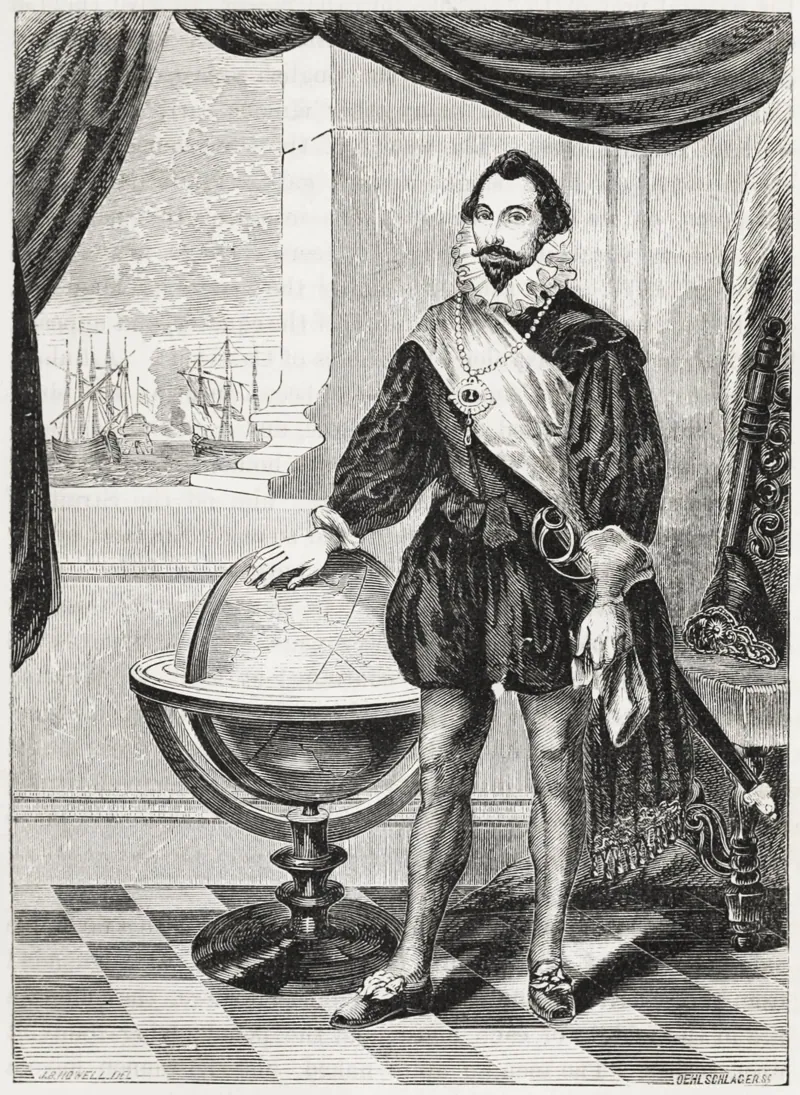
The man at the center had a long career after Santo Domingo. El Día says that in 1588 Drake, as vice admiral, helped defeat the Spanish Armada, and that he died in 1596 near Portobelo, in what is now Panama, possibly poisoned, and that his body was put into the sea. The research summary adds that Protestant England still counted the 1585 to 1586 voyage a success because of the damage to Spanish pride and resources, even though it did not pay for itself.
What You Can See Today
Most of Drake's Santo Domingo is gone, but you can still stand in several places the story touches.
- The Fortaleza Ozama. The castle whose guards fled. The tower and walls are the same ones described by Bigges. See Fortaleza Ozama.
- The cathedral. El Día says it was Drake's headquarters. Its own page has the building's story.
- The hospital ruins. Roofless arches on Calle Hostos, which the visitor guide says the English burned.
- The Monasterio de San Francisco. The ruined monastery uphill from the river, treated in The Ruins of the Monasterio de San Francisco.
- The Fuerte de San Gil. Diario Libre says construction began on 5 August 1543 and that it was the first of the forts of the sea-facing defensive line. It stood until 1887, when it collapsed, and the heritage commission rebuilt it from the original plans in the 1990s. Its start predates the raid by more than forty years.
- The Puerta de San Diego. A 16th-century gate built by the master builder Rodrigo de Liendo, according to Diario Libre.
- The Atarazana and Plaza de España. The waterfront near the old shipyards, with more in Plaza de España and La Atarazana.
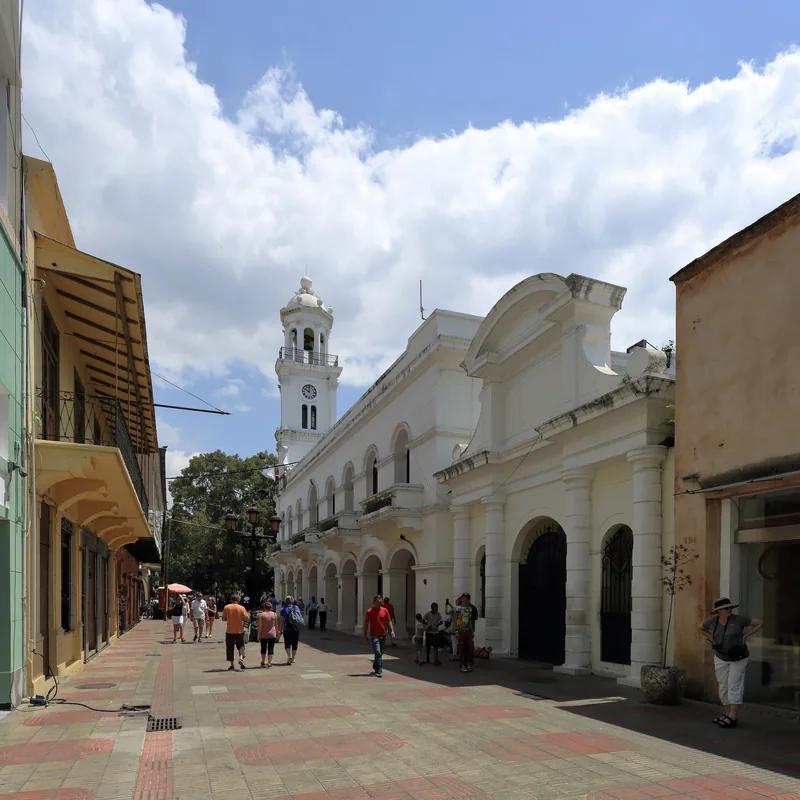
A walk that puts these in order is in the Santo Domingo landmarks guide and the Zona Colonial guide.
Getting there from the penthouse
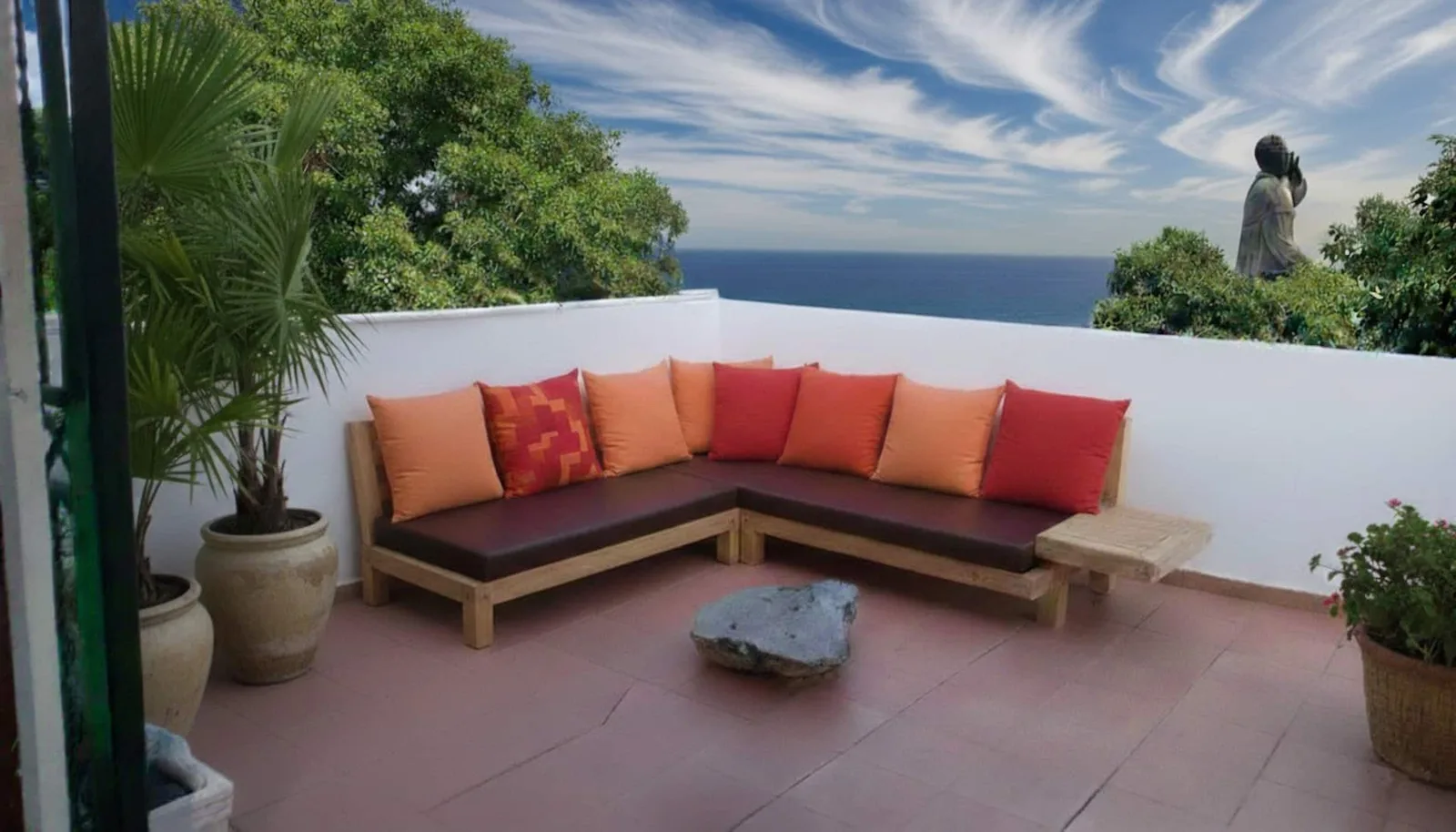
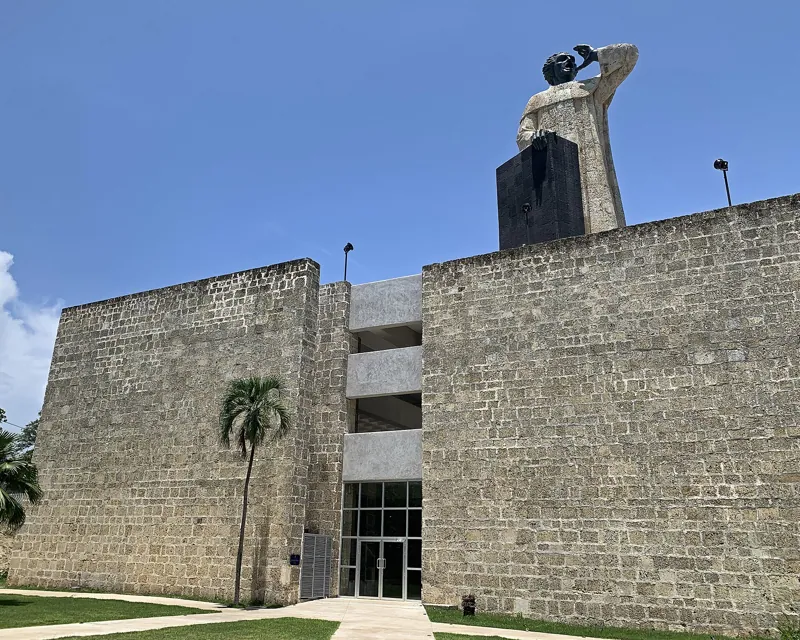
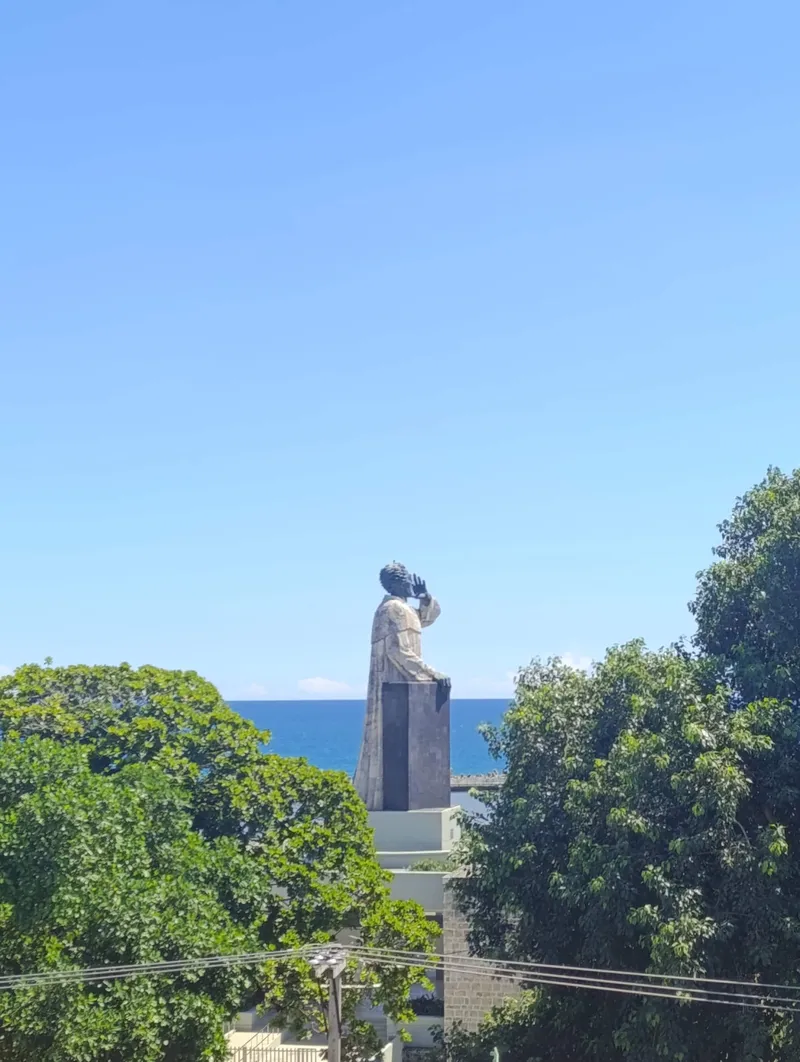
Penthouse Pallazzo sits on the sea edge of the Zona Colonial, facing the Montesinos monument. The nearest part of the Drake story is the Fortaleza Ozama, about 450 meters away in a straight line, which is about 10 minutes on foot. Walk toward the river end of Calle Las Damas, go in, and climb or look at the tower if it is open that day. From there you can walk back through the old city, past the cathedral and the hospital ruins, and see most of the places in this article in a morning. Opening hours change, so check before you go.
Frequently asked questions
When did Drake attack Santo Domingo?
The Bigges account, the research summary and others put the capture on 1 January 1586. One Dominican newspaper gives 14 January for the assault. This page follows the first group, because they agree with one another. The English stayed about a month.
How much ransom did the city pay?
Twenty-five thousand ducats, according to the Bigges account, the research summary and El Día. Bigges values each ducat at five shillings and sixpence, which works out to 6,875 pounds. El Día says Drake first demanded 200,000 ducats.
Was the city destroyed?
Not entirely. The Bigges account says the English burned the outer houses for days but could not consume "so much as one-third part of the town." Churches, convents and houses were damaged, and the city lost archives and treasure, but much of the stone core stood.
Did Drake really use the cathedral as his headquarters?
El Día says so, and adds that it was used as a warehouse and prison and that its art and treasure were taken. The Bigges account does not mention the cathedral. It is well reported on the Dominican side but not confirmed in the English account.
What did Spain do afterward?
A royal warrant of 1586 told the engineer Battista Antonelli to survey the coasts and build or improve fortifications. He reached Santo Domingo on 25 April 1589 and moved the walls closer to the city, with new bulwarks.
Is there a picture of the raid?
Yes. Baptista Boazio's engravings of 1588 and 1589 are the earliest printed views of the city. They were made by an artist who had not been to the Americas, so they are informed pictures, not eyewitness drawings.
Sources
- https://gutenberg.org/cache/epub/3334/pg3334-images.html
- https://www.ebsco.com/research-starters/history/francis-drakes-expedition-west-indies
- https://eldia.com.do/la-invasion-de-francis-drake-a-santo-domingo/
- https://crouchrarebooks.com/browse/the-first-printed-view-of-santo-domingo/
- https://commons.wikimedia.org/wiki/File:Boazio-Sir_Francis_Drake_in_Santo_Domingo.jpg
- https://commons.wikimedia.org/wiki/File:Boazio-Sir_Francis_Drakes_West_Indian_Voyage.jpg
- https://italianlegacyrden.academiadominicanahistoria.org.do/files/assets/basic-html/page-243.html
- https://acento.com.do/opinion/cronica-de-una-colonizacion-de-los-primeros-campamentos-a-las-murallas-9575405.html
- https://www.colonialzone-dr.com/san-nicolas-de-bari/
- https://www.diariolibre.com/portada/reportaje/la-ciudad-de-santo-domingo-y-sus-invaluables-tesoros-coloniales-BP27939181
- https://www.diariolibre.com/actualidad/ciudad/mirando-el-fuerte-de-san-gil-MI813871
- https://www.diariolibre.com/actualidad/las-puertas-de-la-ciudad-PADL1115291
- https://nominatim.openstreetmap.org/search?q=Fortaleza+Ozama+Santo+Domingo&format=json&limit=3