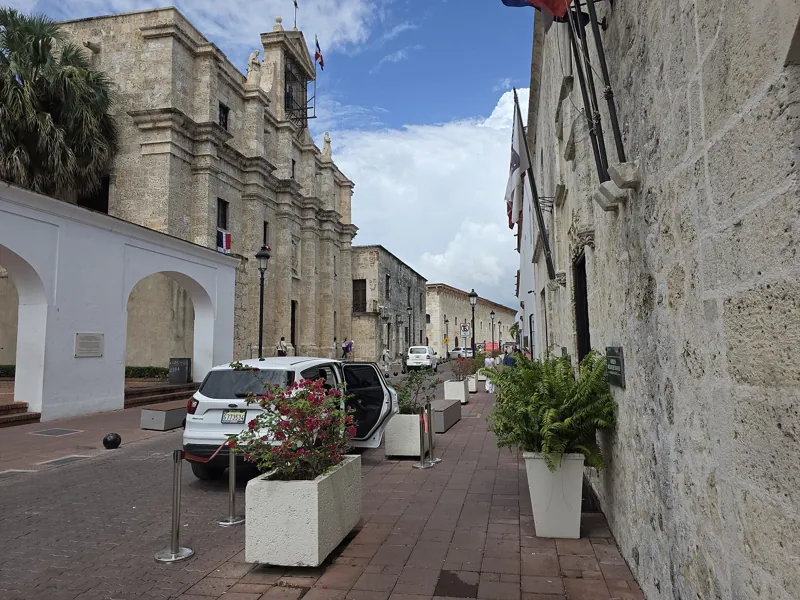
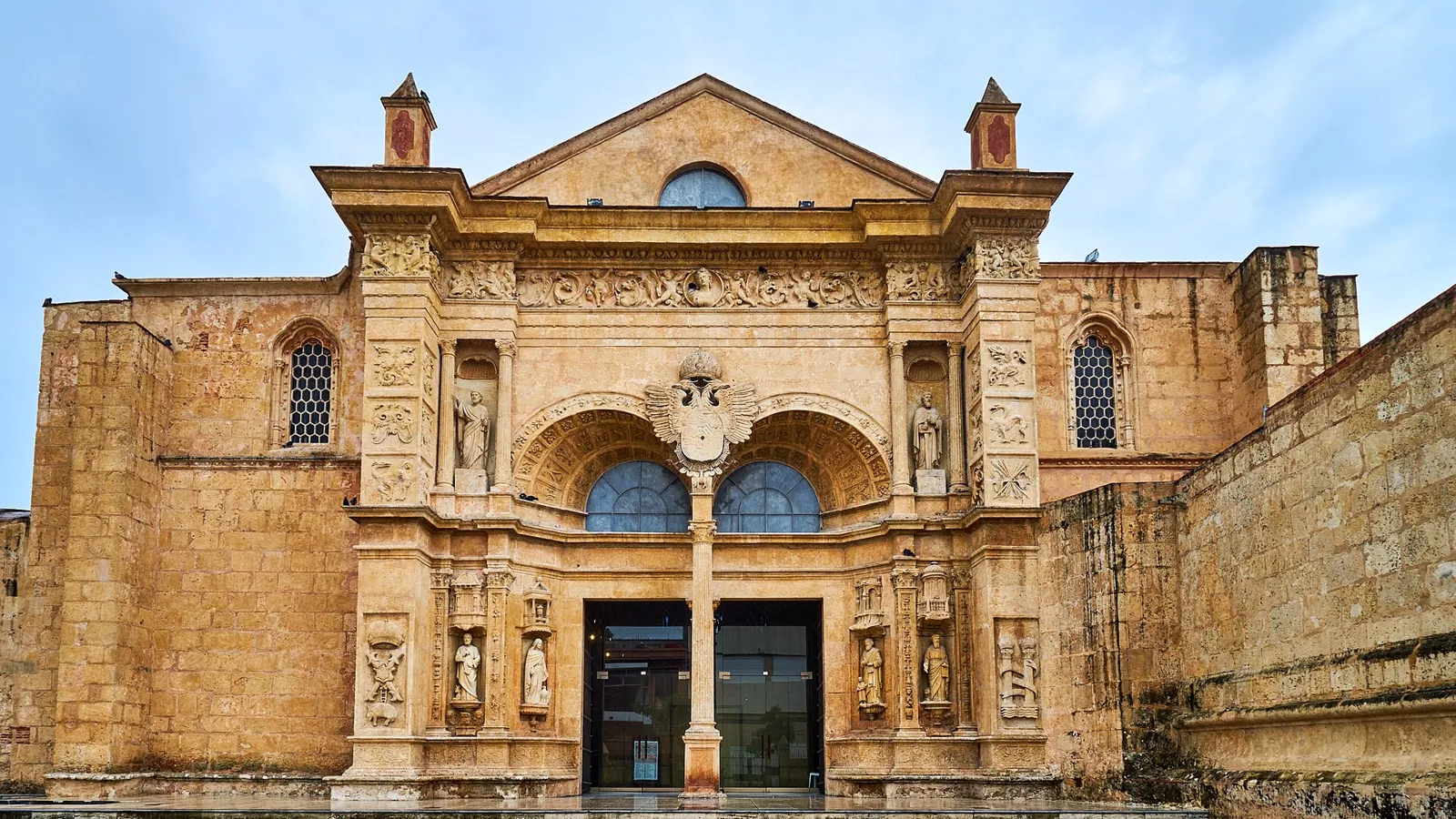
The cathedral on the south side of Parque Colón is the building most visitors to the Zona Colonial walk toward first, and it earns that. Its full name is the Basílica Catedral Metropolitana Santa María de la Encarnación, but almost everyone says Catedral Primada de América, the Primate Cathedral of the Americas. The word "primada" is the point of the whole building. Dominican writers use it because this was the first cathedral erected in the Americas, and the diocese behind it was the first one the Church created in the New World.
The stone you see today took decades to put up, and the people who paid for it, designed it and argued over it left their marks in the plan, the vaults and the side chapels. This page follows the building from the 1504 decision to create a diocese, through a construction history that sources tell in slightly different ways, to the long dispute over Christopher Columbus's bones that still follows the cathedral around. It ends with what you can do inside today and how far it is from the house.
A Diocese Before a Building
A cathedral is the seat of a bishop, so the diocese comes first. In 1920 Pope Benedict XV wrote an apostolic letter raising the church to the rank of minor basilica, and the letter doubles as a short history. It says Pope Julius II created the first episcopal see in the newly discovered Americas in 1504, the See of Saint Dominic. It says Pope Paul III raised that see to metropolitan rank in 1545. A metropolitan see sits at the head of a group of dioceses, which is why Santo Domingo's archbishop looked over the bishops that came later in the Caribbean and on the mainland.
Notice what the 1920 letter does not do. It never uses the word "primatial" and calls the see metropolitan. Dominican sources explain the title "Primada de América" in plain terms: this was the first cathedral erected in the Americas. You will find the claim on the tourism ministry's site and in newspaper features, and the letter's own wording about the first see in the newly discovered Americas supports it. Treat "first" here as a fact about sequence, not a ranking of beauty.
The practical work of building fell to the people who lived on the island: colonial officials, the Columbus family, and the bishops who followed. If you want the story of those first years in the city, the history of the Zona Colonial tells it in a wider frame. Here the focus stays on the building.
Who Built It and When
Sources disagree on the dates, and it helps to say so rather than pick one and hide the others.
The Dominican Ministry of Tourism's visitor page says Julius II ordered the construction in 1504 and that Diego Colón, the Columbus son who governed the island, laid the first stone in 1514. It says Bishop Alejandro Geraldini arrived in 1519, pushed the work along and died on March 8, 1524, before it was finished. It gives 1541 as the completion date and names Luis de Moya and Rodrigo de Liendo as the designers and builders. A separate history article that draws on church records gives a different outline: Pope Julius II ordering the work in 1511, Geraldini starting the project in 1523, and initial construction completed in 1540, with renovation continuing to the present day. The newspaper El Día says only that building began in the first quarter of the 16th century.
What the sources share is the shape. The cathedral was a project of about three decades, not a single push. Work started in the 1510s or 1520s, an Italian bishop, Geraldini, pushed it along in the 1520s, and the main body was finished around 1540 or 1541. If you hold those two facts together, the long period and the change of bishops, many of the building's odd features make sense.
Rodrigo de Liendo is a name worth remembering in this city. On the cathedral, tourism material pairs him with Luis de Moya as the people who handled design and construction. Dominican sources also credit him with directing the building of the Las Mercedes church a few blocks away, which you can read about in Colonial Churches of the Zona Colonial.
The article also records the dates on two inscribed front gates: one marks 1523, and a second records a renovation in 1992. So the cathedral has been repaired and refreshed in the modern era, and what you see is a working building that has been looked after, not a frozen ruin.
The Plan, the Vaults and the Stone
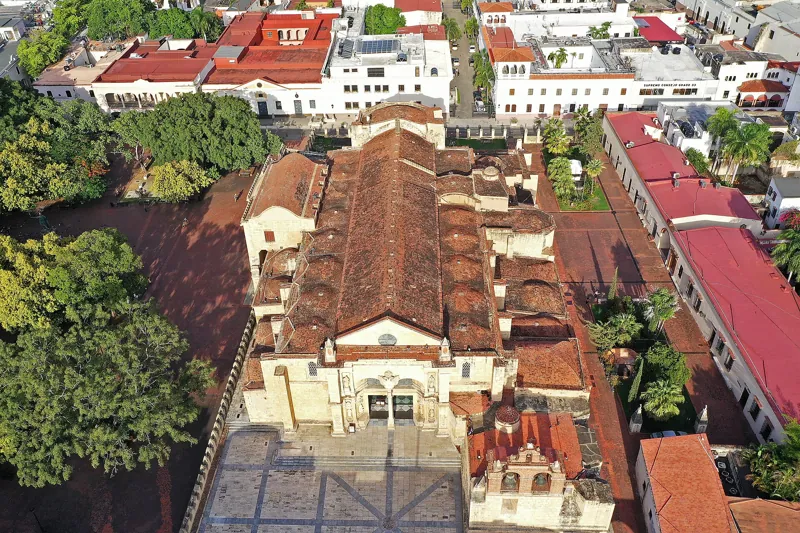
El Día describes the cathedral with some care, and its description is the best short guide to what you are looking at. The church follows the model of the cathedral of Seville. Its early work is in the Gothic Isabelline style, the late Gothic of the Spain of Ferdinand and Isabella, with Romanesque and Mudéjar details mixed in. The plan is a Latin cross. The central nave is 10.80 meters wide, which El Día notes is twice the width of each side aisle.
It is what Spanish writers call an "iglesia de salón," a hall church. In a hall church the side aisles rise almost as high as the nave, so you do not get a tall dark center flanked by low tunnels. Instead the whole interior reads as one broad space, with the vaults at nearly the same height across the width. That is a big part of why the interior feels open and calm rather than cramped. The same article says the church is oriented east to west, toward Jerusalem, in the old way.
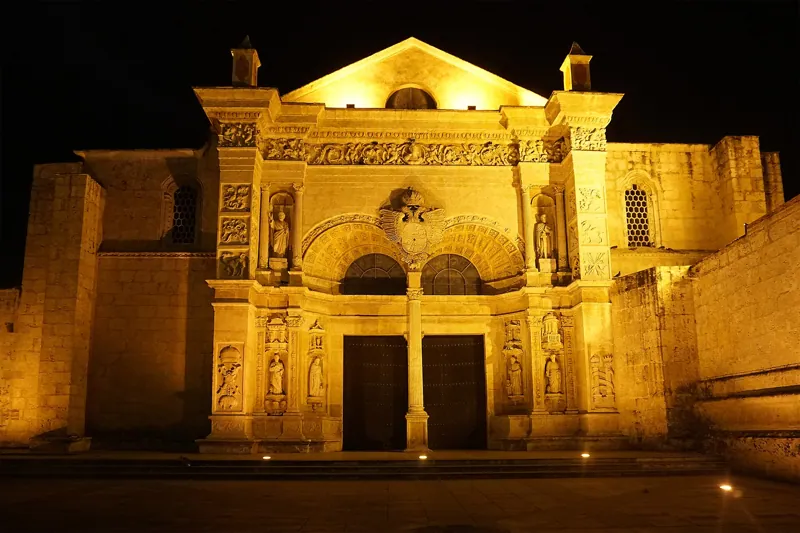
The history article gives the overall size as 54.55 meters long and 23 meters wide. Tourism material says the building has three entrances: two Gothic doors and one Plateresque. Plateresque is the name for the early Spanish Renaissance style that treats stone like silversmith's work, with fine, crowded ornament. One of the doors opens toward Parque Colón. In English you may also read the south door described as the Door of Forgiveness, a name that a travel guide attributes to old tradition. Treat the name as a local tradition, since the sources here do not document it.
The style changes as you move around the building, and the reason is Geraldini. El Día says he added Italian Renaissance elements and replaced some of the original vaults in the eastern chapels with domes on pendentives. A pendentive is the curved triangle of masonry that lets a round dome sit on a square base. You can see the difference between his work and the older Gothic work if you look up at the chapel ceilings. Some chapels have scallop shell forms, which the article links to dignity. Some domes carry garlands of flowers and fruit in the Italian manner, and others have ribbon-like decorative ribs.
The cathedral also had a life outside its walls. Canons lived in houses along the south side, around a central patio that served as their burial ground, and El Día notes that burials of prominent people were once allowed in the church. The patio, the cloister and the houses made up a small church village attached to the main building.
Inside the Chapels
Walk in from the plaza side and the first impression is of scale and coolness. The more rewarding part comes if you go slowly along the side aisles, where the chapels sit between the buttresses. Tourism material counts fourteen chapels today. The history article agrees on the count and divides it into seven on the north side and seven on the south. The chapels were added and endowed over time, so each one carries the taste and the money of a different family or office-holder.
A few are worth knowing by name, based on the article's walk through the interior.
- Capilla de Santa Ana, or Rodrigo de Bastidas. This chapel holds the body of a Spanish bishop whose father was a conquistador, and a marble sculpture above the crypt shows him at rest.
- Capilla de Cristo de la Agonía, or Alessandro Geraldini. The bishop whose energy shaped the building is buried here, according to the blog. The tourism site tells it a little differently, saying he was buried in the cathedral's pre-ministry and that a close collaborator later had a chapel mausoleum built for himself. The two accounts do not fully match, so look at the plaques on the day.
- Capilla de Fernando Arturo de Meriño. This is the mausoleum of an archbishop who also served as President of the Dominican Republic, after Gregorio Luperón. The street beside the cathedral carries his name, Arzobispo Meriño.
- Capilla de San Miguel, or Virgen de los Dolores. The blog calls it the oldest part of the cathedral.
- Capilla del Santísimo Sacramento. This is the most sacred chapel, and the blog says photography was not allowed there.
As you come in, look for the panel of the Virgin of Altagracia dated 1523, which a travel guide lists as an artwork you meet near the entrance. The date puts the image in the cathedral's early years. Tourism material adds that the cathedral holds paintings, saints, biblical scenes and period furniture, and the article mentions silver, altars and statuary. The 1920 papal letter, for its part, says the church holds a relic of the Holy Cross.
What you will notice, if you let your eyes adjust, is how different the chapels are from one another. One is polished marble with a reclining figure. Another is dark wood and gilding. A third is plain. That variety is the clearest sign that this church grew over generations, each family adding its own corner to the whole.
The Columbus Question
You cannot write about this cathedral without the dispute over Columbus's remains, and the fair way to tell it is to say who claims what.
The agreed part comes first. Columbus died on May 20, 1506, in Valladolid, Spain, and was first buried there. His body was later moved to a Carthusian monastery near Seville, and in 1537, according to both an encyclopedia entry and a CBS News report, the remains went to Santo Domingo, sent by his son Diego's widow, María de Toledo (CBS names her as María de Rojas y Toledo). They were placed first in a temporary spot and then in the cathedral.
After that the accounts split. The Spanish version says that in 1795, when Spain gave up Hispaniola to France, the remains in the cathedral were taken to Havana, and in 1898, after Spain lost Cuba, they went to the cathedral of Seville. A research summary gives the move to Havana as 1796. The date varies from source to source, and the transfer happened as French power arrived on the island.
The Dominican version rests on 1877. During work in the cathedral, builders found a lead box inscribed with Columbus's name. According to the research summary, it held 13 large and 28 small bone fragments. Santo Domingo concludes that Spain removed the wrong body, perhaps Diego's, and that the real remains never left the island. The remains now rest in the Faro a Colón, the Columbus Lighthouse, where an NBC News report notes Dominican Navy soldiers guard the tomb.
Then came the science. In 2002 a Spanish project led by the geneticist José Antonio Lorente began testing the Seville remains, with Marcial Castro as the project's organizer. In June 2003 researchers had fragments along with samples from Columbus's son Hernando and brother Diego, who are both buried in Seville. The test against Hernando failed because the remains were too deteriorated. In May 2006, CBS reported, mitochondrial DNA from the Seville remains matched that of Diego. Castro told CBS the result was an "absolute matchup."
Santo Domingo did not agree to the same test. In October 2004 the Dominican deputy culture secretary, Sulamita Puig, said the method would not give clear results and the country would wait for better science, according to NBC News. The research summary says Spanish researchers were allowed to view the remains in January 2005, but permission was withdrawn and DNA extraction was refused, citing religious objections. After the 2006 results, Juan Bautista Mieses, director of the Columbus Lighthouse, told CBS that Columbus is buried in the Dominican Republic and that the remains "have never left Dominican territory."
Where does that leave you? Seville's side says its DNA match proves Columbus is there, and the research summary reports that in 2024 Lorente announced newer methods had confirmed it. Castro also said in 2006 that the Santo Domingo tomb could still hold some of his remains, since the body was moved several times. Santo Domingo has not allowed testing of what it holds. So the strongest statement a careful writer can make is this: Seville has published DNA results, and the Dominican remains have not been tested. The 1920 papal letter, written long before any of that, says the cathedral holds the tomb of Columbus "by tradition." The tomb you can visit now is at the lighthouse, not in the cathedral, and the cathedral is where the story began.
A Basilica and a World Heritage Site
In 1920 the church received a new title. Pope Benedict XV's letter of June 14 raised the Metropolitan Church, dedicated to the Annunciation of the Blessed Virgin Mary, to the dignity of minor basilica. Archbishop Adolfo Alejandro Nouel had asked for it, and the church gained the same privileges as the minor basilicas of Rome. The letter calls the building solid and finely decorated, a remarkable monument of the Dominican region. It is the reason the church is formally a basilica and informally a cathedral.
In 1990 the cathedral became part of the UNESCO World Heritage listing for the Colonial City of Santo Domingo. The listing covers the old city as a whole, and the cathedral sits at its center. If you want the story of how the district got that status and why, the history of the Zona Colonial covers it.
A cathedral is a living place as well as a monument. Masses run through the week, and the church closes to sightseers during services. That is the main thing to plan around, and it is the reason the opening hours below look broken up.
Visiting the Cathedral Today
Hours and fees for this building are reported differently by different sources, so check before you go. Dominican tourism material says the cathedral is open Monday to Saturday from 8:00 a.m. to 5:00 p.m. and closed to the general public on Sundays for worship. A travel guide lists 8:00 a.m. to 4:30 p.m. on weekdays and 9:00 a.m. to 4:30 p.m. on weekends, with no fee, while the history article gives 9:00 a.m. to 4:00 p.m., Monday through Saturday, with a small ticket that includes an audio tour. Those do not agree. The safest plan is to treat tourism material's weekday hours as a guide, expect a closure for Mass, and ask at the door.
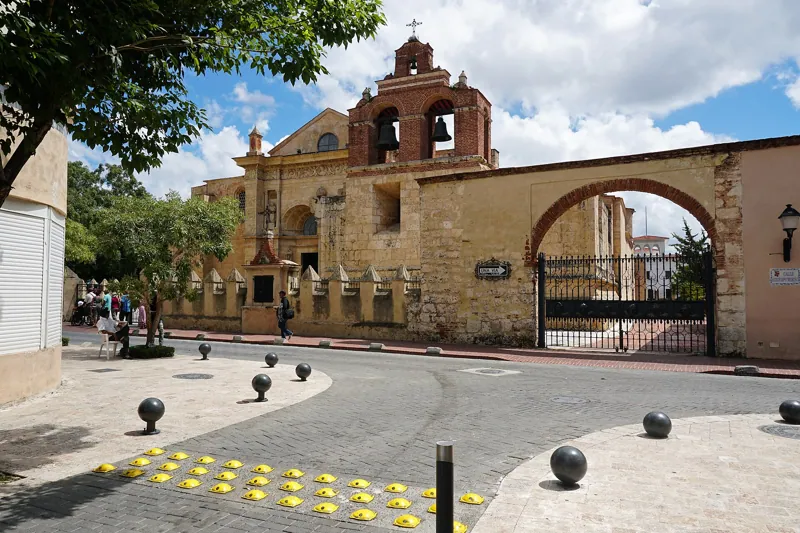
The main entrance is on Arzobispo Meriño Street beside Parque Colón, and a second entrance is on Isabel la Católica Street. You can visit on your own or book a guide in English, Spanish or French from the agencies around the cathedral, as tourism material notes. A travel guide adds that an audio guide is available, that flash photography is not allowed, and that women in shorts will not be admitted. Dress as you would for any active church, with shoulders and knees covered.
Some practical notes that follow from the building itself:
- Go early. The nave is at its calmest in the first hour, when the light comes in low and the plaza outside is nearly empty.
- Give yourself time at the chapels. If you only walk down the center aisle you miss most of what the church holds.
- Look up. The change from Gothic ribs to Renaissance domes is easiest to see in the east end.
- Treat the Santísimo chapel with care, and do not photograph there.
The cathedral pairs well with the other great church on the same walk. The Dominican convent church, a short walk north, has its own zodiac ceiling and a university claim, covered in Convento de los Dominicos. The 1511 sermon of Fray Antón de Montesinos, which happened in that same period of the city's life, has its own page at Fray Antón de Montesinos and His 1511 Sermon. The ships that threatened the city in the next century, including Drake's fleet in 1586, appear in Francis Drake's Raid on Santo Domingo in 1586. For a wider view of the landmarks in one morning, see the Santo Domingo landmarks guide.
Getting there from the penthouse
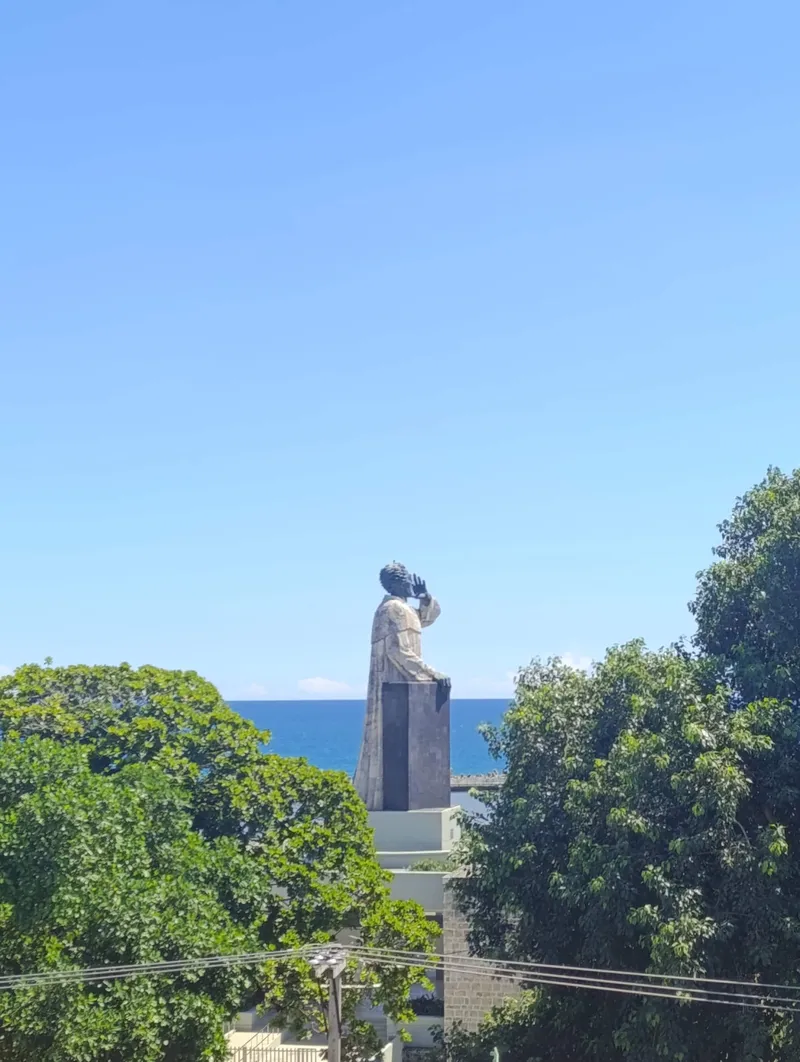
The cathedral stands on Parque Colón. From Penthouse Pallazzo, which sits about 150 meters north of Playa Montesinos facing the Montesinos monument, the straight-line distance to the cathedral is roughly 390 meters, using OpenStreetMap's coordinates for the building and the house's position. Multiply by 1.3 for the real streets and divide by 80 meters a minute and you get about 10 minutes on foot. The route runs along the Zona Colonial's own streets, so you will pass shaded doorways and coffee counters on the way.
Come out of the penthouse in the morning and the cathedral is a good first stop, before the groups arrive. If you would rather ride, any short taxi or ride-app trip into the old city ends at the edge of the pedestrian area near the park. The best use of the walk is to take it slowly and keep the sea behind you, since the Caribbean is south and the cathedral sits uphill and inland from the water.
Frequently asked questions
Is the Catedral Primada really the first cathedral in the Americas?
Dominican sources say it was the first cathedral erected in the Americas, and the 1920 papal letter says Pope Julius II created the first episcopal see in the newly discovered Americas in 1504. The claim is about sequence. The building went up between roughly the 1510s and 1541, and sources differ on the start year.
When was the cathedral built?
Sources give different dates. Dominican tourism material says construction was ordered in 1504, the first stone was laid by Diego Colón in 1514, and the work was completed in 1541. Another account gives 1540 for the completion of the initial work. All agree that it took about three decades.
Is Christopher Columbus buried in the cathedral?
Not now. His remains were in the cathedral from 1537 until the late 1700s by Spain's account. Seville holds remains that DNA tests in 2006 matched to his brother Diego, and Santo Domingo keeps another set at the Faro a Colón, which has never been tested. Each side claims the real remains.
What are the opening hours?
Sources disagree. Tourism material says Monday to Saturday, 8:00 a.m. to 5:00 p.m., closed to the public on Sundays for worship, and other sites give slightly different hours. The church also closes to visitors during services, so check before you go.
What should I wear to visit?
Wear what you would to any active church. Shoulders and knees should be covered, and travel guides report that women in shorts are not admitted. Flash photography is not allowed, and the Santísimo chapel is off limits to photographs.
Can I visit without a guide?
Yes. Tourism material says you can go in on your own or book a guided visit in English, Spanish or French from agencies near the cathedral. A travel guide also lists an audio guide.
Sources
- https://visitdominicanrepublic.com/destinations/catedral-primada/
- https://www.vatican.va/content/benedict-xv/la/apost_letters/documents/hf_ben-xv_apl_19200614_inter-americae.html
- https://eldia.com.do/basilica-menor-de-nuestra-senora-de-la-encarnacion-primada-de-america/
- https://abbyeppletthistorian.blogspot.com/2023/10/catedral-primada-de-america.html
- https://travellingfoot.com/best-places-to-visit-in-dominican-republic/tourist-attractions-in-santo-domingo/catedral-primada-de-america
- https://ebsco.com/research-starters/history/identification-christopher-columbuss-remains
- https://www.cbsnews.com/news/columbus-remains-found-in-spain
- https://www.nbcnews.com/news/amp/wbna6228731
- https://gcatholic.org/churches/caribbean/54798
- https://nominatim.openstreetmap.org/search?q=Basilica+Catedral+Santo+Domingo+Zona+Colonial&format=json&limit=3
- https://nominatim.openstreetmap.org/search?q=Monumento+a+Fray+Antonio+de+Montesinos+Santo+Domingo&format=json&limit=3