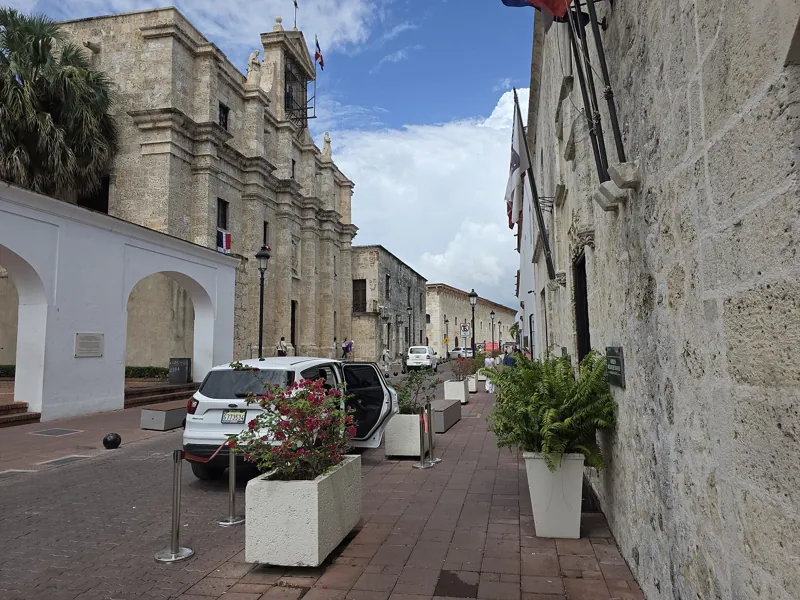
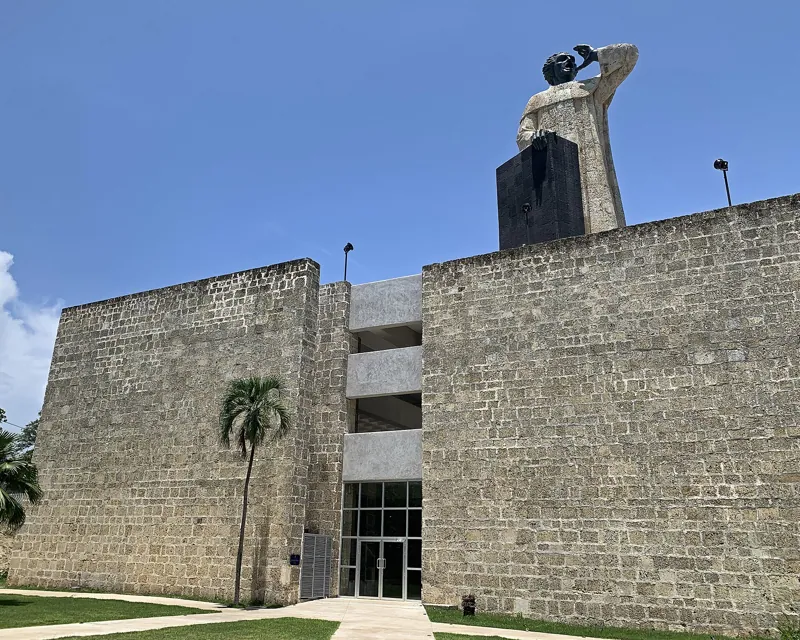
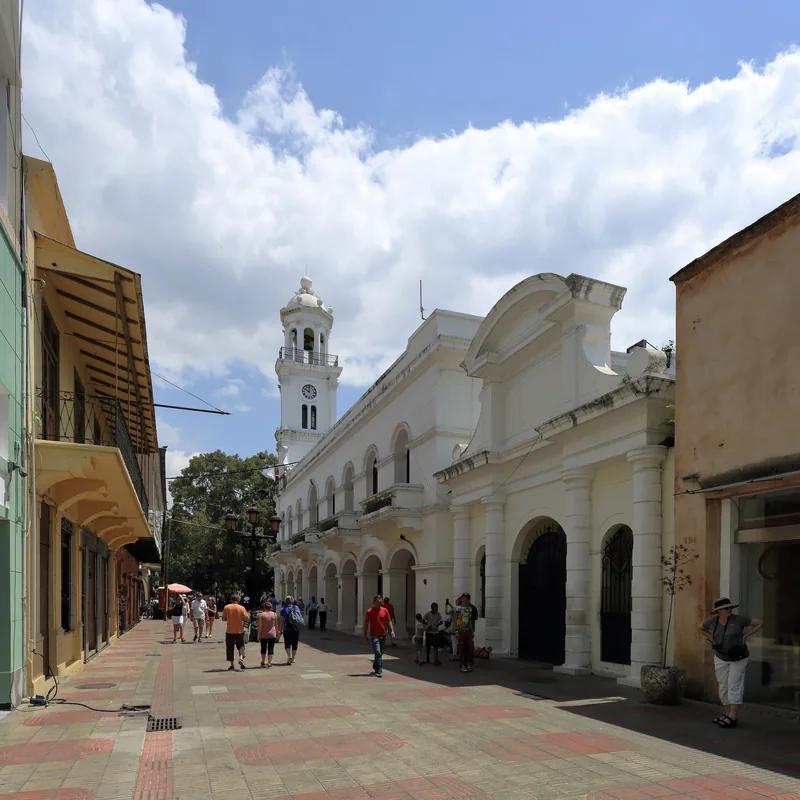
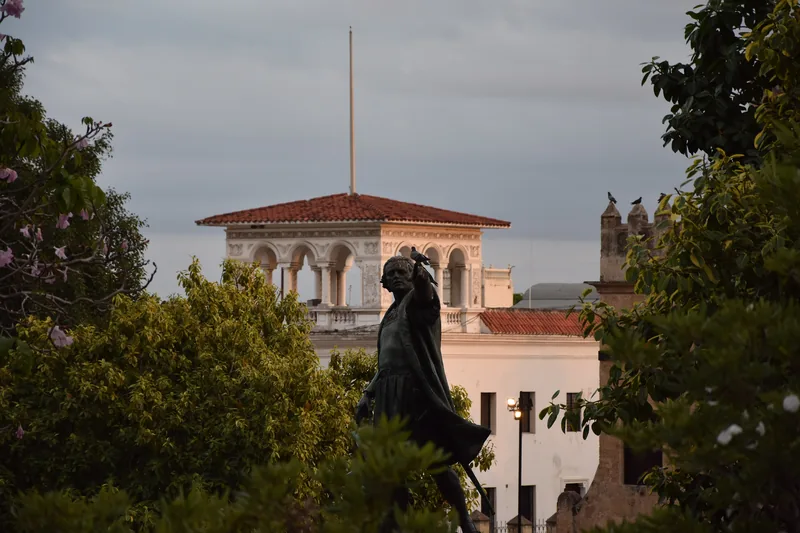
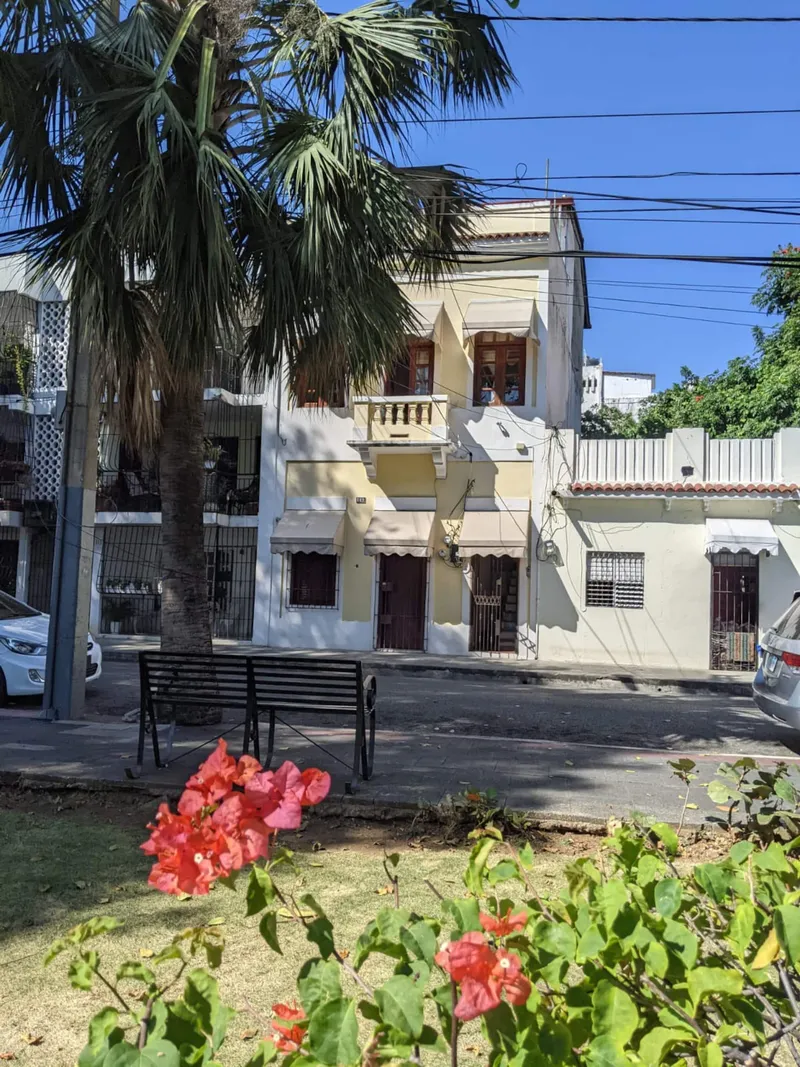
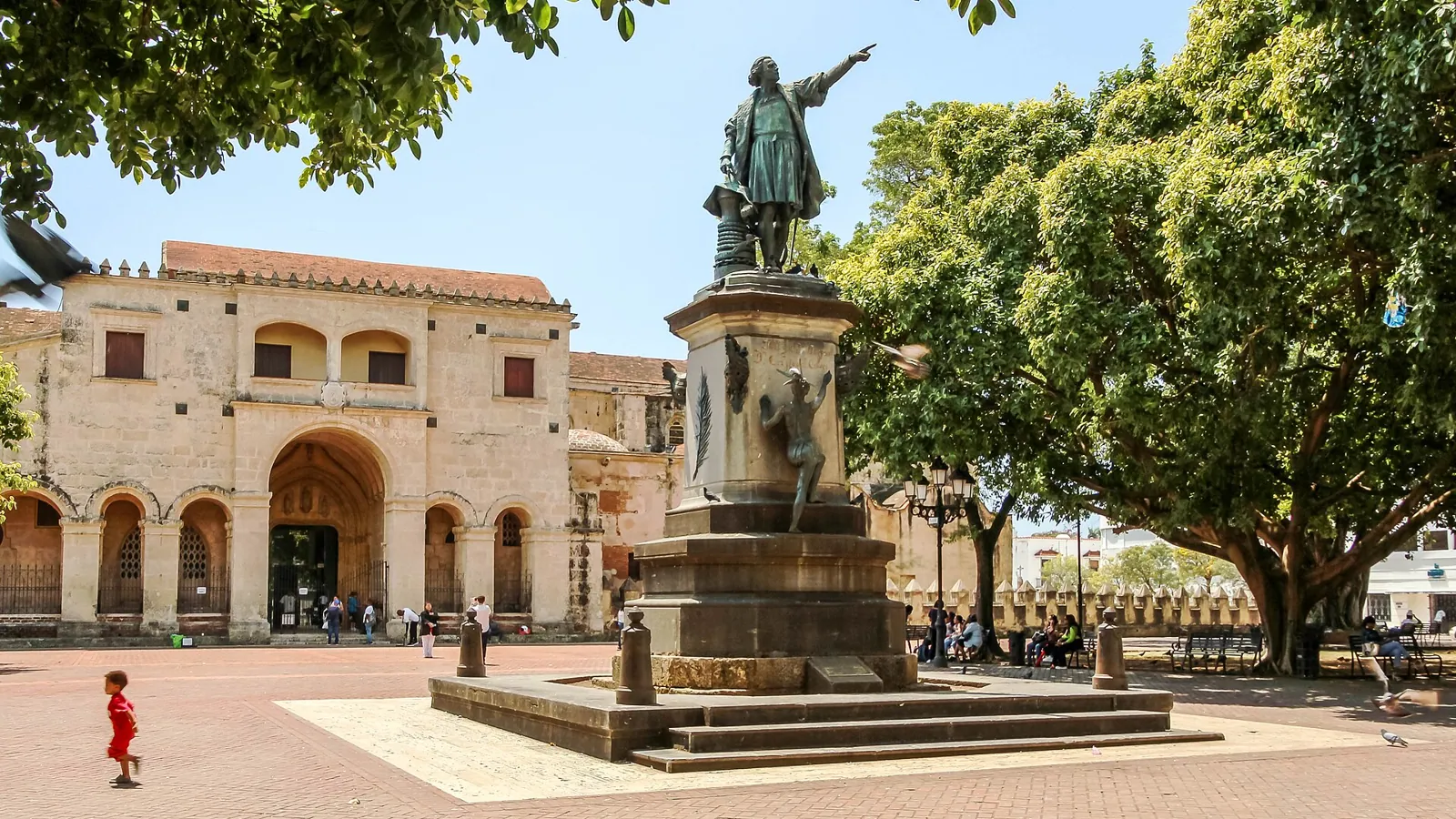
Parque Colón is the room that the rest of the Zona Colonial opens off. The cathedral fronts it, the city hall stands on one corner, and a long pedestrian street runs west from it to the gate where independence was proclaimed. A bronze Columbus stands in the middle on a pedestal, pointing out over the square. People sit on the benches around him, guides wait under the trees, and a good share of everyone who comes to the Ciudad Colonial crosses this square at least once.
The park is much older than the statue, and the street is much older than its present life as a promenade. This page follows both. It starts with the square when it was called the Plaza Mayor, moves to the monument and the arguments it raises, looks at the buildings on its edges and then walks the street called El Conde through its shop years, its 1960s political moment, its pedestrianization and the plans to revive it.
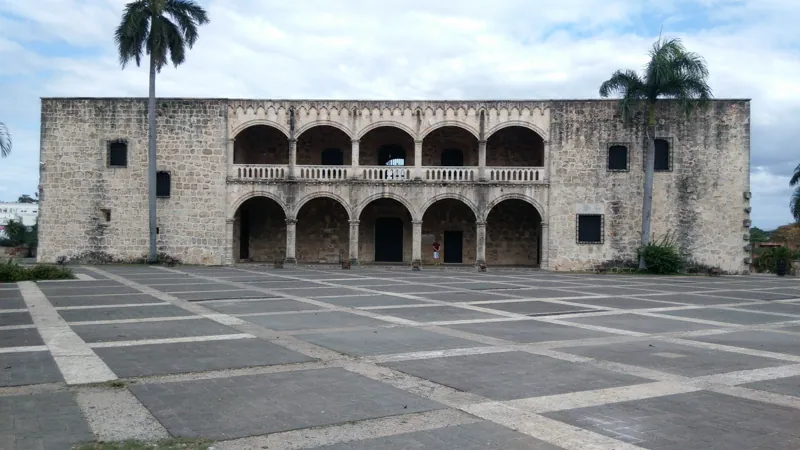
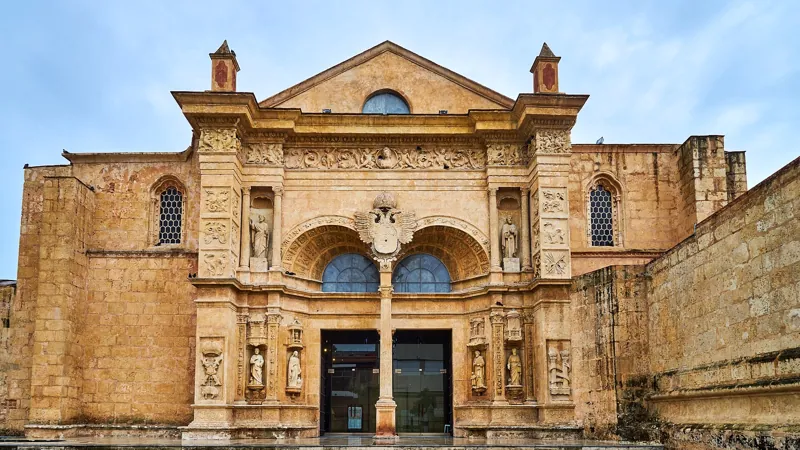
The buildings are covered on their own pages: the Catedral Primada de América on the south side of the square, the Alcázar de Colón elsewhere in the district, and the Puerta del Conde at the far end of the street. This page stays with the open space and the street that leads from it.
The Plaza Mayor
According to a guide to the Colonial Zone, the square was named Plaza Mayor by Nicolás de Ovando in 1506. It was also called the Plaza de Armas, and after the first cathedral was completed in 1523, it became the Plaza de la Catedral. The same guide says the plaza was originally bare earth with no trees, and that the first tree was planted during the Haitian occupation, in 1822, with more added after independence.
The guide also says that construction of the cathedral began in 1521 and took over more than half of the park, including parts of the old plazas and the houses along Calle Padre Billini. That is a claim about the shrinking of the older open space as the church took its place, and it is not confirmed in a second source, so take it as one writer's account. The cathedral's own page in this series has the building dates and the debate about them.
What the sources agree on is the basic role: this was the main plaza of the city, with the church beside it. A little later in this page you will see the buildings that still frame it.
The square today is a brick plaza, about 90 by 60 meters, according to the same guide, with large trees, shaded benches and a relaxed atmosphere. The pedestrian Calle El Conde borders the park, along with Isabel la Católica and Arzobispo Meriño. It gets visitors, locals, families, tour guides, taxi drivers and vendors. The guide's account of the vendors is blunt: they sell trinkets and snacks, and some will offer a flower and then ask for payment.
The Name Changes in 1887
The square took its present name when the Columbus statue was unveiled on 27 February 1887, according to the guide. It is also the date of the proclamation of independence at the Puerta del Conde, 43 years earlier. Several sources give the same date, and a metal plaque on the monument says it was inaugurated then.
The sculptor is usually given as Ernest Gilbert. His name appears in variants: the plaque says Ernesto Gilbert, and a Dominican education article writes Ernest Guilbert and gives his years as 1848 to 1920, calling him a French sculptor known for public works. A statue catalog entry lists the date as 1886 in one field and notes that the plaque says 1887, which fits a statue cast in France in 1885 and 1886 and unveiled in Santo Domingo in 1887. The same education article says the bronze was cast in France between 1885 and 1886 and that the city council placed it in the plaza during the government of Ulises Heureaux.
Writers disagree on how it arrived. The education article says the city council put it there. An art historian says it was a gift from France, and suggests France was still bitter over losing Saint-Domingue. No source settles the point, so both are noted.
What the Statue Shows
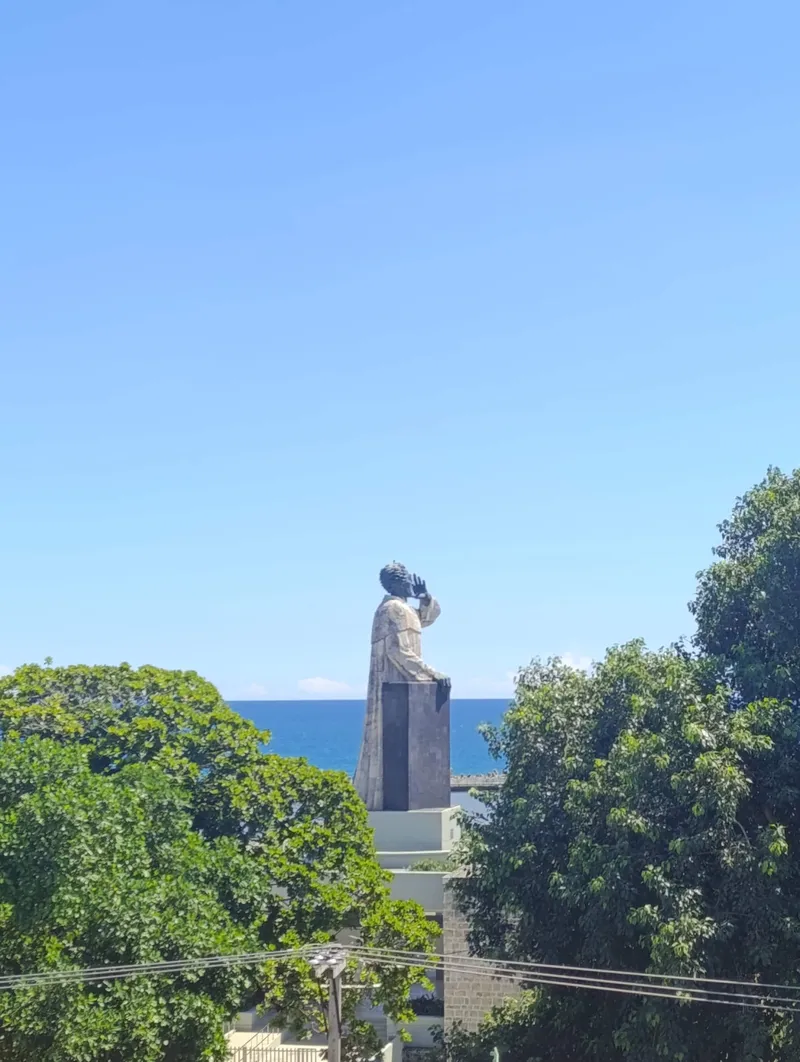
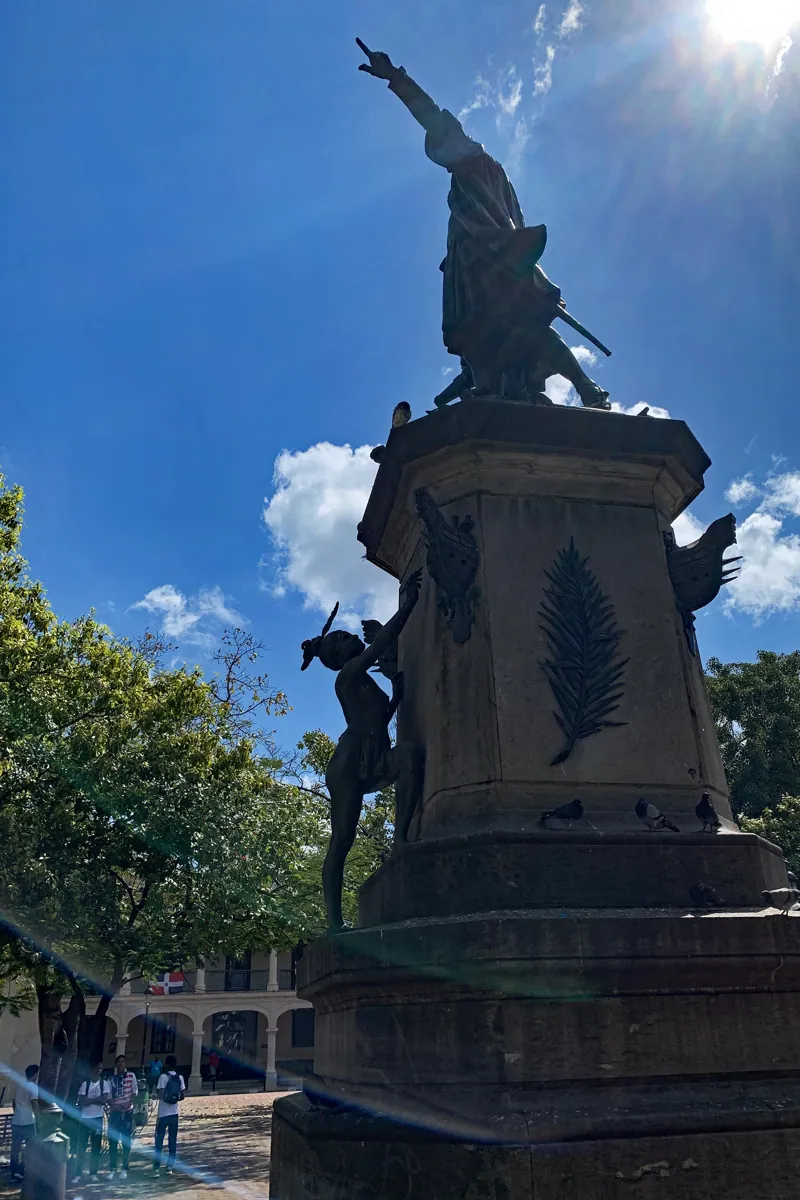
The monument is a bronze group, not a single figure. A statue catalog describes Columbus as pointing north, with a Taíno figure climbing up toward him. One description identifies the figure as Anacaona, a claim the catalog attributes to a beach guide, and says that her village was burned and she was later hanged on orders from Ovando. The Dominican education article says the group includes Anacaona and caravels on the pedestal, which is concrete with a granite finish.
The pedestal inscription reads "Ilustre y Esclarecido Don Cristoval Colon," according to the catalog, and a metal plaque honors Columbus as discoverer of the New World and first viceroy and governor of America. The same catalog notes that the monument appears on postcards and on a Dominican stamp.
The monument has been criticized. The art historian Veerle Poupeye, writing in 2020, says the Taíno figure appears to be trying to climb up to Columbus's level and also writing the inscription on the base, and argues that the design presents colonial subjugation as beneficial. She calls the imagery troubling and notes that the statue is still prominent in tourist guides. Her reading is her own, and other people read the monument differently, but it is useful to know the objection before you stand in front of the statue. The page on the Taíno of Hispaniola gives the other side of the picture, the people who lived on the island before Columbus came.
The Buildings Around the Square
The cathedral takes up the south side of the park. Two other historic buildings are worth knowing before you cross the square.
The Palacio Consistorial
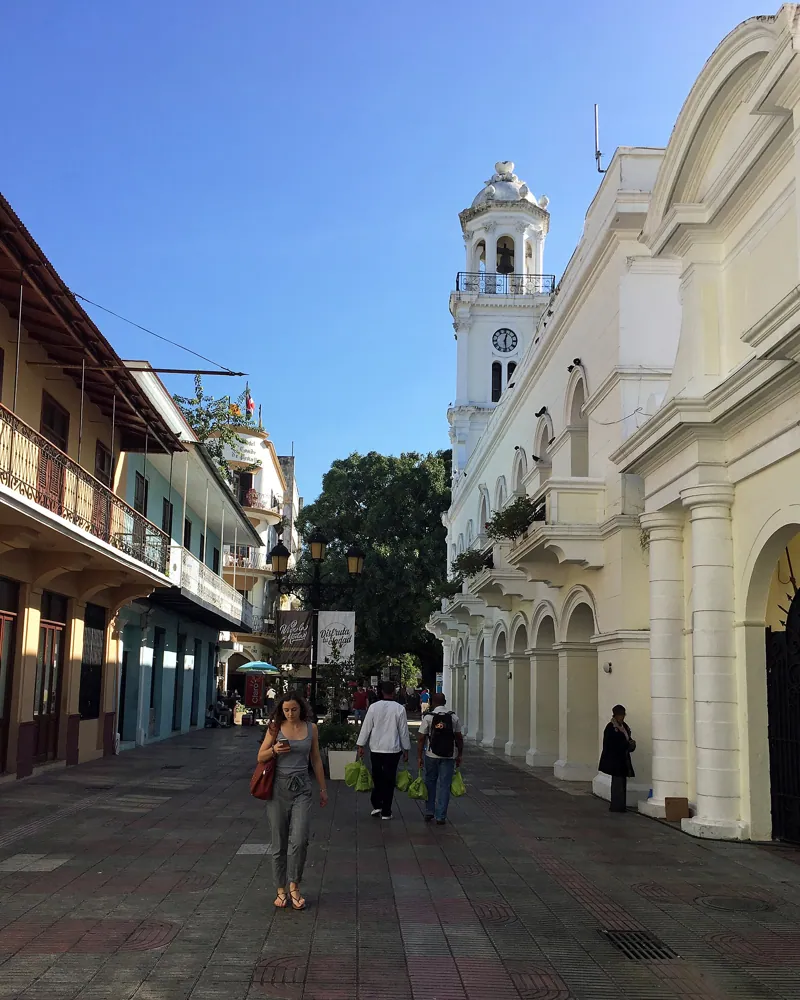
The Palacio Consistorial stands at the corner of Calle El Conde and Calle Arzobispo Meriño. A travel guide dates the building to 1502 to 1504 and says it was first built as the residence of the alcalde mayor. The guide says it was completely remodeled in the neoclassical style in the nineteenth century and that a 29-meter tower was added in 1913. It houses the city hall, and visitors who go in can find a small patio and an information office. The 1502 to 1504 dates are repeated in several guides but no scholarly confirmation is cited, so treat them as the usual attribution.
The Palacio de Borgellá
On the east side of the square, on Calle Isabel la Católica, stands the Palacio de Borgellá. A travel guide says it is a sixteenth-century house that belonged to the colonizer Diego de Herrera. The Haitian governor Gerónimo Borgella made it his residence and remodeled it, and it served as the government palace from 1822 to 1844. After that, the guide says, it housed the Senate and other government offices. The building is named for the Haitian governor, and so the name is itself a record of the 22 years of Haitian rule that ended at the Puerta del Conde.
Calle El Conde Before the Promenade
The street takes its name from the Conde de Peñalba, who turned back the English invasion of 1655, the same man the Puerta del Conde is named for. An article in El Nacional says the street was formerly called Calle del Clavijo, that its history is said to go back to 1543 and that it lies between Parque Colón and Parque Independencia, which makes it the gateway to the Zona Colonial. Hoy says some periods called it the Calle Real e Imperial, and a nickname for it was the Vía Blanca de los escaparates de lujo, meaning the white way of the luxury shop windows.
For most of the twentieth century it was where the city went shopping. Hoy describes the 1950s as the time when El Conde was the city's main commercial, social and political street. Shops included Cerame, Calzados Vogue, La Ópera, Joyería Oliva and Casa Plymouth. A men's clothing store, Casa López de Haro, opened on 25 November 1956 at the corner of Sánchez. There were movie theaters: the Roxy, the Panamericano and the Santomé, formerly called El Encanto. A bowling club operated in the basement of the Edificio Baquero from 4 p.m. to midnight, and Chinese restaurants such as the Colón, the Quisqueya and the El Conde were popular.
The Hoy article also records a small, odd fact from the same era: in 1958, according to the newspaper La Nación, eight men were prosecuted for catcalling women on the street. It says nothing about how the case ended, and it is passed on only as a detail of what the street was like.
In 1961 Trujillo announced plans to close the street to traffic and make it a promenade, comparable to famous avenues in other capitals, the Hoy article says. The plan was not carried out then.
The street's best-known building from this period is the Edificio Copello, built in 1939 by Guillermo González, per El Nacional. During the April 1965 revolution the street saw political negotiations and armed clashes, and the Edificio Copello served as headquarters of the Constitutionalist government led by Colonel Francisco Alberto Caamaño. That is the same Caamaño whose empty tomb is in the Panteón de la Patria. El Nacional, writing in 2010, proposed turning the building into a museum about the April 1965 uprising.
Hoy also says that the first Dominican flag was embroidered in a hut near the street by Concepción Bona. That story is part of the national tradition, and the sources on the flag do not all agree about who sewed it, as the page on the Puerta del Conde explains.
The Pedestrian Street
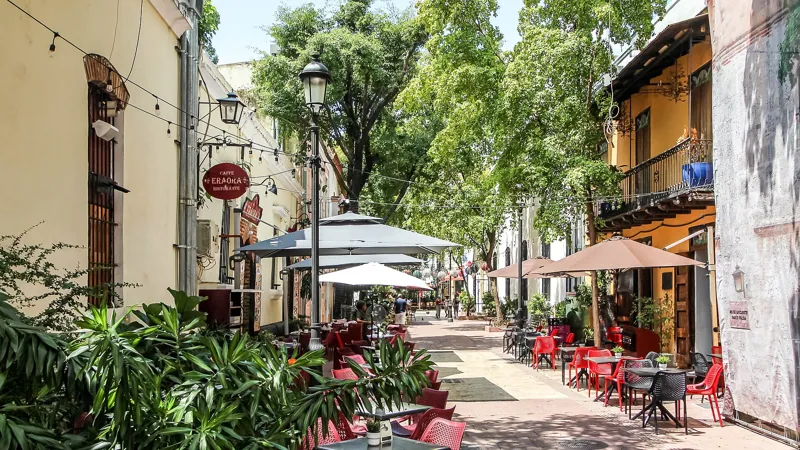
El Conde became a walking street in the late 1980s. Diario Libre says it was in 1989, when the authorities removed the asphalt and kept the street for pedestrians only, and that the decision is credited to Rafael "Fello" Suberví Bonilla, who was mayor of the Distrito Nacional from 1986 to 1990. The idea began, the newspaper says, as a Valentine's Day event on 14 February that closed one segment to cars. Its success led to the permanent change. Merchants reportedly wanted it, though it was first questioned and later praised, and the architect Marcos Barinas, quoted in the article, considers it one of Suberví's two main achievements as mayor. Other accounts put the date in the mid-1980s, and the 2024 Diario Libre report says the street has been closed to vehicles since then, so sources differ by a few years.
The street was part of the project to restore the Ciudad Colonial, which UNESCO listed as a World Heritage Site on 8 December 1990, according to El Nacional. Today El Conde is about one kilometer long, according to Diario Libre in 2024, and runs from Palo Hincado to Avenida del Puerto.
El Conde Today
The street has been through a hard stretch. Diario Libre, in 2024, said it had deteriorated in places, with abandoned buildings, fewer businesses, insecurity, noise and hygiene problems, and that many upper-floor properties were empty. One official quoted said that at night the street was left dead. El Nacional's 2010 article made a similar complaint about neglect and about vendors, so this is not a new problem. Hoy describes the street as dominated by tourism, bars, money changers and betting shops, with a few older establishments remaining, including Ciros, Flomar, Capriles and Joyería Di Carlo, and the Baquero, Diez and Saviñón buildings. It says a Santa Claus figure at La Margarita is still standing. The Hoy article is undated, so shop names may have changed.
A revival project has been planned. Diario Libre reported in February 2024 that the Inter-American Development Bank had budgeted US$5.4 million for it, executed with the Ministry of Tourism, the Distrito Nacional city government and the European Union. The design varies by section: a plaza with a patriotic character near Palo Hincado, a commercial stretch between Espaillat and Santomé, and the areas around the historic monuments from Hostos to Meriño and Isabel la Católica. It includes rest areas, solar-powered lighting, new trees, pavement that absorbs excess water and kiosks to relocate street vendors. Work was expected to begin that August. No report on its completion is cited here, so what you see on the street may be different from the plan. Check what is open.
The Street and the Politics of the City
El Conde was a place where the city's political life happened in public. The Hoy article says the street hosted celebrations after the end of the Trujillo era, as well as protests and rallies, and that a newspaper, Unión Cívica Nacional, operated at the corner of Espaillat and El Conde. It also says Casa López de Haro, the men's clothing store that opened in 1956, had two floors and a hand-forged console in the Louis XV style.
Then comes April 1965. El Nacional records that the street was the scene of political negotiations and armed clashes, and that Colonel Caamaño's constitutionalist government worked from the Edificio Copello. The 2010 article argued that the building should become a museum site.
The sequence of dates is easy to lose, so here it is in one place, with the source of each.
- 1543. El Nacional says the street's history is said to go back to this year.
- 1655. The English attack on Santo Domingo, after which the gate and the street take the name of the Conde de Peñalba.
- 1822 to 1844. The Haitian occupation. The Palacio de Borgellá serves as the government palace.
- 27 February 1887. The Columbus statue is unveiled in the square.
- 1939. The Edificio Copello is built.
- 1950s. The street is the commercial heart of the city.
- 1961. Trujillo announces plans to close the street to traffic.
- April 1965. The street becomes a political and military stage.
- 1989. The asphalt is removed and El Conde becomes a pedestrian street.
- 8 December 1990. The Zona Colonial is listed by UNESCO.
- 2024. A revival project funded with US$5.4 million is announced.
Why the Revival Plan Matters
The revival plan is worth a few more words, because it tells you what the people in charge think the street needs. Diario Libre says the design is divided by section according to each area's role. The stretch with the historic monuments is meant to show off the buildings. The commercial stretch is meant to bring shops back. The end near Palo Hincado gets a plaza with a patriotic character, which connects to the Puerta del Conde and Parque Independencia. Studies cited by the project say that shaded areas can be five degrees cooler, which is the reason for the new trees. The pavement is designed to absorb excess water, as part of measures against climate vulnerability for the Ciudad Colonial. And the kiosks are there to relocate street vendors, which the article calls a key IDB requirement.
Amín Serulle, who leads the project, is quoted as working to build consensus among merchants, vendors and residents. A street that has been a promenade for more than thirty years has its own habits, and a plan that moves vendors has to deal with them. As you walk it, notice how the street is used: who sits where, which blocks are quiet, and which doors are open at night.
Walking It
The easiest way to use this page is to walk the street from east to west, from the square to the gate. Start at the Columbus statue. Look at the Palacio Consistorial clock tower on the corner. Then follow El Conde west. Buildings to look for along the way include the Baquero, Diez and Saviñón buildings and the Edificio Copello. The street ends at the Puerta del Conde and the Altar de la Patria. The whole thing is about a kilometer, and a slow walk with a few stops takes longer than you might expect.
Use the street as a compass, as the Zona Colonial complete guide suggests, and for restaurants and bars see the eating and drinking guide. For evening plans, the Zona Colonial at night article covers how the district changes after dark, and for the museums and monuments nearby, the Santo Domingo landmarks guide.
For the larger picture of how the square fits into the grid the Spanish laid out, the page on the history of the Zona Colonial covers the 1502 plan and its later fortunes.
Getting there from the penthouse
Parque Colón is at roughly 18.4734, -69.8840 according to OpenStreetMap. From Penthouse Pallazzo, about 150 m north of Playa Montesinos at roughly 18.4697, -69.8851, the straight-line distance is about 430 m. Allowing for the street grid and a pace of 80 m a minute, that is about 10 minutes on foot. From the square you can start the walk down Calle El Conde at once.
Frequently asked questions
When was the Columbus statue unveiled, and who made it?
It was unveiled on 27 February 1887. The sculptor is usually given as the French artist Ernest Gilbert, also spelled Guilbert, and the bronze was cast in France in the mid-1880s.
What was the square called before it was Parque Colón?
Plaza Mayor, a name tied to Nicolás de Ovando and the year 1506, and also Plaza de Armas. After the first cathedral was completed in 1523 it became the Plaza de la Catedral. It was renamed for Columbus in 1887.
Why is Calle El Conde called that?
Because the Puerta del Conde at its far end is named for the Conde de Peñalba, who defended the city against the English in 1655. The street was earlier called Calle del Clavijo, according to El Nacional.
Is El Conde really a pedestrian street?
Yes. It has been closed to vehicles since the late 1980s. Diario Libre dates the permanent change to 1989 and credits the mayor Fello Suberví. It runs about a kilometer.
Is the statue controversial?
Some critics are troubled by its design, in which a Taíno figure is shown climbing toward Columbus. Veerle Poupeye's 2020 essay is one example. The statue is still a fixture of the square and of tourist guides.
Are the shops on El Conde worth visiting?
Some older businesses remain, and the street is useful as a route. Reporting in 2024 described deterioration, abandoned buildings and fewer businesses, and a revival project has been planned, so conditions vary from block to block.
Sources
- https://www.colonialzone-dr.com/parque-colon/
- https://planlea.edu.do/2021/12/quien-hizo-la-estatua-de-colon-ubicada-en-la-ciudad-colonial/
- https://statues.vanderkrogt.net/object.php?webpage=CO&record=do004
- https://veerlepoupeye.com/2020/08/19/notes-on-the-columbus-statues-of-the-caribbean/
- https://www.visitarepublicadominicana.org/palacio-consistorial-santo-domingo
- https://www.visitarepublicadominicana.org/palacio-borgella-santo-domingo
- https://elnacional.com.do/el-conde-es-reliquia-historica-del-pais/
- https://hoy.com.do/el-pais/del-conde_231102.html
- https://www.diariolibre.com/actualidad/nacional/2025/07/15/arquitecto-elogia-aportes-urbanos-de-fello-subervi-en-el-dn/3183505
- https://www.diariolibre.com/actualidad/ciudad/2024/02/05/calle-el-conde-tendra-mas-atractivos/2595728
- https://acento.com.do/opinion/puerta-del-conde-y-o-baluarte-del-conde-9168666.html
- https://nominatim.openstreetmap.org/search?q=Parque+Colón+Santo+Domingo&format=json&limit=3
- https://commons.wikimedia.org/w/index.php?search=Columbus+statue+Parque+Colón+Santo+Domingo&ns6=1&limit=30