Juan Pablo Duarte never stood at the Puerta del Conde on the night of 27 February 1844. He was in exile, ill and far away, when the republic he had spent six years preparing was proclaimed. Within months he was exiled again. He died in Caracas in 1876, at 63, in poverty, after most of his adult life had been spent either planning a country or being sent away from it. Dominicans call him the Father of the Homeland.
His story begins and ends in the Zona Colonial. He was baptized in a church in the Ciudad Colonial. A museum house on Calle Isabel la Católica is dedicated to him, and the mausoleum where his remains lie is at the Puerta del Conde. In between there is a long, uneven biography, with dates that biographers do not all agree on, and a legacy that was slow to arrive.
This page follows the life in order, marks the places where sources disagree and finishes with what you can visit. The night of the proclamation has its own page, Puerta del Conde and Independence in 1844, and the page on the Taíno of Hispaniola covers the older layers of the island's story. This one stays with Duarte.
Birth and Family
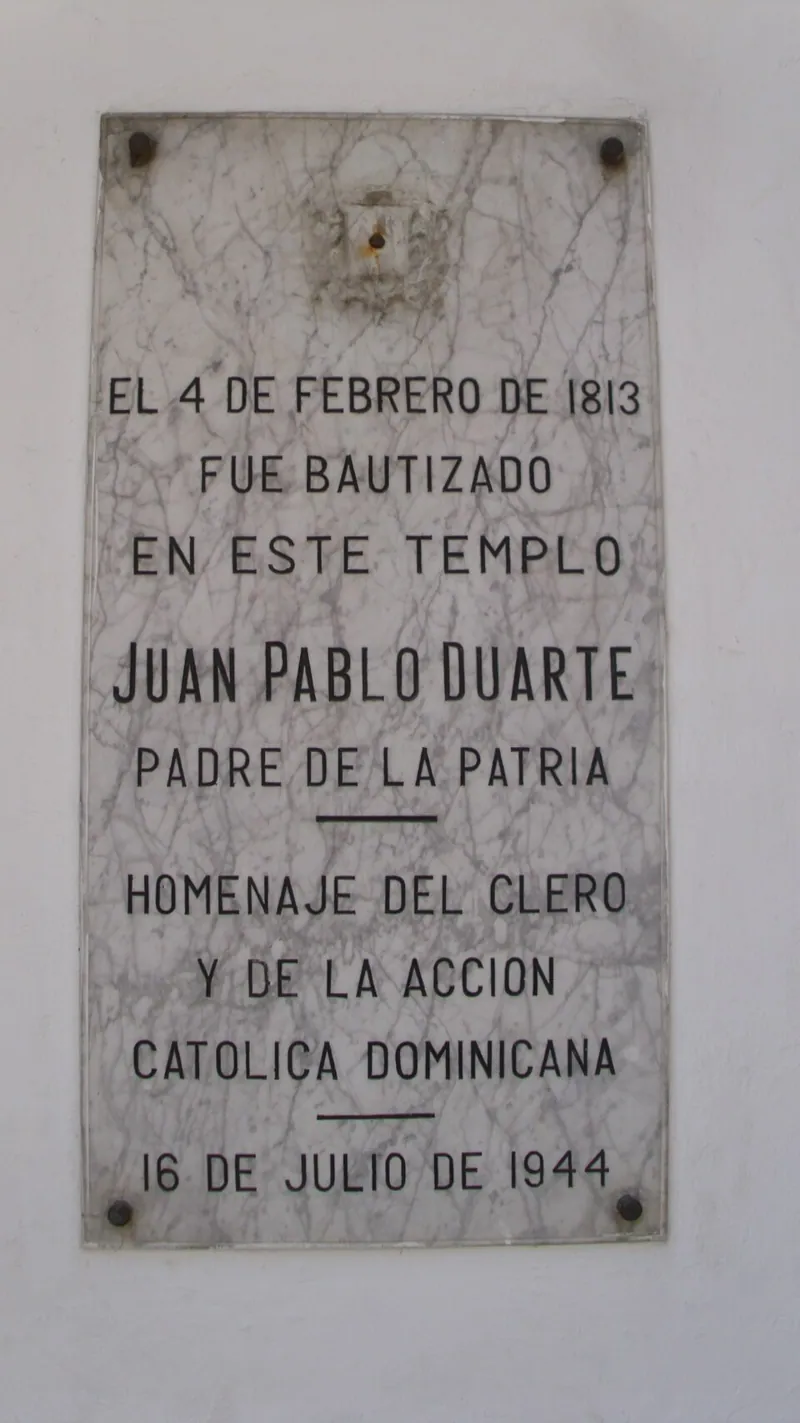
Duarte was born on 26 January 1813 in Santo Domingo. His parents were Juan José Duarte and Manuela Díez Jiménez. One online encyclopedia says his parents had fled French rule to Mayagüez, Puerto Rico, in 1801, and returned in 1809, and places his birth in the Atarazana district. Diario Libre says he was baptized on 4 February 1813 at the Santa Bárbara church and was taught languages, philosophy and Roman law by private tutors. A Hoy chronology adds that he began school in 1819 under Manuel Aybar.
The Duartes had enough means to send their son abroad to study, and they were a family of a particular moment. Duarte was eight when José Núñez de Cáceres and the creole elite declared independence from Spain in 1821, and nine when Haiti took over the whole island in 1822. He grew up inside the occupation. According to the online encyclopedia, living under Haitian rule taught him to value liberty and equality, and this is the common reading in Dominican biographies.
Where exactly he was born is a small question with two answers. Listín Diario describes the house museum at Isabel la Católica 308 as the house where he was born. The Instituto Duartiano's own material, as summarized in a 2023 travel article, says "here lived" Duarte and does not say he was born there. The cautious wording is that he lived there with his family, and one newspaper says he was born there.
Europe and the Return
In his teens he was sent abroad to study. The online encyclopedia says the family sent him to the United States and Europe in 1828. A Hoy chronology gives both 1828 and 1830 for the trip and records his return in 1831. Diario Libre writes that he founded La Trinitaria after returning from Spain in 1838, which does not match the 1831 return. Biographers disagree about how long he stayed and where he went, and no source settles it. What the sources agree on is the effect. He studied in Europe, where the French Romantic movement shaped his thinking.
The ideas he brought home are the ones he built the movement on: liberty and equality, and a country of its own.
La Trinitaria
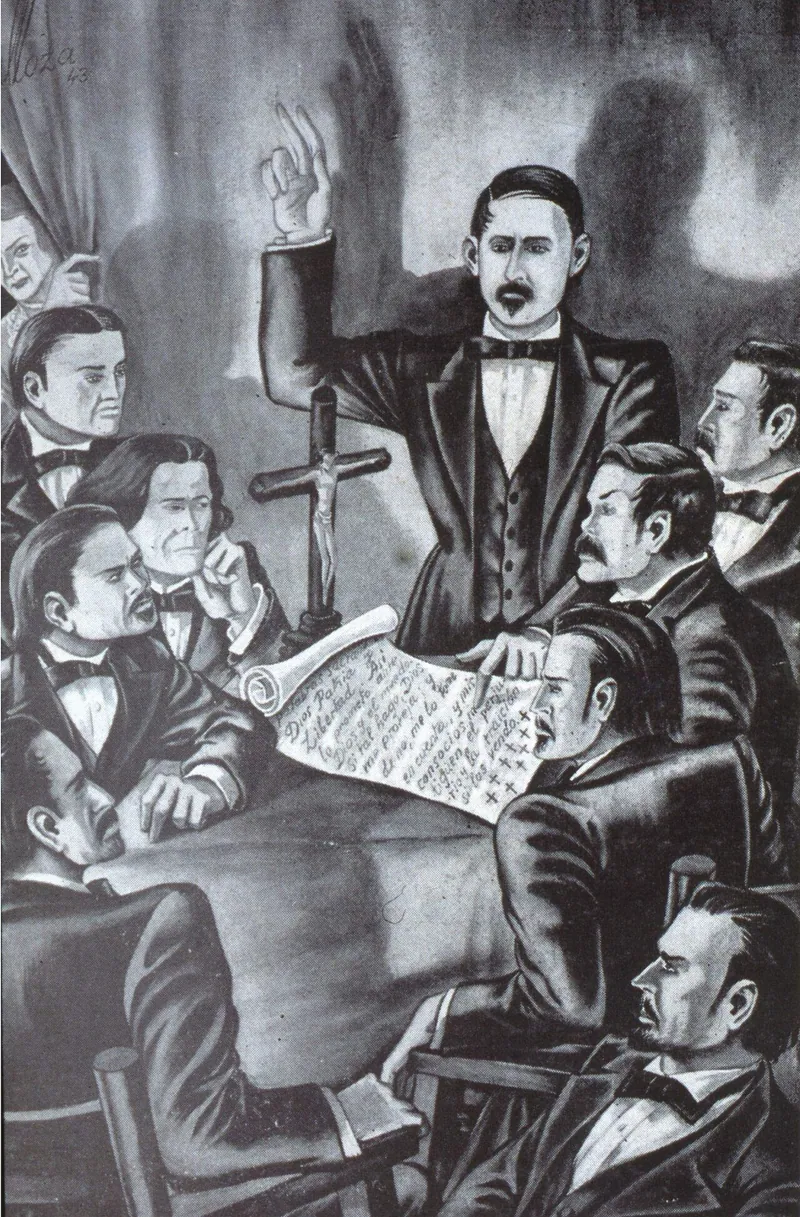
On 16 July 1838 Duarte founded La Trinitaria, a secret patriotic society. A Hoy chronology says it had nine original members. The online encyclopedia names some of the early members, including Juan Isidro Pérez, Pedro Alejandrino Pina and Félix María Ruiz. Francisco del Rosario Sánchez and Matías Ramón Mella, who would later play the leading parts on 27 February 1844, are listed as having joined the movement, Mella later, according to El Día. The same chronology says the society's goal was to free the eastern part of the island from Haitian rule.
The Dominican Foreign Ministry's page on national symbols says Duarte conceived the flag and described it in the Trinitarian oath, which called for a tricolor banner with a white cross. The Trinitarian motto, according to the same page, was "Dios, Patria y Libertad," which means God, Homeland and Liberty. Historian Manuel Núñez Ascencio, quoted by Acento, attributes to Duarte the name República Dominicana, the motto and the conceptual design of the flag. That attribution is common in Dominican writing, and it is worth reading as the historians' view, not a single document.
After the first society was discovered, the movement kept going under other names. In 1840, the Hoy chronology says, Duarte founded La Filantrópica and La Dramática. The online encyclopedia describes La Filantrópica as the more public society, one that used theater to spread ideas of liberation.
1843 and the Escape
In 1843 the situation in Haiti changed. A reform movement began there on 27 January, and the Trinitarios joined it. The Hoy chronology says that on 24 March they led the movement against Haitian rule, and that on 2 August Duarte fled to Venezuela. His father died on 25 November. El Día adds that the Trinitarios' alliance helped overthrow Haitian president Jean Pierre Boyer, but that Boyer's successor, Charles Rivière-Hérard, jailed some of the Trinitarios and forced Duarte into exile.
In December 1843, El Día says, the rebels asked Duarte to return, but illness prevented him. This is how the founder of the movement came to miss its decisive night. On 27 February 1844 the republic was proclaimed at the Puerta del Conde by Sánchez and Mella and their companions. Diario Libre says that those present shouted "Viva Juan Pablo Duarte," which acknowledged him as the main promoter of the separation.
The Return and the First Months
Duarte came back. A Hoy chronology records that on 4 February 1844 he had proposed that his family give its property to the cause of liberty, and that on 14 March 1844 he returned to Santo Domingo and was greeted as the Father of the Homeland. The new government was a coalition, and the Trinitarios were not its strongest part. On 26 May 1844, the chronology says, Duarte opposed a French protectorate proposed by Tomás Bobadilla. On 9 June he and his supporters removed the protectionists from the Junta Central Gubernativa. On 4 July the northern region proclaimed him president, but he declined.
His idealism put him at odds with military leaders. The online encyclopedia says Pedro Santana's faction exiled him, and that his family was exiled in 1845. In August 1844, the Hoy chronology says, the junta led by Santana declared Duarte and his followers traitors. On 22 August, Diario Libre says, Santana banished Duarte, Sánchez, Mella and others. On 10 September 1844, according to Hoy, Duarte was exiled to Hamburg, and on 30 November he traveled from Hamburg to Venezuela.
So the founder of the movement spent about six months of 1844 in the country. He was jailed and exiled by Santana. A line in that entry describes him as someone who "could inspire but not lead," and it should be read as one author's verdict, not a settled judgment.
The Years in Venezuela
For the next decades Duarte lived mostly in Venezuela. This is the part of his life that sources describe differently. The Hoy chronology lists 1846 to 1858 as the years he lived in Venezuela, and says he buried his mother in Caracas on 1 December 1858. A reference entry describes about fifteen years as a recluse in the Venezuelan jungle, and the online encyclopedia says he was named Dominican consul and given a pension, which he later lost. Acento, citing the Instituto Duartiano, says he lived about three years in Achaguas, in the state of Apure, a place where his residence is documented.
These accounts do not fit together neatly. Some describe him on a remote frontier, others in the capital, and the dates overlap. A fair summary is that he spent most of the years between 1844 and 1876 in Venezuela, that some of that time was in remote country and some in Caracas, and that the details are still debated. The Casa Duarte museum, described below, is the place to read the institute's own account.
He kept writing. The Hoy chronology records messages he issued on 7 March 1865 and 29 October 1869, the last one. And a Diario Libre article says his verses were first published on 25 June 1884, after his death, in the Revista Científica, Literaria y de Conocimientos Útiles, and quotes the phrase "Yo soy dominicano," which he reportedly said to a ship's captain.
The Annexation and the Restoration
In 1861 Pedro Santana proclaimed the annexation of the country to Spain. The Hoy chronology records that on 4 July 1861 Francisco del Rosario Sánchez and his companions were executed in San Juan de la Maguana, when Sánchez was 44. In 1862, the same chronology says, Duarte returned to Caracas and prepared a liberation expedition. The Restoration War began on 10 August 1863.
On 24 March 1864 Duarte returned to Santo Domingo to serve the restoration government in Santiago. A little over two months later, on 4 June 1864, Mella died of dysentery while serving as vice president, per the same chronology. On 7 June Duarte left for South America as a consul, to raise funds for the Restoration. Acento, citing the Instituto Duartiano, says he was later appointed minister plenipotentiary in Venezuela and stayed there until his death. The online encyclopedia and the reference entry say he was excluded from the provisional government and exiled a third time in 1865. These are different ways of describing the same period, and they do not agree on whether he left by choice or by pressure.
Last Years and Death
In the years that followed, he lived in Venezuela, supported, the Hoy chronology says, by a candle factory. On 19 February 1875 President Ignacio María González asked him to return home. He did not. Duarte died in Caracas on 15 July 1876, at the age of 63. Acento says he was the last of the founding fathers to die.
A photograph from 1873 by Próspero Rey, taken in Caracas, is described by a travel article as the only known surviving image of Duarte. That article says it is on display in the museum house.
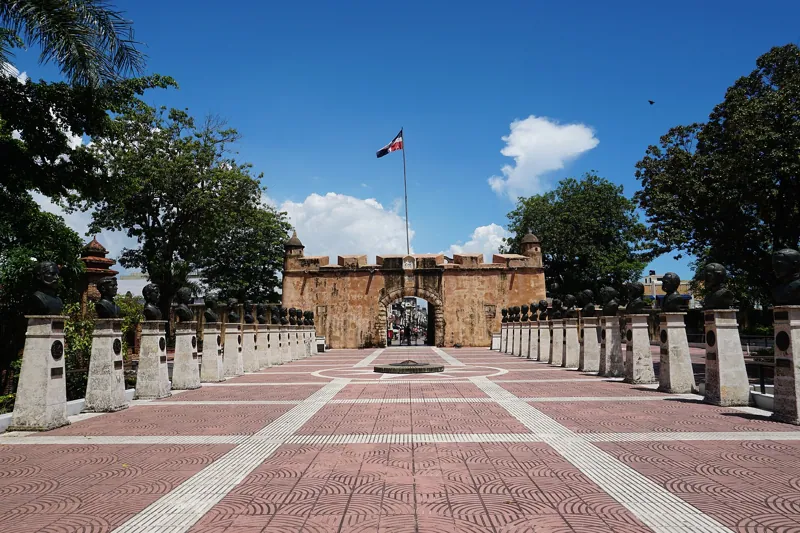
His remains were brought home in 1884. The online encyclopedia says this happened under Ulises Heureaux. Duarte's remains, with those of Sánchez and Mella, were interred at the Puerta del Conde on 27 February 1944, the centennial, per the Hoy chronology, which is why the gate is now called the Altar de la Patria.
Duarte and the Other Two Founders
Dominican tradition names three Padres de la Patria, and Duarte's life only makes sense next to the other two. Matías Ramón Mella was born in Santo Domingo on 25 February 1816, according to Acento, and joined La Trinitaria in 1838. Acento describes his role as strategic and military: coordinating actions and organizing groups. After independence he sat on the Junta Central Gubernativa, and El Día says that he proclaimed Duarte president of the Junta to keep colonial-minded figures from taking power. Santana then expelled Mella. He came back in 1848 under an amnesty, joined the Restoration in 1861 despite being ill, served as vice president of the republic in arms and wrote a guerrilla warfare manual in January 1864. He died on 4 June 1864 at 48.
Francisco del Rosario Sánchez was 27 when he was passed over for the presidency of the junta in 1844, according to Diario Libre. His end came earlier than Duarte's: the Hoy chronology says he and his companions were executed on 4 July 1861 in San Juan de la Maguana, at 44. María Trinidad Sánchez, one of the women the Foreign Ministry lists as sewing the first flag, was executed in 1845 after a trial for conspiring against Santana's government.
Duarte outlived both of them by years and was the last of the three to die. The three came together again only in 1944, when their remains were placed side by side at the Puerta del Conde.
What Duarte Believed
Because Duarte wrote little and moved around, the sources about his ideas are partly later accounts. The historians quoted in Acento's article on his legacy describe a pattern. Núñez Ascencio says Duarte saw independence as a project of ideas, not only of force, and so promoted organized citizenship through La Trinitaria. Núñez Ascencio also stresses the sacrifice: Duarte gave a large part of the family fortune to the cause, endured long exiles and never used his status as founder to get privileges. Historian Reynaldo Espinal says Duarte understood nationality as a process of self-determination and dignity that was not defined in opposition to other peoples, and describes him as a human figure, not an idealized one.
The article from Diario Libre includes a line from the diary of his sister Rosa Duarte that says he decided to prove that Dominicans deserved their name. That is a family memory and not a government document, and it fits with the rest of the picture: a man who thought a country begins with a decision about who belongs to it.
How He Is Remembered
Dominicans mark his birthday on 26 January. The online encyclopedia notes that Pico Duarte, the highest peak in the Caribbean, carries his name, along with a park in New York. The flag and the coat of arms, with the motto "Dios, Patria y Libertad," are described there as inspired by him. The Dominican Foreign Ministry's page confirms the motto and the flag's origin in the Trinitarian oath.
His significance was recognized only after his death. In Santo Domingo you can follow that story in three places: the church where he was baptized, the house where he lived and the mausoleum where he rests.
The Casa de Duarte Museum
The Museo Casa Duarte stands at Calle Isabel la Católica 308 in the Zona Colonial. It belongs to the Instituto Duartiano. A 2022 Hoy article says a group of Dominican historians founded the institution in 1966 and that it opened to the public on 26 January 1967. A 2023 travel article adds that in December 1967 the house was recognized by decree as the Instituto Duartiano, with the special status of a house museum, and that it was the residence of the Duarte Díez family.
The house has one floor, thick walls and high ceilings. Hoy says it is divided into three numbered rooms. The collection, per Hoy, includes portraits, photographs, books, manuscripts, paintings and objects of the Duarte family, along with weapons from the wars of Independence and Restoration, a baptismal record from 1813, the urn that held his remains and paintings of the founding of La Trinitaria.
Listín Diario reported in 2018 that the museum was inaugurated on 15 March 2017 by President Danilo Medina, which probably refers to a new exhibit, since Hoy dates the first opening to 1967. The article says it drew more than 80,000 visitors in its first nine months. It has thirteen life-size dioramas covering his life from baptism to death, and the first has six wax figures, including the priest and his parents. A tour takes about fifteen minutes, and groups of 25 are taken in turn.
Visiting details are not settled. Listín Diario in 2018 and a 2023 travel article that cites the institute's own listing give Tuesday to Sunday, 9:00 a.m. to 5:00 p.m. Hoy in 2022 says visitors should request an appointment in advance by phone or email, while Listín in 2018 said unannounced groups were still received. Listín Diario said admission was free in 2018 but that the institute was considering a fee. Given the mixed evidence, check before you go.
Related Places on the Walk
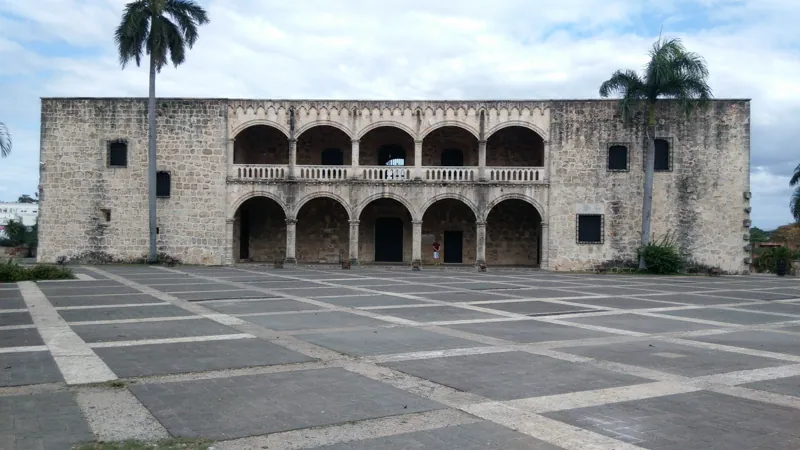
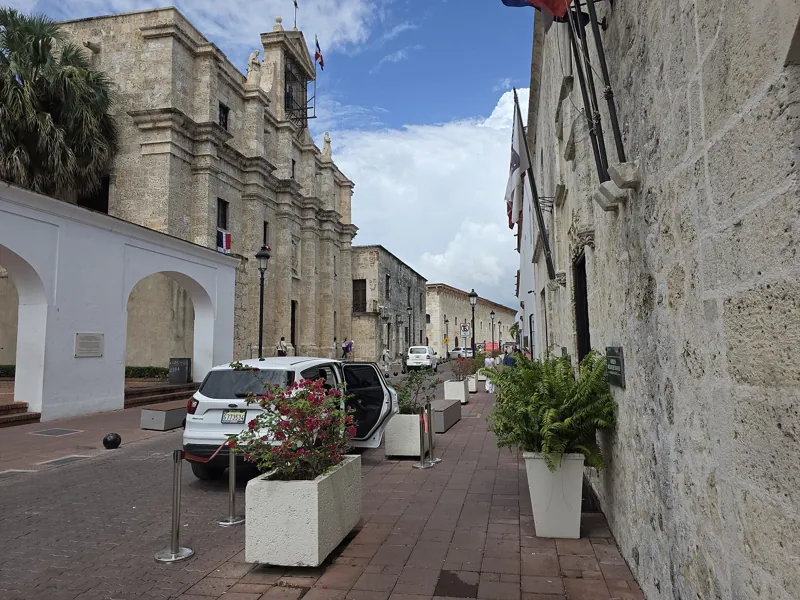
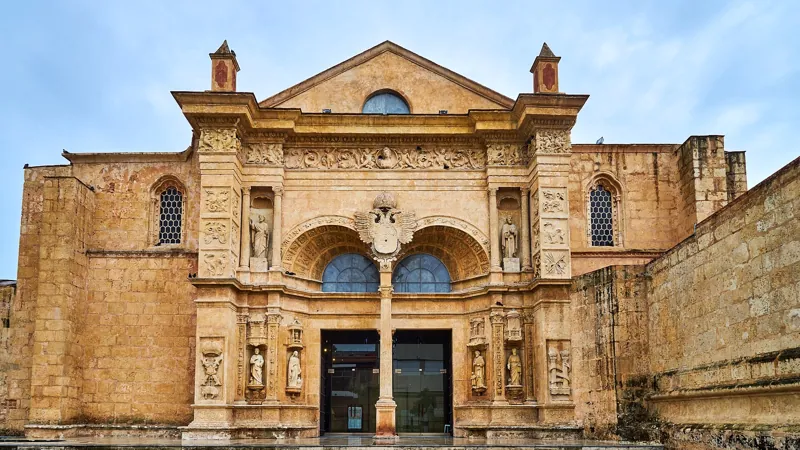
The Iglesia de Santa Bárbara, where Diario Libre says Duarte was baptized, is covered in the page on colonial churches of the Zona Colonial. The Puerta del Conde is on its own page. The Altar de la Patria and Parque Independencia are at the western end of the pedestrian Calle El Conde, so a Duarte walk can run from the museum house to the gate, with a stop at the cathedral square on the way. For the wider district, see the Zona Colonial complete guide and the first city of the Americas history walk.
The founding fathers are not buried in the Panteón. Their tombs are at the gate. The national pantheon on Calle Las Damas has its own page, Panteón de la Patria.
Getting there from the penthouse
The Museo Casa Duarte is at roughly 18.4777, -69.8843 according to OpenStreetMap. From Penthouse Pallazzo, about 150 m north of Playa Montesinos at roughly 18.4697, -69.8851, the straight-line distance is about 900 m. With the street grid factor and a pace of 80 m a minute, that is about 15 minutes on foot. The walk goes north through the old city. Check the hours before you set out, and consider calling ahead if you are bringing a group.
Frequently asked questions
Why is Duarte called the Father of the Homeland?
Because he founded La Trinitaria in 1838, the secret society that organized the movement for independence, and because historians credit him with the name República Dominicana, the motto Dios, Patria y Libertad and the idea of the flag. He was greeted as the Father of the Homeland when he returned on 14 March 1844.
Was Duarte present on 27 February 1844?
No. He had fled to Venezuela on 2 August 1843, and when the rebels asked him to return in December 1843, illness prevented him. Sánchez and Mella led the proclamation at the Puerta del Conde.
Where did Duarte die, and where is he buried?
He died in Caracas on 15 July 1876. His remains were brought to Santo Domingo in 1884 and today rest in the Altar de la Patria at the Puerta del Conde, with Sánchez and Mella.
Can I visit the house where he lived?
Yes. The Museo Casa Duarte is at Calle Isabel la Católica 308. Sources give Tuesday to Sunday, 9:00 a.m. to 5:00 p.m., but some say an appointment is needed, so check before you go.
Was Duarte born in the museum house?
One newspaper says yes, and the Instituto Duartiano's text, as summarized in a travel article, says he lived there. Sources differ on the point.
Is there a photograph of Duarte?
A 1873 photograph by Próspero Rey, taken in Caracas, is described as the only known surviving image of him and is said to be shown in the museum.
Sources
- https://hoy.com.do/suplementos/areito/cronologia-de-la-vida-del-patricio-juan-pablo-duarte_900780.html
- https://www.newworldencyclopedia.org/entry/Juan_Pablo_Duarte
- https://encyclopedia.com/humanities/encyclopedias-almanacs-transcripts-and-maps/duarte-juan-pablo-1813-1876
- https://www.diariolibre.com/planeta/historia/2022/01/26/juan-pablo-duarte-lider-de-la-independencia-nacional/1602633
- https://acento.com.do/especiales/cual-es-el-legado-de-juan-pablo-duarte-a-150-anos-de-la-muerte-del-padre-de-la-patria-9719350.html
- https://eldia.com.do/matias-ramon-mella-valiente-estratega-en-la-lucha-por-la-independencia-nacional/
- https://www.diariolibre.com/especiales/el-grito-que-cambio-el-derrotero-de-la-historia-dominicana-BY9274298
- https://mirex.gob.do/simbolos-patrios/
- https://hoy.com.do/museo-casa-duarte-lugar-de-grandes-de-historias/
- https://listindiario.com/la-republica/2018/01/02/497097/patriotismo-resalta-en-casa-museo-de-duarte.html
- https://turismoglobal.com/2023/01/24/casa-museo-de-duarte-un-destino-que-debes-visitar-en-familia/
- https://nominatim.openstreetmap.org/search?q=Museo+Duarte+Santo+Domingo&format=json&limit=5
- https://acento.com.do/actualidad/quien-fue-matias-ramon-mella-republica-dominicana-se-prepara-para-conmemorar-el-dia-del-procer-de-la-patria-9628400.html
- https://commons.wikimedia.org/wiki/Category:Juan_Pablo_Duarte