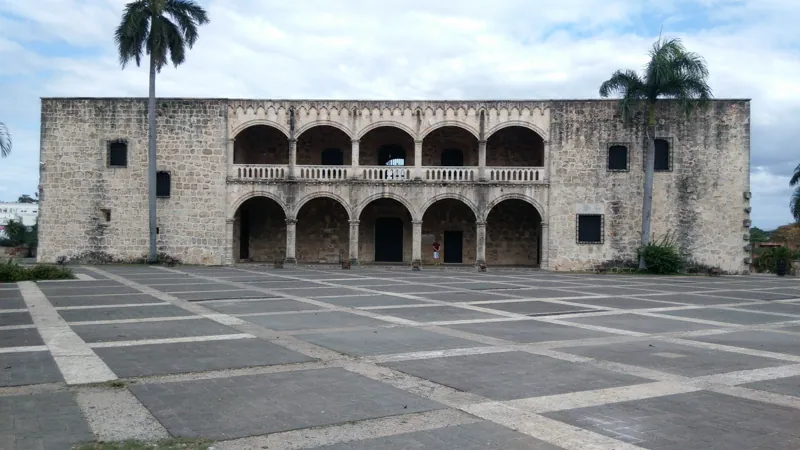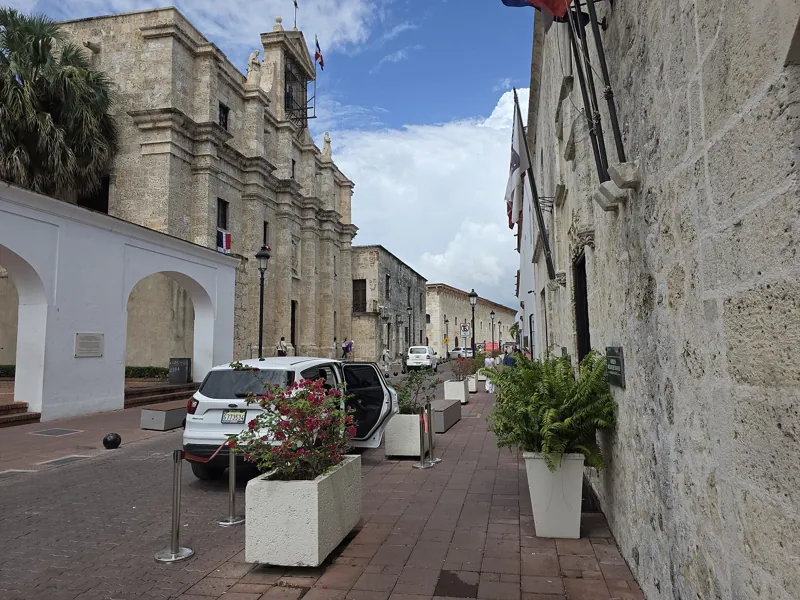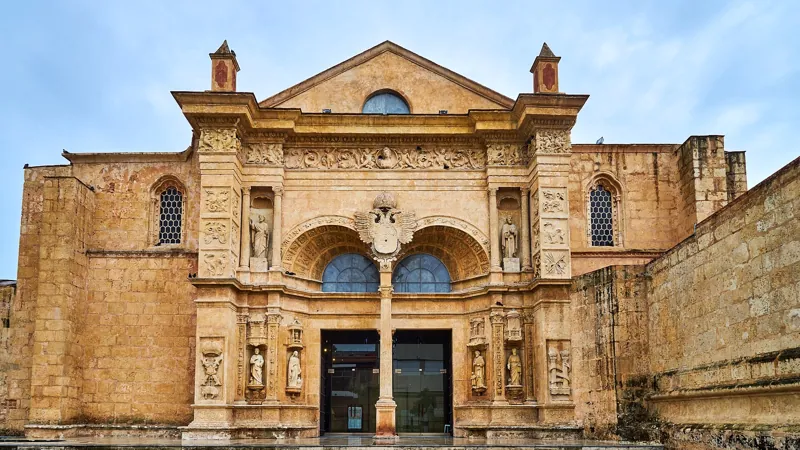
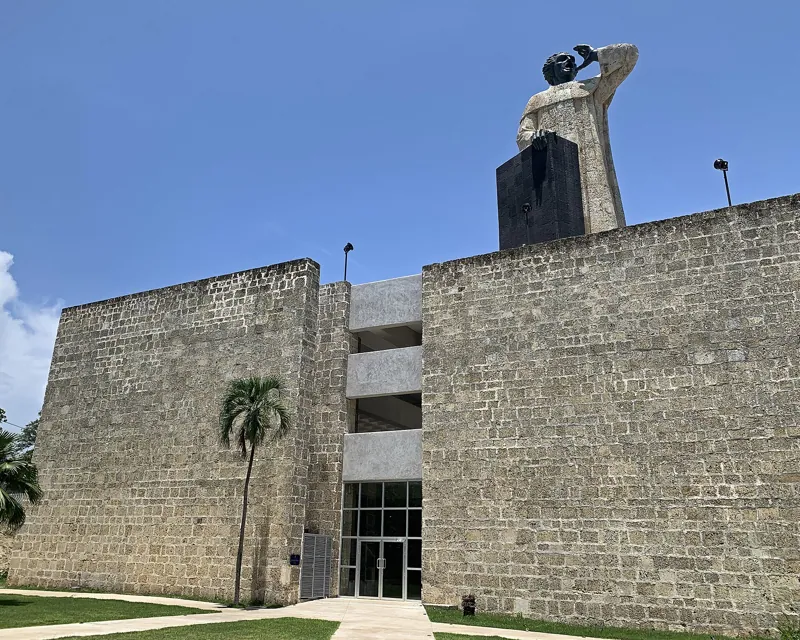
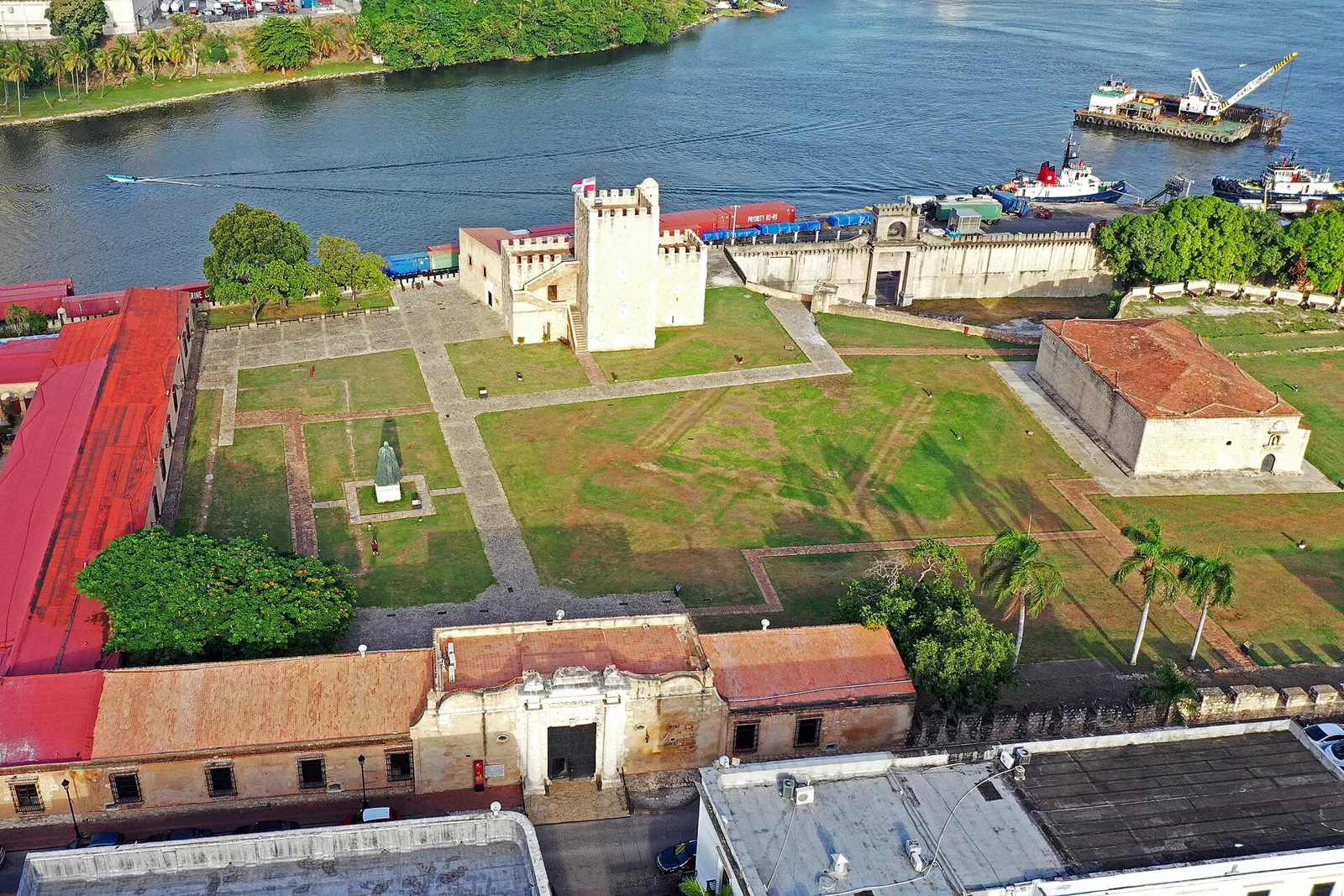
The Fortaleza Ozama sits where Calle Las Damas runs out of street. Walk south past the last colonial doorways and the road ends at a thick coral-stone wall, a gate and a squat tower that has watched the mouth of the Ozama River for more than five hundred years. Many guides call it the oldest military building of European origin in the Americas. Diario Libre, a Dominican newspaper, calls it the oldest military building on the island, which is the safer way to put it. The dates behind both claims are the same: work began in 1502.
What makes the fort worth an hour is how many jobs it did. It was a lookout, a lodging for a governor's family, an armory, a barracks and, through much of the twentieth century, a prison. Each period left something you can still find on the grounds: a cannonball in a wall, bullet holes in a gate, a bronze statue, a concrete rampart poured against an older one. This article follows those layers in order, says where the sources disagree, and finishes with how to visit. The fort has two close neighbors with their own stories, and they have their own pages: the palace across the plaza, covered in Alcázar de Colón, and the street that leads to the gate, covered in Calle Las Damas.
Why the Fort Stands Here
Santo Domingo began on the other side of the river. The Dominican newspaper Diario Libre says the first stone of the settlement was laid on 4 August 1496 on the left bank of the Ozama's mouth, and an article in the Dominican newspaper Acento places the 1496 settlement on the river's east bank too. Nicolás de Ovando, who arrived as governor in April 1502 with a fleet of about thirty ships and roughly 2,500 colonists, refounded the city on the west bank. A reference biography of Ovando puts it in one line: Santo Domingo was refounded on the opposite bank of the Ozama, laid out on a gridiron plan that later became common across Spanish America.
On the west bank the river mattered twice over. It was the harbor, and a fort at its mouth could see every ship that came in. An article from Acento about the city's founding describes the arrangement as one system: the audiencia, the town council and the port on the west bank, with the Torre del Homenaje and the Fortaleza Ozama controlling the river's mouth. For more on the river and the harbor, see The Río Ozama and the Old Port.
Building It, 1502 to 1508
A visitor guide to the district gives the construction dates as 1502 to 1508 and says Ovando chose the site himself. The master builder was Gómez García de Varela. He built the tower first, then the shooting platforms, then the main fort. The same guide says the walls are coral stone cut in blocks and fitted tightly, and that the labor was done by enslaved African and Taíno people. That last point is worth keeping in mind as you walk the grounds. The stone you touch was cut and lifted by people who had no say in the work. The story of the Taíno on the island has its own page: The Taíno of Hispaniola.
The walls are about three meters thick, except on the river side, where the same guide says they are about one meter. The explanation offered is that if a powder store ever exploded, the blast would be sent toward the river and away from the city. No historian's source is cited for that explanation, so treat it as the guide's account. The guide also says the mortar was mixed from gypsum, clay, lime and animal blood. No archaeological report cited here confirms that recipe, so it stays the guide's claim.
The Torre del Homenaje
The tower is the oldest part. It dates to 1503, stands about 18 meters high with walls about two meters thick, and was the tallest building in the colony in the sixteenth century. The Italian-Dominican research book The Italian Legacy in the Dominican Republic agrees on the 18 meters and adds a detail about how it was used: boats arriving at the port were greeted from the tower.
The name needs a word. Homenaje is the Spanish term for the keep of a castle, the central tower where the commander took the oaths of his men. Diario Libre says the tower was also called the Torre de la Vigía, the lookout tower, because it overlooked the river's mouth and the Caribbean coast. Both names fit. The tower worked as a symbol of authority and as a place to watch from.
One local guide also says the tower housed Diego Colón and his wife María de Toledo while their palace, the Alcázar, was being built. The couple's own story belongs to the Alcázar article. This claim has no second source, so it is the guide's account.
Inside the tower complex the same guide lists a brick dungeon opening off the tower's courtyard, and it says the tower stays cool inside because of the thick walls. That matters on a Santo Domingo afternoon.
The Columbus Story
You will hear that Christopher Columbus was imprisoned here. Here is what the sources say, and where it gets uncertain.
The arrest itself is well documented. Filson Young's 1906 narrative of Columbus's life says that in 1500 the new governor Francisco de Bobadilla reached Santo Domingo, and that Columbus was arrested on the outskirts of the city, chained and imprisoned. Young writes that he was "lodged in the fortress, the tower of which exists to this day." That is a very old version of the tradition. The difficulty is the calendar. The sources that give construction dates for this fort begin in 1502, two years after the arrest, and Acento's account puts the city on the east bank in those years. A fort begun in 1502 on the west bank cannot be the place where a prisoner was held in 1500. Either Columbus was held in an earlier building, perhaps the first provisional works across the river, or the tradition attached his name to the tower later. No primary source settles it, so this one is best called a tradition. When a guide at the gate tells it, you now know what to ask.
The Fort in 1586
The fort's first serious test came on 1 January 1586, when Francis Drake's English fleet took the city. The 1589 account of the expedition, credited to Walter Bigges, says that the castle was "furnished with great store of artillery" but that its guards fled once the English had reached the city gates, some of them by boat. By his telling, the garrison left the fort after midnight. Bigges also reports that the English carried off about four score pieces of ordnance from Santo Domingo, including whole cannon, demi-cannon and culverins.
The fort was never taken by force. Those two statements can both be true in a narrow sense, if you count an abandoned fort as not taken by force, but a reader should know the English held the city and its castle for a month. The full story has its own article: Francis Drake's Raid on Santo Domingo in 1586.
What came after matters for the fort. King Philip II issued a warrant in 1586 telling the engineer Battista Antonelli to survey the coasts and build or improve fortifications. A chapter in The Italian Legacy in the Dominican Republic says Antonelli reached the island on 25 April 1589 with the engineer Tejada, found the existing wall plan weak and too far from the city center, and moved the walls closer. He added bulwarks along the whole line. The same chapter notes that Santo Domingo by then had lost much of its political and commercial importance, and that the earlier wall plan had assumed growth that never came. The fort stayed where it was. The walls around the city were what changed.
The Eighteenth Century
One local guide lists several additions from this century. The Polvorín de Santa Bárbara, the armory, is dated to 1787 and the guide says it was built to look like a church so that pirates would not know it held gunpowder. A new main gate, the Puerta de Carlos III, is also dated to 1787 by that guide, which says it is made of imported African ebony. The Italian-Dominican research book dates the Carlos III gate to 1797, so a careful visitor should expect the plaque or the guide to say one or the other. The old army barracks along Calle Las Damas date from about 1789, built after Spain sent a battalion.
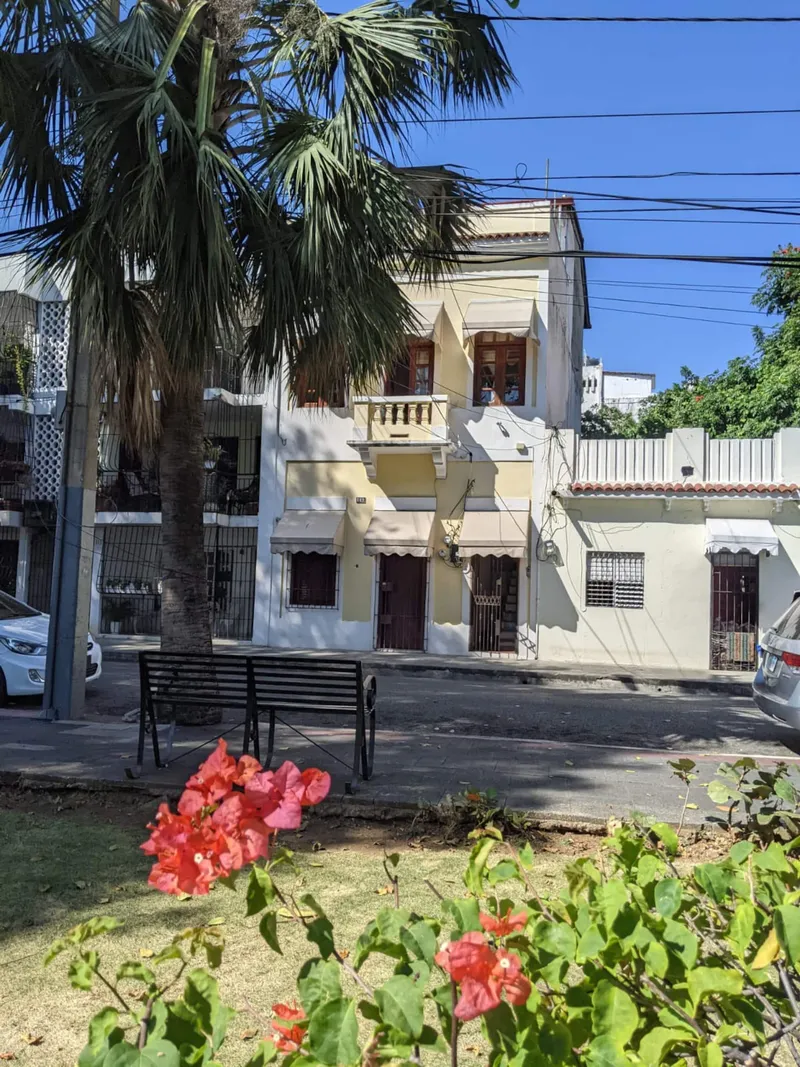
The low shooting platform is dated to 1570 and the high platform to 1650 by the same guide, which adds that some of the cannons on the platforms came from ships sunk in the colonial period. If you want the wider picture of how the city lived in the century the penthouse's townhouse was built, see Santo Domingo in the 1700s.
The Night of 27 February 1844
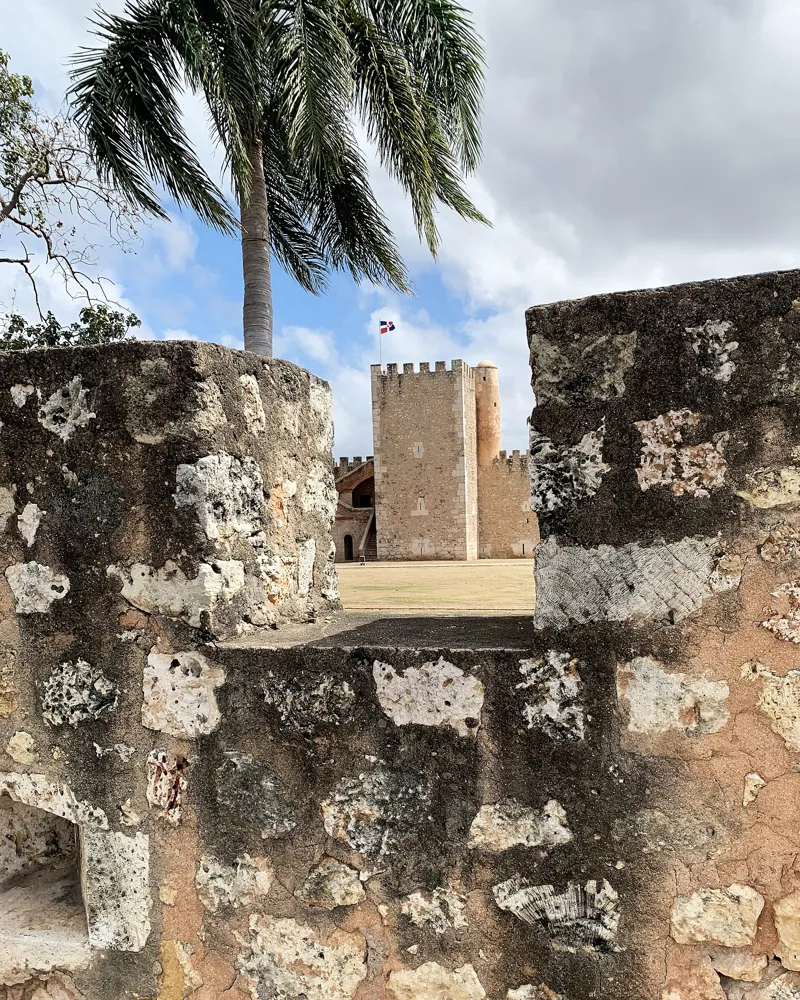
The Dominican independence story has a small chapter at this fort. In 1844 it was called La Fuerza and held soldiers of the Haitian government, which had ruled the east of the island for 22 years. Diario Libre's account of the night says a Haitian patrol near the Puerta del Conde was driven off with gunfire on 27 February, and the fort fired three cannon shots as an alarm. The patriots answered with three volleys. Juan Alejandro Acosta and his group took the commander's post during those hours.
The next day the Haitian commander, Etienne Desgrotte, sent officers to ask what the rebels wanted. The patriots replied in writing that the Dominican people were determined to be free and independent. That afternoon the Haitians agreed to capitulate, with the French consul Eustache Juchereau de Saint-Denys acting as go-between. On 29 February Desgrotte handed the place to the Dominicans without resistance. The Diario Libre article notes that Juan Pablo Duarte was not there that night, because he had already gone into exile. The story of that night, and of the gate where the first shot was fired, is in Puerta del Conde and Independence in 1844, and Duarte's life is in Juan Pablo Duarte.
The fort's role in the independence period had a darker second act. The same newspaper says that after Pedro Santana took control, he declared Duarte, Francisco del Rosario Sánchez and Matías Ramón Mella traitors and had them exiled, following a resolution of the Junta Central Gubernativa dated 22 August 1844. A visitor guide says Juan Pablo Duarte was held in the tower dungeon, giving the year as 1836, and that later political figures including Juan Bosch were jailed there too. The 1836 date has no second source, so it is not repeated here as fact.
The Prison Years
The fort served as a prison for a long time, and the record is serious. It was used as a prison until the 1960s and held many of the country's political prisoners.
The most detailed account of the twentieth century is by Alejandro Paulino Ramos, published in Acento in 2018 as part of a series on the torture centers of the Trujillo dictatorship. Rafael Trujillo took office on 16 August 1930. According to Ramos, the fortress cells were renovated and new areas were opened on 2 January 1938, and a wall on the east side was inaugurated on 15 February. Diario Libre gives a slightly earlier date for the work, saying Trujillo reinforced the fort in 1937 with a crenellated wall. The wall is now known as the Muralla de Félix Benito, and the local guide says it was built when the port and the Malecón were created. The Italian-Dominican research book places the concrete fortification in the 1950s. Writers date the same wall to the 1930s and the 1950s, so all that can be said is that it belongs to the Trujillo era and that it was poured against the original inner stone wall.
Ramos describes a prison with different wings. Political prisoners and opponents were held in solitary cells in the tower, while ordinary prisoners were in an infirmary wing where they had some contact with family. He writes that prisoners were held in damp pits where many died. He names the writer Juan Isidro Jiménez Grullón, whose book Una Gestapo en América, published in Havana in 1946, documented torture and deaths of political prisoners. He also names the writer Juan Bosch, who was held at the fort and at Nigua between 1933 and 1934 and who was moved to a tower cell after an incident, where conditions were very harsh. The worst of the details are not repeated here. They are in his article for anyone who wants them, and they are a reminder that the thick walls the guides praise were used for something very different from defending a city.
When did it stop being a prison? Ramos says the fortress prison formally operated until 16 August 1952, when the La Victoria National Penitentiary opened. Diario Libre says it served as a prison until 1970. The Italian-Dominican research book says it was used as a prison until the end of the 1960s. A visitor guide says until the 1960s. These do not agree. The likely reading is that the formal prison closed in 1952 and the site was used for detention and by the military well after that, but no single source says so directly.
Opening to the Public
Diario Libre says the fort remained in military use until the 1970s, when added elements were removed to restore its original proportions. It was retired from military service in the 1970s, then restored and opened to the public. The Italian-Dominican research book gives 1965 as the year the fortified complex opened to the public. The bullet holes in the gate doors date from the fighting of 1965.
The Italian-Dominican research book says the fort and the Colonial City of Santo Domingo became a World Heritage Site in 1990. For the arc of how the district got there, read A History of the Zona Colonial.
What You Can See Today
Most of what follows comes from the numbered walking map in a local guide, which is the most detailed description of the grounds. Treat the dates as that guide's, and expect the signs on site, where they exist, to differ in places.
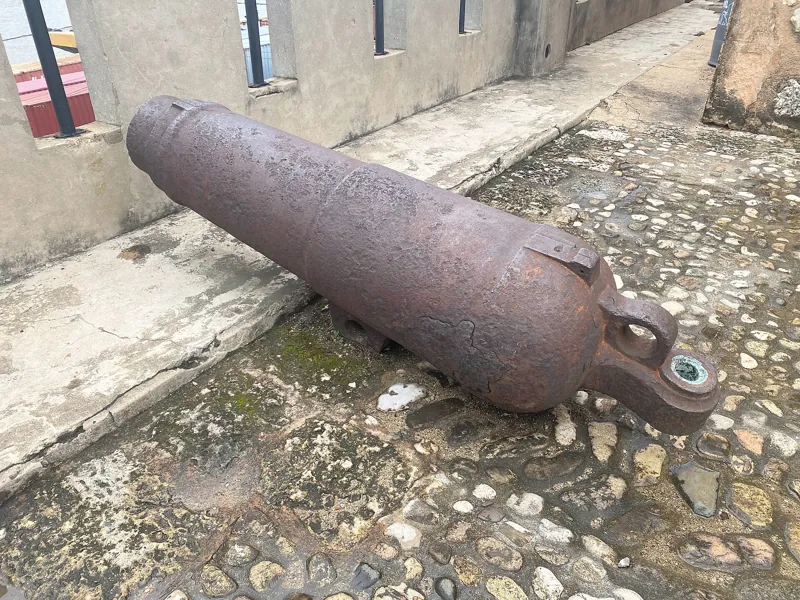
- The gate and the cannonball. Visitors enter through the Puerta de Carlos III, with a cannonball embedded in the outer wall near the main entrance and bullet holes in the doors.
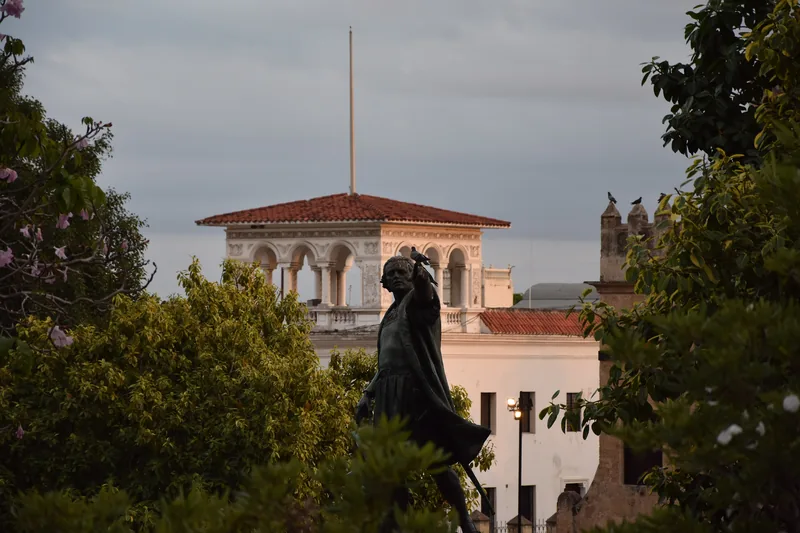
- The statue of Oviedo. A bronze statue from 1977 honors Gonzalo Fernández de Oviedo, who the guide says was governor and warden of the fort from 1533 to 1557, and who wrote a chronicle of the Indies for Charles V.
- The Torre del Homenaje. The central keep, with the dungeon off its courtyard and, in some seasons, a climb to the top.
- The small windows. The guide calls the narrow openings in the wall "ojos mágicos", magic eyes, because defenders could see out without being seen.
- The platforms. A low platform, dated to 1570, protected the port at water level. A high platform, dated to 1650, covered a wider range.
- The Primera Obra. The remains of the first, provisional fort, with three chambers.
- The Fuerte de Santiago. A first line of defense dated to 1567. Only four arches and part of the floor remain.
- The Garita Ozama. The original sentry house at the farthest point of the fort.
- The old barracks. Along Calle Las Damas, from about 1789, with remnants of the older wall still visible.
- The Casa de Bastidas. A house near the tower, dated by the guide to about 1505, with arches and a patio. It is covered further in Calle Las Damas.
The grounds also have mango trees along the back wall, and the guide says visitors may be able to pick fruit in season. Pottery and porcelain fragments turn up on the ground, and the guide's author was told by a guide at the gate that some pieces may be Portuguese. Do not take any. They belong to the site.
Planning Your Visit
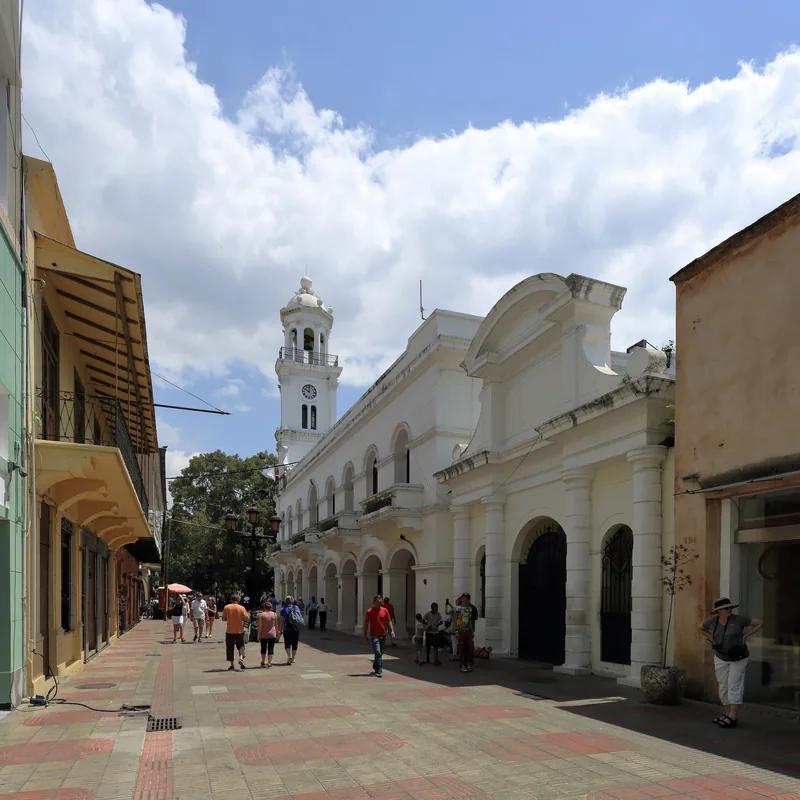
The fort is at Calle Las Damas and Calle Pellerano Alfau, at the river end of the street. From Calle El Conde, the local guide says, you turn toward the river onto Calle Las Damas and the fort is about one block down on the left. It is part of the same walk as the other great sites on that street, so see Santo Domingo Landmarks and the Zona Colonial guide for routes that combine them.
Opening hours, ticket prices and access to the tower change, and the sources disagree with each other. Some travel guides say the fort closes on Mondays. Others give different closing times on Sundays. The prices on the most detailed guide date from 2013, so they are not quoted here. Check before you go, and ask at the gate whether the tower is open that day. Guides gather at the entrance. If you want one, agree on the price first. If you prefer to look around on your own, the numbered list above will keep you oriented.
Go in the morning if you can. The grounds have little shade, and the stone holds heat. The tower's interior, as noted above, stays cool.
Getting there from the penthouse
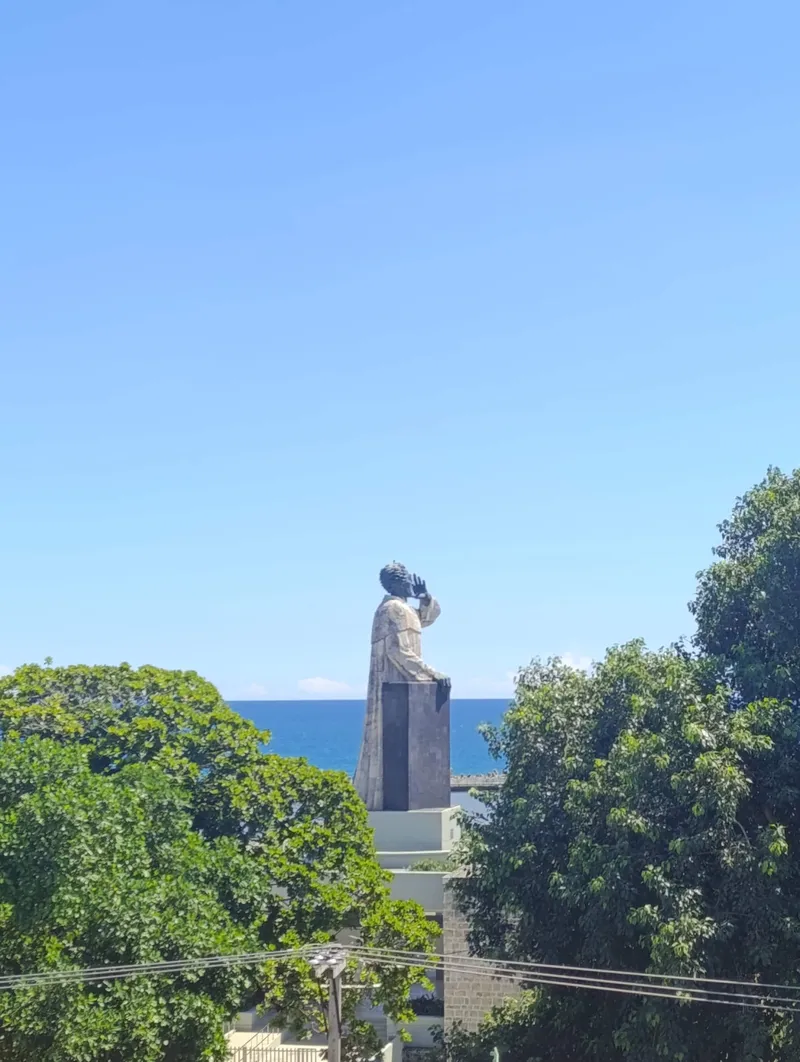
Penthouse Pallazzo is on the sea edge of the Zona Colonial, facing the Montesinos monument. The straight-line distance to the fort is about 450 meters, which comes to about 10 minutes on foot. The walk follows the colonial streets toward the river end of Calle Las Damas, and a ride would waste the best part of it. Pair the visit with the Plaza de España and the Museo de las Casas Reales a few minutes further along Las Damas, and finish at the Alcázar de Colón.
Frequently asked questions
Is the Fortaleza Ozama really the oldest fort in the Americas?
It is described that way in many guides, and the dates sources give (1502 to 1508) support the claim for an existing European military building. Diario Libre phrases it more narrowly, as the oldest military building on the island. A claim of this kind is always relative to what else survives, so it is best quoted as "among the oldest" unless you have the source in front of you.
Was Columbus imprisoned in the tower?
This is a tradition with problems. Filson Young's 1906 narrative says Columbus was arrested in 1500 and lodged in a fortress whose tower still exists. But the sources that date this fort begin work in 1502, and the city was then on the other side of the river. No primary source places him in this tower.
Did Drake capture the fort?
The 1589 account credited to Walter Bigges says the castle's guards fled when the English reached the city gates, and that the garrison abandoned the fort after midnight. The English then held Santo Domingo for about a month. A visitor guide says the fort was never taken by force, so the answer depends on what you count as force.
Can you climb the tower?
One local guide describes the interior as cool even at midday and says the climb is comfortable, which suggests access in the past. Access has changed over the years and may be restricted for renovation. Ask at the entrance on the day you go.
Was it a prison in the Trujillo era?
Yes. Alejandro Paulino Ramos, writing in Acento, describes it as one of the dictatorship's detention centers, with solitary cells in the tower and a wing for ordinary prisoners. Sources disagree on when it stopped being a prison, with dates from 1952 to 1970.
How long should I plan for?
About an hour is enough for the grounds and the tower. Allow more if you hire a guide or want to read each building on the numbered map.
Sources
- https://www.colonialzone-dr.com/fortaleza-ozama/
- https://www.colonialzone-dr.com/fortaleza-ozama-inside/
- https://www.diariolibre.com/portada/reportaje/la-ciudad-de-santo-domingo-y-sus-invaluables-tesoros-coloniales-BP27939181
- https://www.diariolibre.com/especiales/el-grito-que-cambio-el-derrotero-de-la-historia-dominicana-BY9274298
- https://acento.com.do/politica/los-centros-torturas-la-dictadura-trujillo-la-fortaleza-ozama-1-8526879.html
- https://acento.com.do/opinion/cronica-de-una-colonizacion-de-los-primeros-campamentos-a-las-murallas-9575405.html
- https://italianlegacyrden.academiadominicanahistoria.org.do/files/assets/basic-html/page-244.html
- https://italianlegacyrden.academiadominicanahistoria.org.do/files/assets/basic-html/page-243.html
- https://gutenberg.org/cache/epub/3334/pg3334-images.html
- https://www.gutenberg.org/files/4114/4114.txt
- https://encyclopedia.com/humanities/encyclopedias-almanacs-transcripts-and-maps/ovando-nicolasde-1451-1518
- https://nominatim.openstreetmap.org/search?q=Fortaleza+Ozama+Santo+Domingo&format=json&limit=3