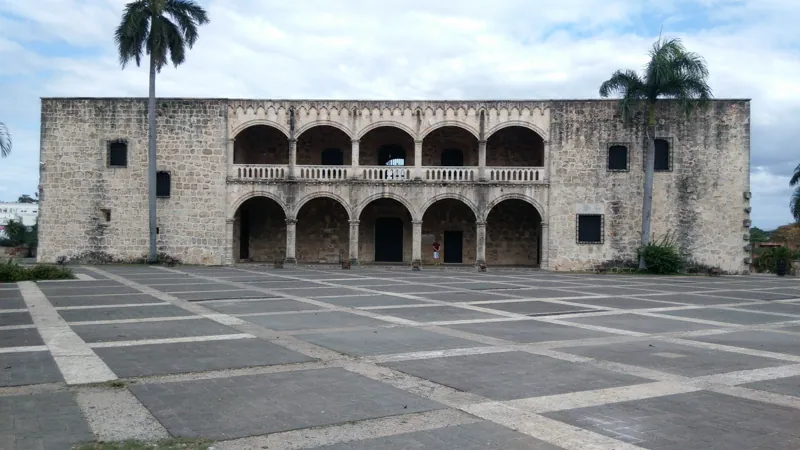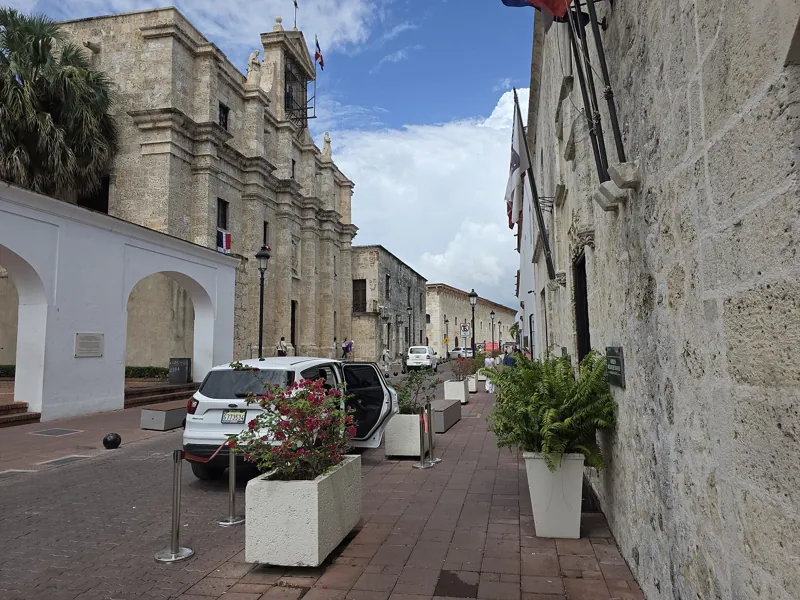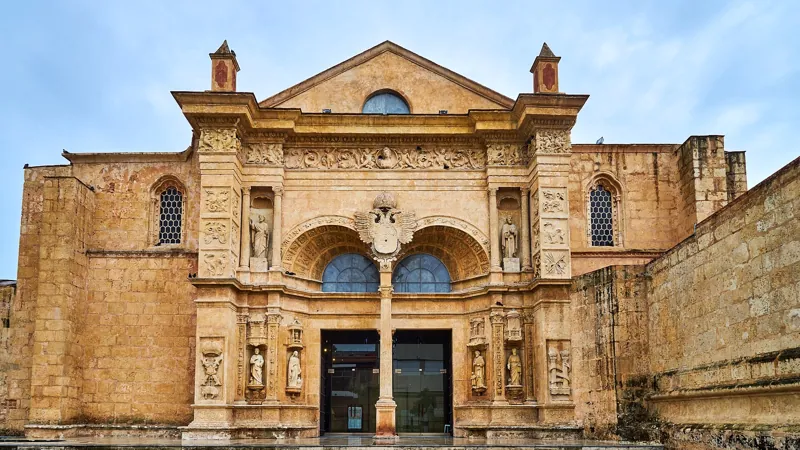
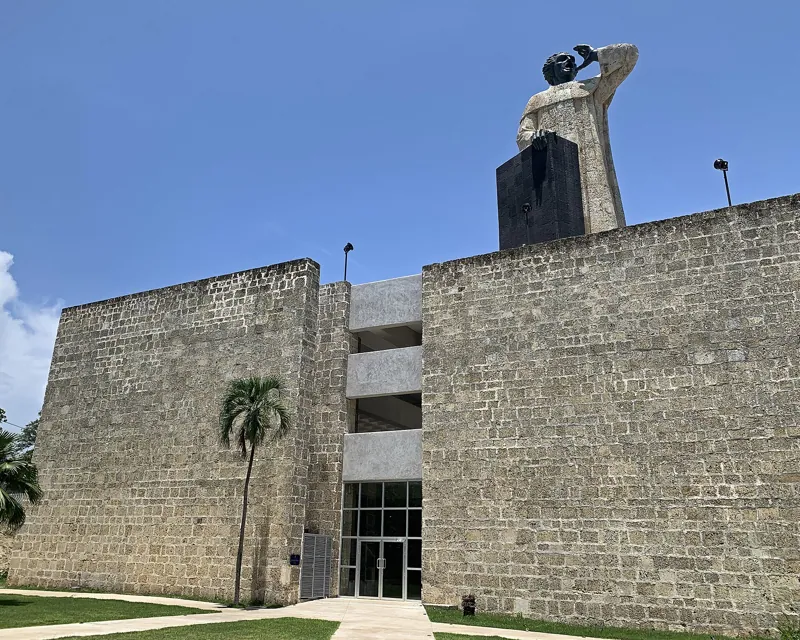
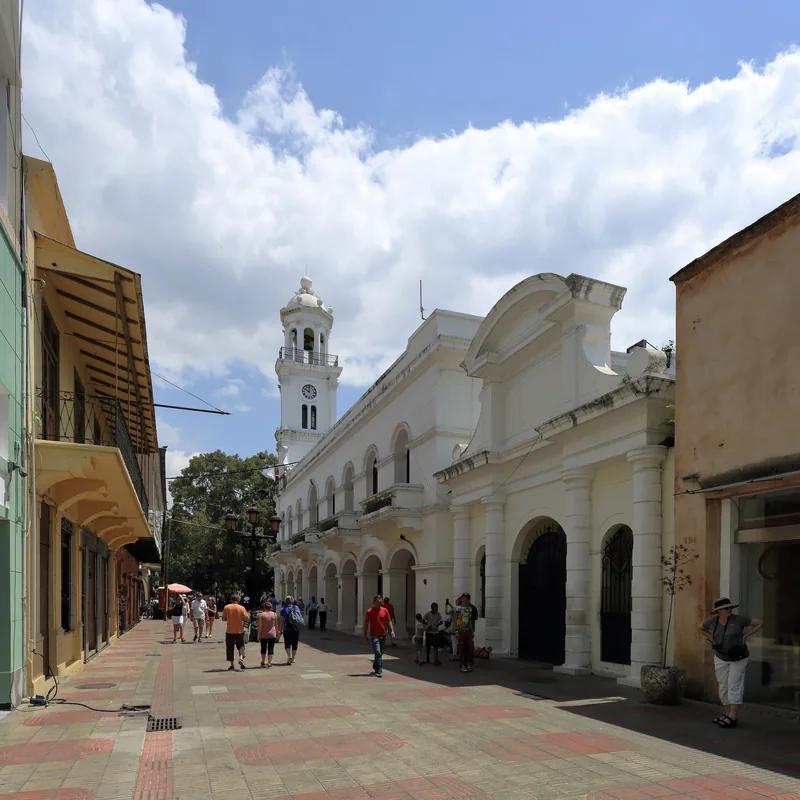
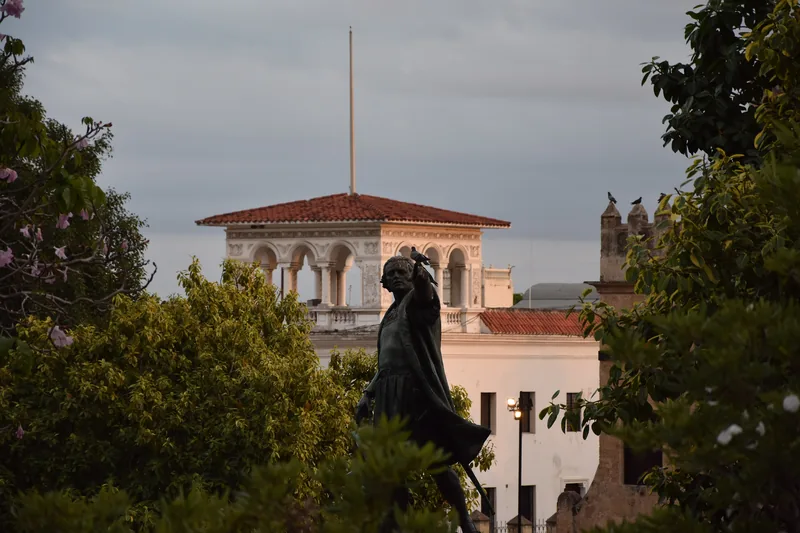
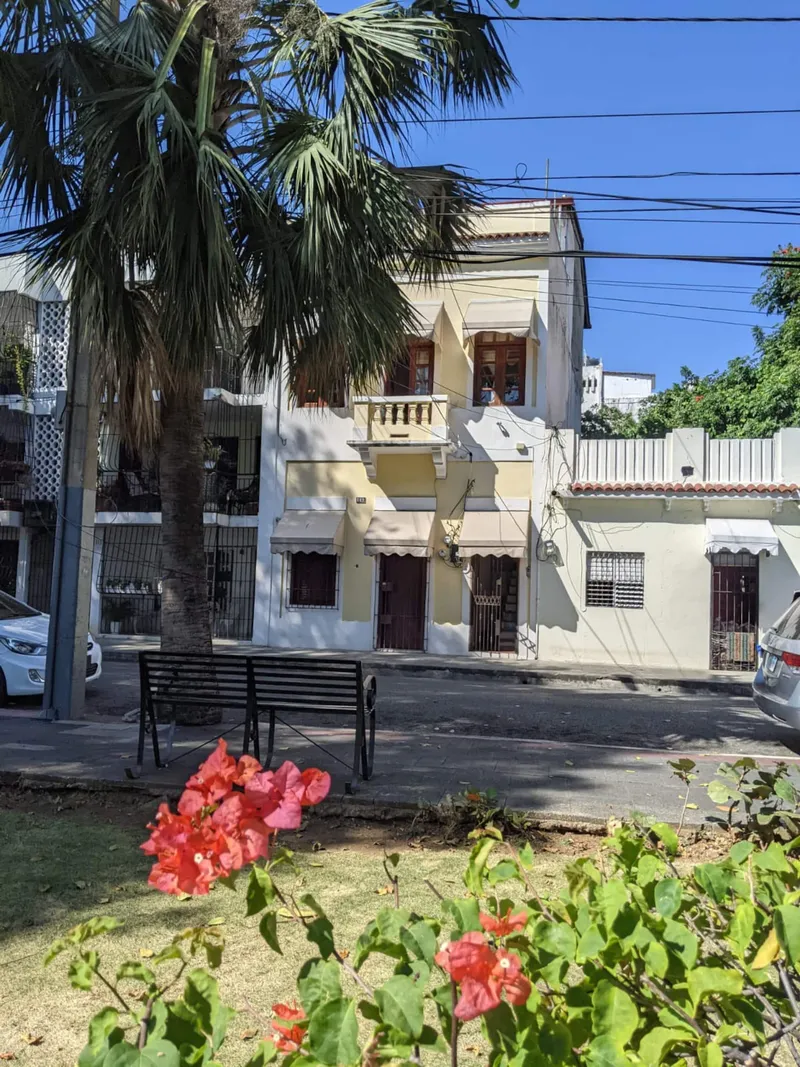
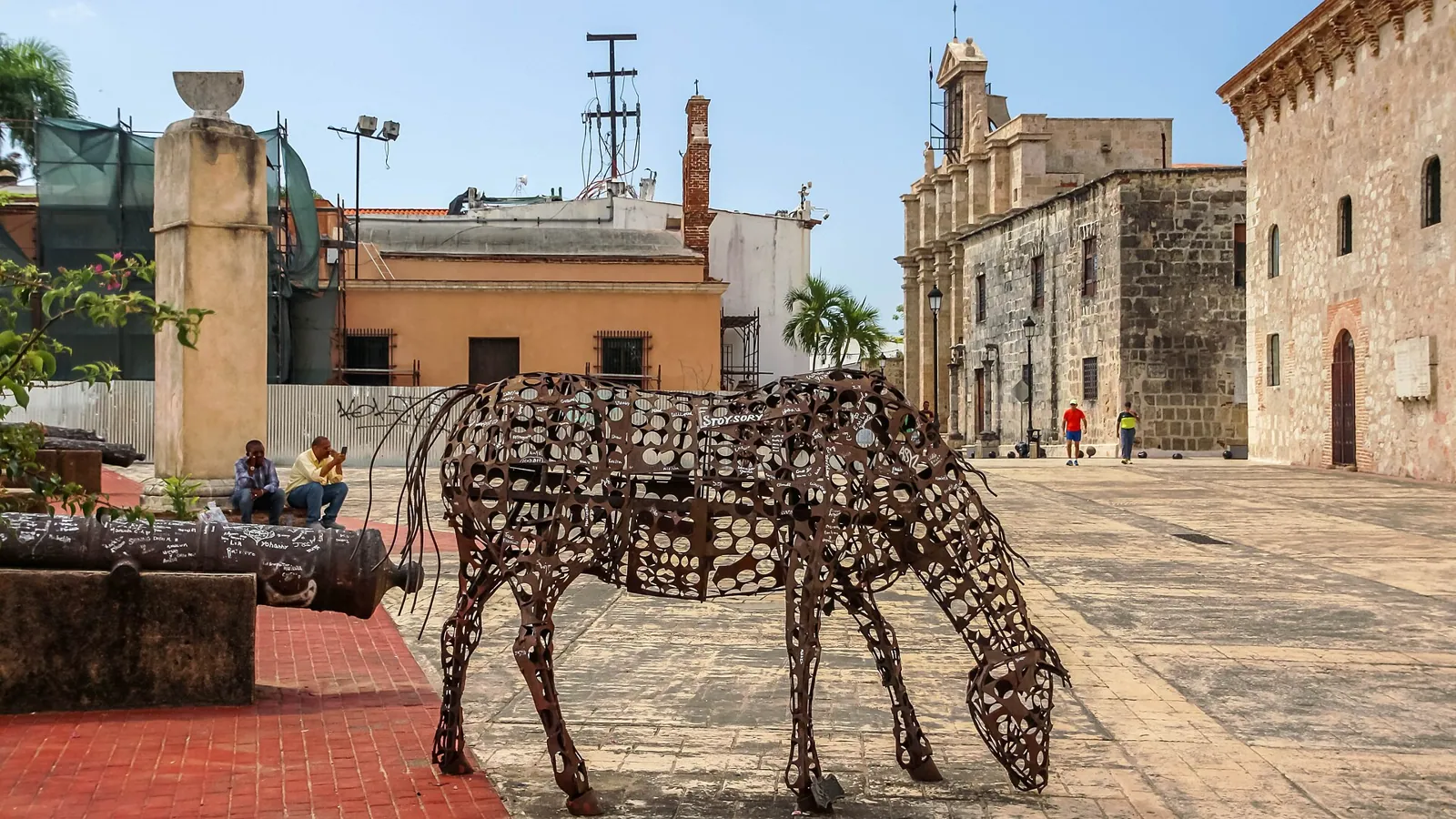
The Casas Reales, or Royal Houses, are two connected stone buildings on Calle Las Damas, a short walk below the Alcázar de Colón. The Spanish Crown ordered them in 1511 to hold the offices of royal authority in the colony. One building was the home of the governors. The other held the Real Audiencia, a court that heard appeals from across the Spanish Caribbean and beyond, along with the treasury accountants who watched the money.
The name says plural for a reason. Nothing about this was a single palace built to impress. It was a government complex, and the museum that fills it today is the most direct place in the Zona Colonial to see how the colony was run: who judged, who governed, who counted, and who got to ask for a decision from the king. This page covers the order of 1511, the court and the governors, the building and its later lives, the sundial outside, what the collection holds, and what to check before you go.
The Order of 1511
The usual date given for the order is 5 October 1511. Dominican heritage sources that repeat it say King Ferdinand II of Aragon commanded the construction, and that the purpose was to house the main government offices of the colony in two connected buildings. One online encyclopedia describes the complex as ordered in 1511 to host the first institutions of colonial government in the Americas.
That year was a busy one for the young city. The Alcázar of Diego Colón was being started a few hundred meters away. A Dominican friar was about to climb a pulpit and challenge the colonists. And the Crown, which had spent its first years leaving governance to the Columbus family, was setting up a court of its own. If you want the palace side of the story, it is told on the page for the Alcázar de Colón. The pulpit story belongs to Fray Antón de Montesinos.
You will see construction dates that differ. One tourism listing gives 1505 for the buildings. Most other sources point to the 1511 order. The simplest reading is that the order of 1511 is the document, and anything earlier is either an earlier structure or a guess. I use 1511 here.
What the Real Audiencia Was
An audiencia was a royal court with judges appointed by the Crown. The one in Santo Domingo is described by the reference entry as the first appeals court in the New World, created by a royal decree of 5 October 1511. Its stated reason was practical. Colonists who wanted to appeal a decision had to send their case across the Atlantic, which cost time and money, and the court was meant to spare them that.
The same source adds an unstated purpose: to limit the powers of Diego Colón. That is worth sitting with. The Crown had given the Columbus family a great deal of authority and then built a court next door that could overrule it. The two buildings, the palace of the viceroy and the houses of the court, were built about the same time and stand a few minutes apart. They show the two forces in the colony, the family that held a title and the government that watched them.
Its reach was large, and it changed over time. According to the reference entry, Mexico got its own audiencia in 1527, and the court at Panama, set up in 1538 or 1540, took Central America, Colombia and the Pacific coast. Florida was added to the Santo Domingo court in 1565. In 1786 the court lost the northern coast of South America and went from four judges to three.
After Diego Colón's final return to Spain in 1523, the court took over the governing of the island as well, according to the same source. It also tells of a bishop, Sebastián Ramírez de Fuenleal, who came as president in 1529 and quarreled with the judges for years over who really governed. It is worth mentioning because it makes the point that this building held arguments as much as rulings.
The Governors' Palace
The second building, which the museum calls the Palacio de los Gobernadores, housed the successive governors and captains general of Santo Domingo. A visitor guide says the offices of the justice tribunal and the treasury shared the complex, and that rooms were set aside for military captains. The two buildings were joined, and what you see from the street looks like one long facade.
The complex went through different uses across the centuries. According to a 2015 travel article, the building was later the seat of the School of Fine Arts and then the Government Palace. The online encyclopedia records that in 1807 the French general Louis Ferrand gave the building a French style, and that more changes were made under the governments of Morales Languasco and Trujillo. Ferrand's time in Santo Domingo came out of the treaty that handed the eastern part of the island to France, which the page on Santo Domingo in the 1700s explains. The Audiencia, for its part, moved to Cuba in 1799 after Spain ceded the Spanish part of Hispaniola to France in 1795. It returned to Santo Domingo in 1861 and ended in 1865.
So the building has been a court, a governors' residence, a school and a government seat. It did not stay a museum from the start. Each use left a trace in the walls, and some of the work done in the twentieth century was meant to take the building back to something earlier.
The Building Itself
The sources agree that the complex combines Isabelline Gothic and Renaissance Plateresque elements with a plain, military look. Isabelline Gothic is the late-medieval Spanish style named for Queen Isabella, with stone ornament and pointed forms. Plateresque is the early Renaissance style whose carved stone surfaces look like silverwork. The heavy walls and small windows are the military note.
One detail you can look for is on the facade facing Calle Las Mercedes. Both an online encyclopedia entry and a Dominican museum listing say it carries the coat of arms of Queen Juana, called Juana la Loca, and that it is the only one of its kind known. No second, independent source backs the "only one" claim, so take it as the museum's own statement. The shield is worth finding all the same.
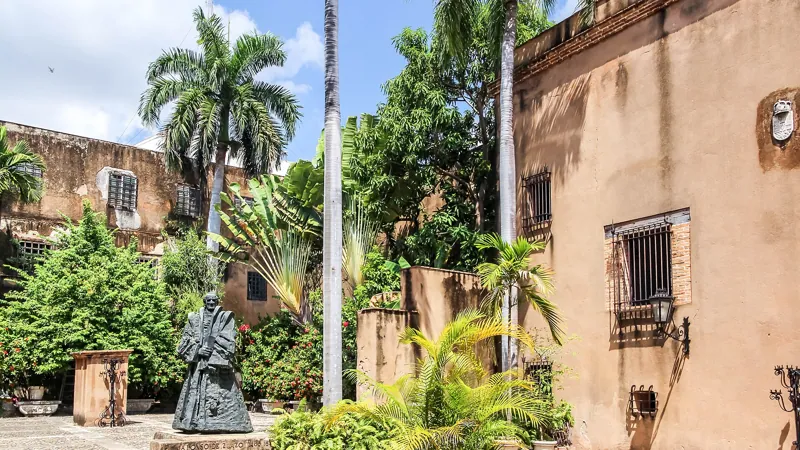
Inside, the museum keeps gardens and a patio, and the interior has architecture and furniture of the period, according to a 2015 travel article. A cafeteria on the ground floor is listed in the online encyclopedia entry. The upper floors hold the formal rooms: the Audiencia gallery, the chief judge's office, the captain general's office, and a Great Hall of the Governors.
How It Became a Museum
Dominican sources agree on the sequence but not on every date. The online encyclopedia gives 18 October 1973 for the opening and 31 May 1976 for the official recognition as the national museum, with King Juan Carlos I of Spain present. The Dirección General de Museos says the museum opened in 1973 and was officially recognized in 1976 with the king in attendance. A tourism entry credits President Joaquín Balaguer with converting the site into a government museum in 1973. Put the three together and the picture is steady: a 1973 start under Balaguer, and a formal ceremony in 1976.
A page on Calle Las Damas says the building was restored and opened as a museum in 1976. That matches. So the museum is a creation of the 1970s, and the buildings are about four and a half centuries older.
The Sundial Outside
In front of the Casas Reales stands a sundial that every visitor passes and few stop for. It is the Reloj de Sol, and the sources say it was built in 1753 by order of Governor Francisco Rubio y Peñaranda, during the reign of Carlos III. The reason is stated directly: so that the magistrates working in the Casas Reales could read the time from their offices. The online encyclopedia adds that it also told officials when the working day ended, and that it was relevant to executions carried out a few meters away at a place called the Picota.
The sources do not agree on what it looks like. The online encyclopedia calls it a sturdy column in the middle of a plaza, with two faces: the southeast face showing the morning hours and the southwest face the afternoon ones, and a metal gnomon casting the shadow. A travel guide describes a low horizontal stone, about waist high, in coral limestone, with a bronze triangular gnomon and Roman numerals running across the flat top, and says a weathered dedication names the governor and the year. It is not clear which description is right. Both sources agree on the date, the governor and the purpose. They also agree it stands at the end of Calle Las Damas, at the entrance to the plaza.
One nice detail if you go: One travel guide says you should add about 30 to 50 minutes to the sundial's reading to get Dominican civil time.
What the Collection Holds
The permanent exhibition covers the history of the island from 1492 to 1821. The museum describes itself as the most complete of its kind on the continent, and that is a claim to hold lightly. The content is broad. Two floors hold about twenty rooms by the count in two reference entries. A 2015 travel article counts nine. The difference is most likely down to how rooms and galleries are counted, and it is a good reminder that museum figures change.
The ground floor
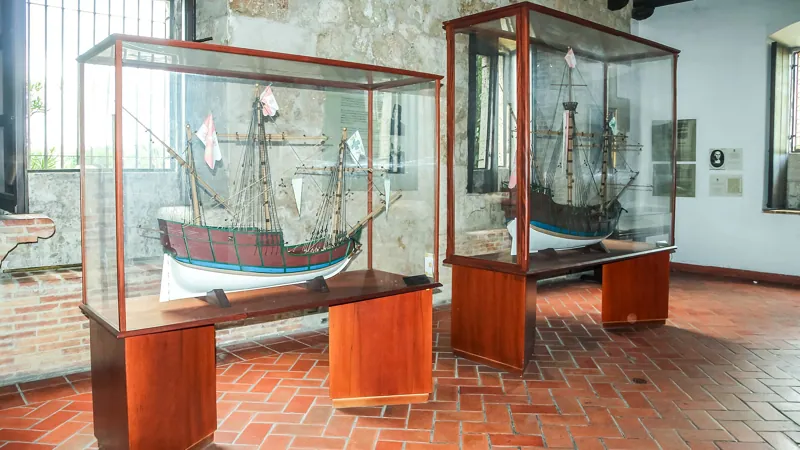
On the first floor you move through the stages of the conquest. There are galleries on discovery, conquest and evangelization, then piracy and smuggling, the colonial economy, the pharmacy, and and a room about Santa Bárbara. The tourism entry also lists Taíno artifacts, navigation equipment, historical maps, ship models, paintings of the conquest, and items about pirates and African slavery.
The treasury area has a more unusual setup. The online encyclopedia says it shows numismatic processes, barter and kinds of coins, with life-size dioramas. A 2015 article mentions a nineteenth-century pharmacy display and reproductions of some of the main ships of the age. If you like ships, this floor is where the collection is strongest. The sea route that fed the colony is the reason the Atarazanas warehouses stand across the plaza, and you can read about them on the page for Plaza de España and La Atarazana.
The upper floor
Upstairs the rooms are about authority. The Audiencia gallery is where the court sat. The chief judge's office and the captain general's office are set up as they might have been, and a room about family life shows what a colonial household held. The Great Hall of the Governors is the largest formal space. There is also a room of historic ceramics and an arms room.
Here the museum touches the twentieth century. A tourism entry says the arms room includes a collection belonging to Rafael Trujillo, A visitor in 2026 should read that as a reminder that the building itself stayed a seat of power long after the colony ended. The online encyclopedia also notes a collection of arms from several periods.
What the museum cannot show
A museum of the colony runs into a problem of who left records. The papers that survive are those of officials and judges. The Taíno, the enslaved Africans and the poor settlers show up in objects and in the margins of laws. The museum lists Taíno artifacts and a slavery theme among its galleries, and you can read the longer story of the island's first people on the page about the Taíno of Hispaniola. When you look at a room of formal furniture, ask who is not in it. The Alcázar's 2026 renovation asked the same question, and the two museums read well together.
Restoration and Current Status
Here the facts are unsettled, so caution is needed. In September 2026, at the reopening of the Alcázar, Tourism Minister David Collado said the ministry had put 400 million pesos into emblematic projects, and he listed the Puerta de la Misericordia, 13 churches, the Panteón de la Patria and the Museo de las Casas Reales, according to Diario Libre. Infobae's report of the same event repeated the list and gave no details on the Casas Reales work. That tells you the building was part of the program. It does not tell you whether it is open.
On that point the sources conflict. One Dominican museum listing says the museum is closed for restoration and lists old prices of 50 pesos for adults and 5 for children. That page is undated. Other 2026 listings show regular hours, and a traveler's review mentions the first floor being closed. No official notice settles it. Before you walk down Calle Las Damas planning an afternoon inside, confirm with the Dirección General de Museos or the Ministry of Tourism. It costs one phone call, and the neighboring Alcázar and the Atarazanas museum are open alternatives if you find the doors shut.
Visiting
The hours most sources give are Tuesday to Sunday, 9 a.m. to 5 p.m., closed Monday. The online encyclopedia gives those hours, a tourism entry gives them, and a 2015 travel article does too. The official museum page shows a Monday closure but its hours are scrambled, so it is not a reliable guide.
Prices change. The tourism entry gives 100 pesos for everyone, foreigners included, with audio guides in English and other languages. The undated listing above gives 50. Take those as a range and confirm at the door.
Plan about an hour. If you like detail, plan more, because the two floors and the weapons rooms reward slow reading.The museum sits where three things meet in a line: the sundial outside, the plaza beyond it, and the Alcázar at the head of the plaza. Visit them in that order and you cover the clock, the court and the viceroy's house in under half a day. The Panteón de la Patria, a former Jesuit church now used as the national pantheon, stands a few doors south along the same street, and it has its own page at Panteón de la Patria.
What the Casas Reales Tell You
A visit here gives you something the cathedral and the forts do not. The cathedral shows what the colony believed, and the fortress shows what it feared. The Casas Reales show how it decided things. The Audiencia heard appeals and, from 1523, helped run the island. Its jurisdiction shrank over the 1500s as Mexico, Panama and other courts took over their regions. By 1786 it had lost the northern coast of South America and a judge, and by 1799 it had left the island.
That arc is the story of Santo Domingo itself: the first court in a vast territory, then one of many, then a distant seat of a small colony. You can read the same shrinking in the building's later uses, from court and palace to school and offices. And you can see how the Zona Colonial was kept alive by being used, not frozen.
For the larger story of how the city moved from its founding to the present, see A History of the Zona Colonial. For a walking route that includes the Casas Reales, the landmarks guide and the Zona Colonial complete guide set out the order.
Getting there from the penthouse
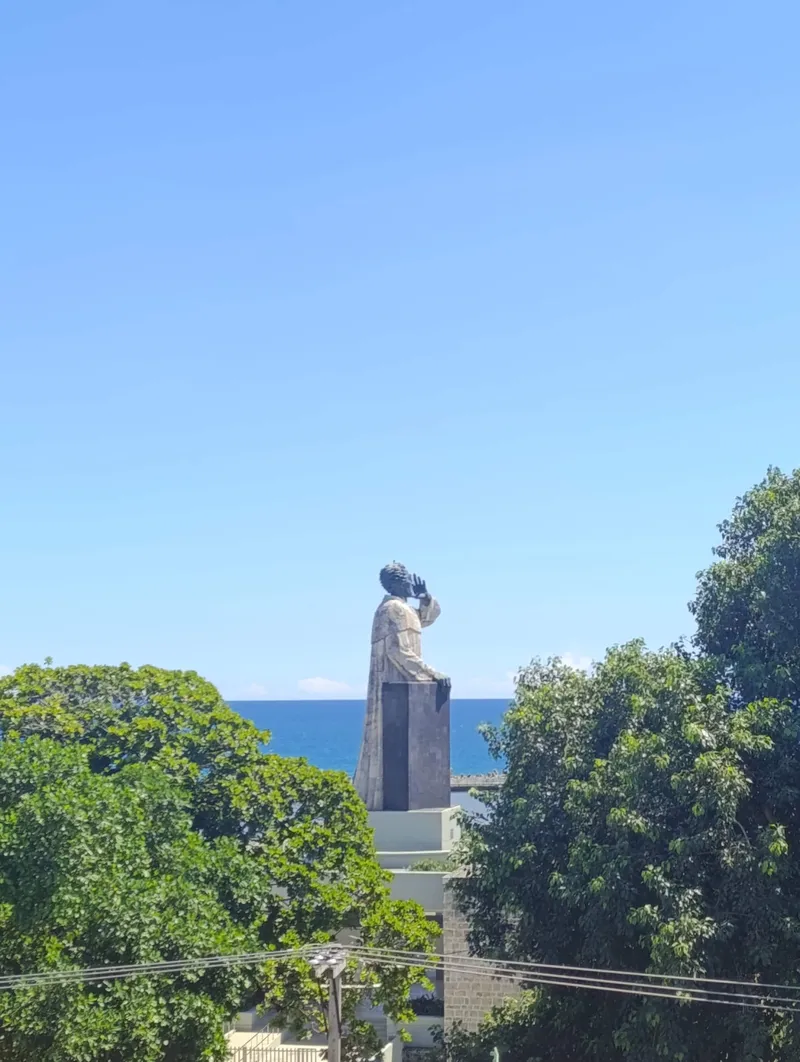
Penthouse Pallazzo is about 150 meters north of Playa Montesinos, facing the Montesinos monument. The Casas Reales stand roughly 700 meters from the house in a straight line, to the north and slightly east, near the plaza end of Calle Las Damas. With the bends of the streets, that is about 15 minutes on foot.
The easiest route is to walk toward the river and the Fortaleza Ozama, join Calle Las Damas and follow it north. You will pass the old houses along the street, and the Casas Reales stand near the sundial, before the street opens onto Plaza de España.
Frequently asked questions
What were the Casas Reales?
Two connected buildings ordered by the Spanish Crown in 1511. One was the Palace of the Governors, where governors and captains general lived and worked. The other housed the Real Audiencia, the first appeals court in the New World, and the treasury accountants.
Is the museum open?
Most sources list Tuesday to Sunday from 9 a.m. to 5 p.m. One undated listing says it is closed for restoration, and the Ministry of Tourism named the building among its 2026 restoration investments. Confirm with the Dirección General de Museos before you go.
When was the sundial built?
In 1753, by order of Governor Francisco Rubio y Peñaranda, so that the magistrates in the Casas Reales could read the time from their offices. Sources describe its shape differently, so look closely when you stand in front of it.
What does the museum cover?
The history of the island from 1492 to 1821, over about two floors. Galleries cover discovery and conquest, piracy and smuggling, the economy, a pharmacy, the Audiencia, family life and the governors. There are also Taíno artifacts, maps, ceramics and arms, including a collection that belonged to Rafael Trujillo.
Why did the court leave Santo Domingo?
After Spain ceded the Spanish part of Hispaniola to France in 1795, the Audiencia moved to Puerto Príncipe in Cuba, in 1799 by the reference entry's account. It returned to Santo Domingo in 1861 and ended in 1865.
Sources
- https://www.encyclopedia.com/humanities/encyclopedias-almanacs-transcripts-and-maps/santo-domingo-audiencia
- https://www.ecured.cu/Museo_de_las_Casas_Reales_(Rep%C3%BAblica_Dominicana
- https://www.ecured.cu/Reloj_de_Sol_(Rep%C3%BAblica_Dominicana
- https://www.ecured.cu/Calle_Las_Damas_(Santo_Domingo
- https://visitdominicanrepublic.com/history-heritage/museo-de-las-casas-reales/
- https://www.visitarepublicadominicana.org/museo-de-las-casas-reales-santo-domingo
- https://www.porconocer.com/republica-dominicana/museo-de-las-casas-reales-un-recorrido-por-la-historia.html
- https://apuntesyviajes.com/2024/07/12/museo-de-las-casas-reales-un-vistazo-a-la-historia-colonial-de-santo-domingo/
- https://drrevealed.com/things-to-do/culture-history/reloj-del-sol-the-colonial-sundial-facing-the-royal-houses
- https://www.diariolibre.com/actualidad/nacional/2026/09/28/abren-alcazar-de-colon-tras-renovacion-de-tres-anos/3672527
- https://www.infobae.com/republica-dominicana/2026/09/29/la-ciudad-colonial-se-renueva-restauracion-historica-y-movilidad-sostenible-para-santo-domingo/
- https://nominatim.openstreetmap.org/search?q=Museo+de+las+Casas+Reales+Santo+Domingo&format=json&limit=3