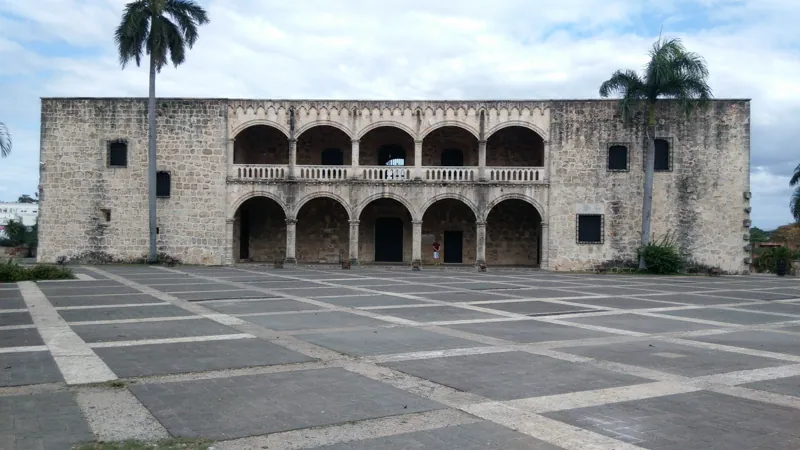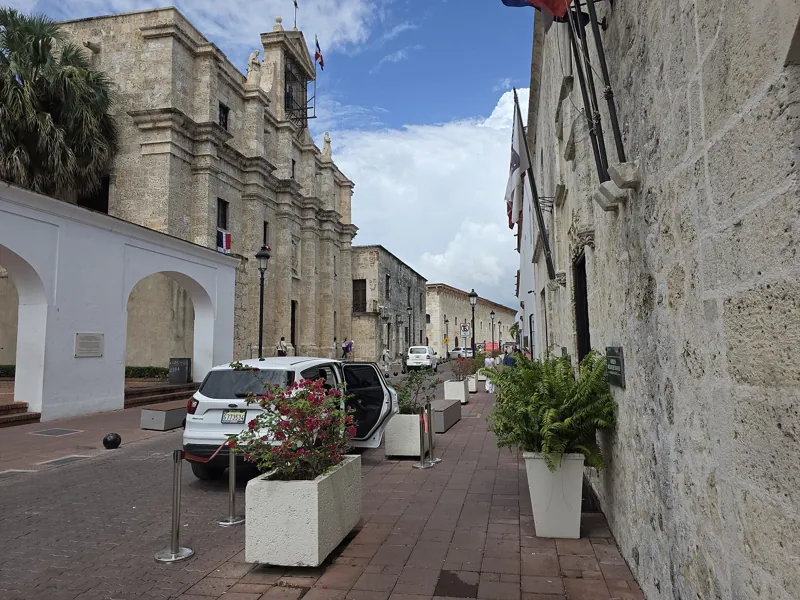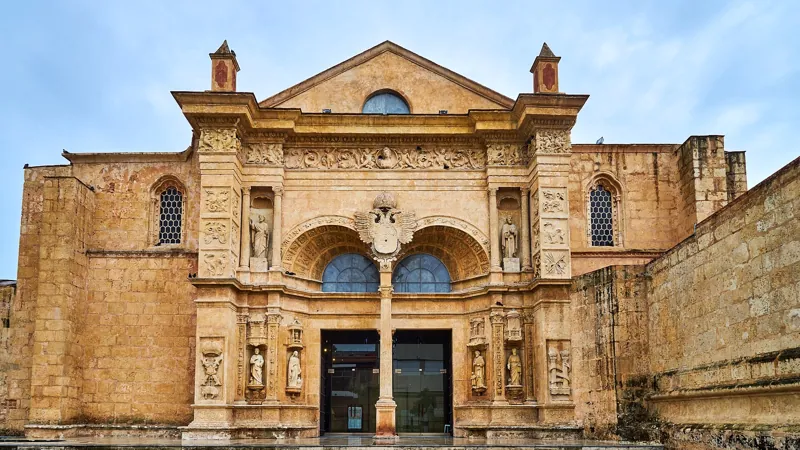
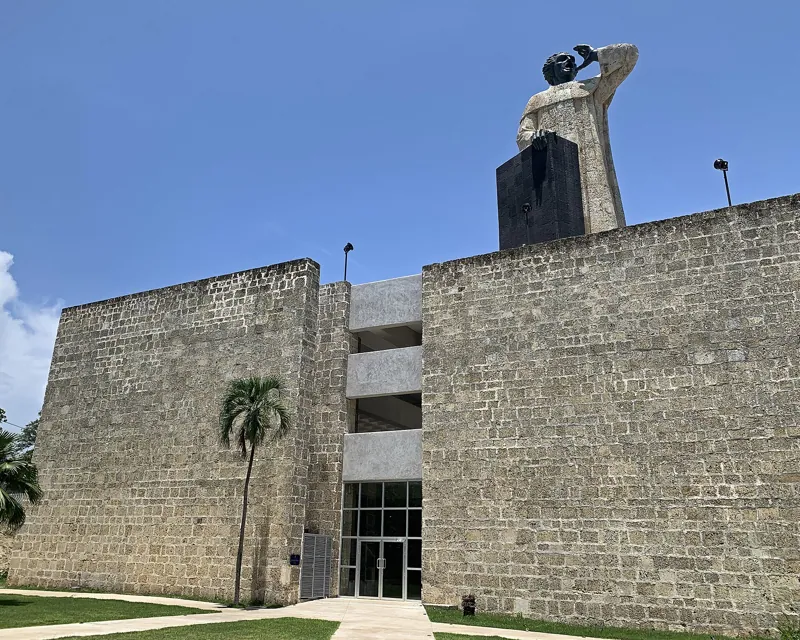
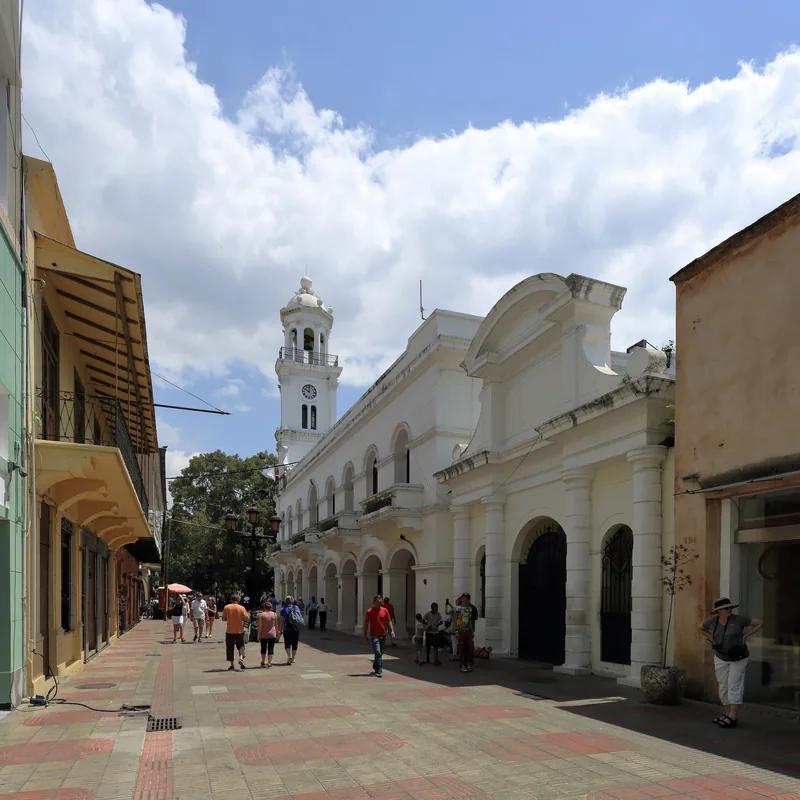
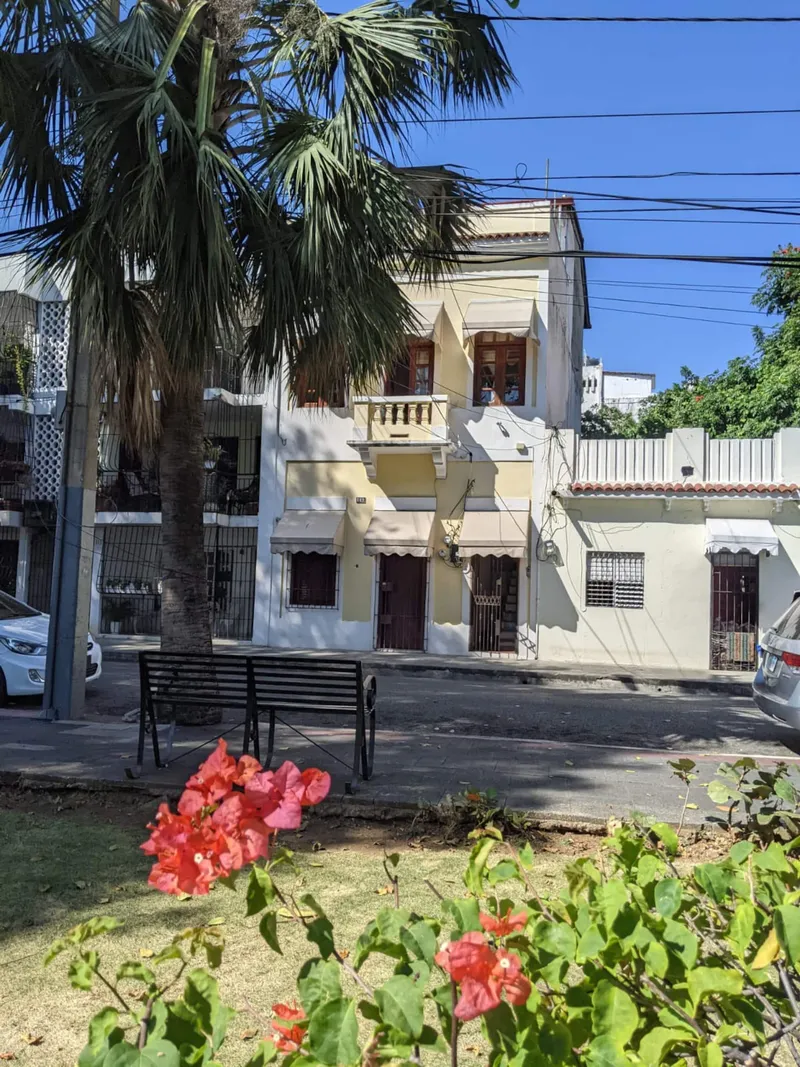
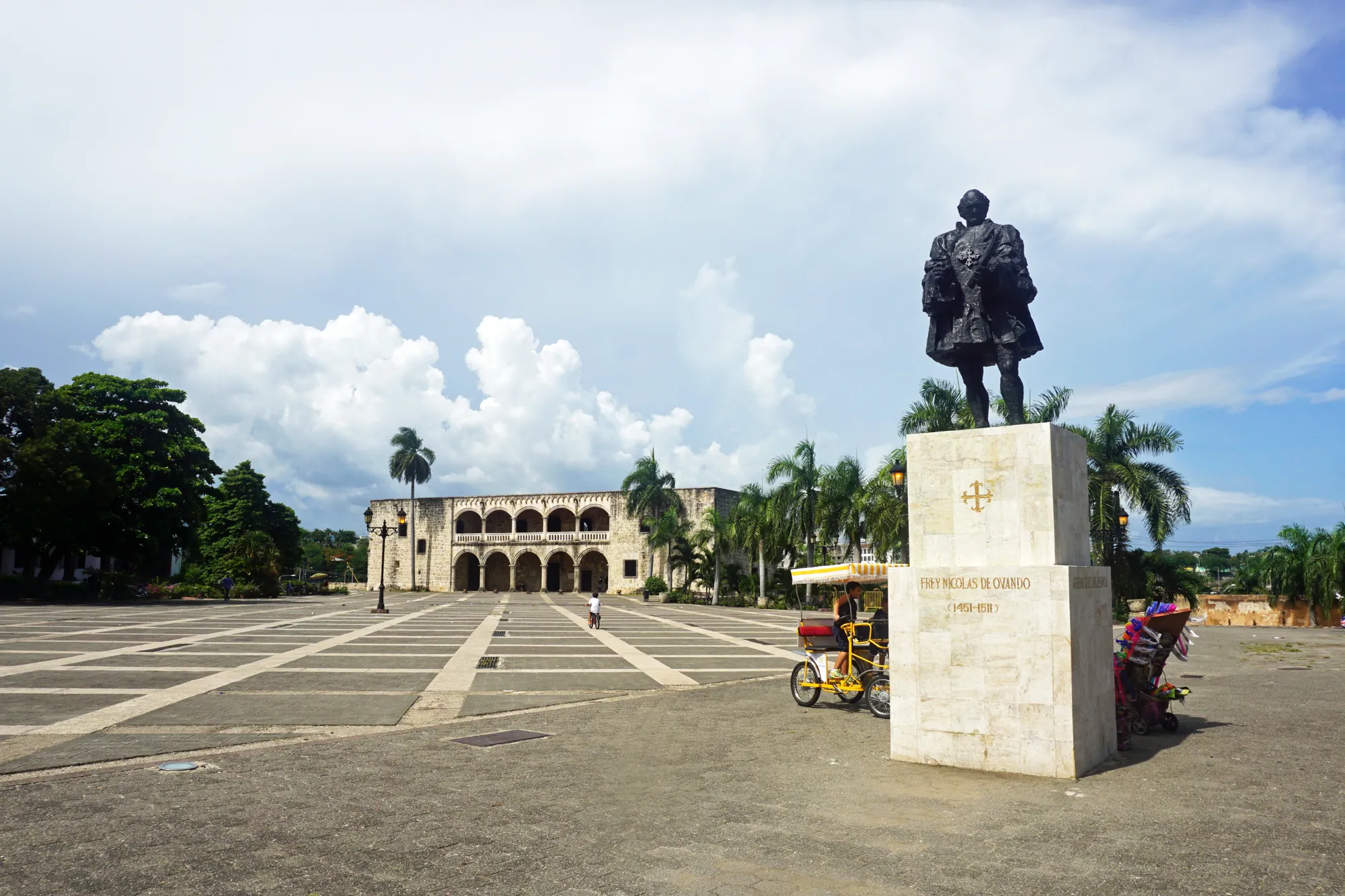
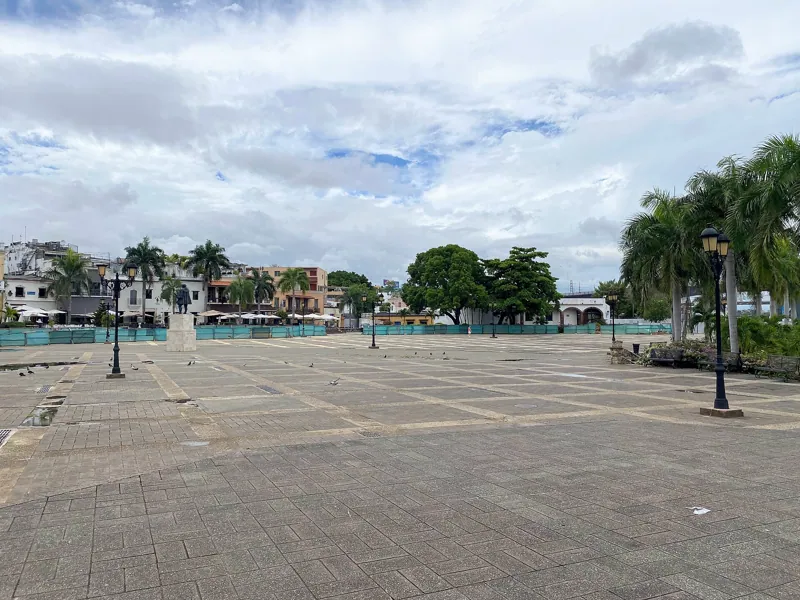
Plaza de España is the widest open space in the Zona Colonial, and it sits where the old city met the river. The Alcázar de Colón fills its western side. The Casas Reales and their sundial stand at the head of Calle Las Damas. To the north runs Calle La Atarazana, lined with the long brick warehouses that once supplied and outfitted the ships of the Spanish colony. To the east a stone gate in the old wall opens toward the Ozama and the port.
The plaza is also a place people use. Families walk through it, and in the evening the restaurant terraces fill the arcades. This page tells you how the square came to be, who the statue in the middle honors, what La Atarazana was and why it matters, and how to spend an hour or an evening here. It also says where the sources disagree, because on this square they do more often than you would expect.
One Square, Two Names
You will see the square called Plaza de España and Plaza de la Hispanidad. Both names are in use in Dominican sources. A local history of the plaza says a presidential decree, number 4217 of 3 January 1974, formally gave it its present name. That is worth knowing because it tells you something about the square: the space is old, but the name is a modern, official label.
The sources also differ on how old the square itself is. Both an online encyclopedia and a local history of the plaza say it dates from the sixteenth century. The encyclopedia adds that it was a social center for the first Spanish families, and that the first colonial houses were built nearby, close to the river. That fits the geography. This corner is where the city's governor, its court and its port all stood within a few minutes of one another, and the open ground between them would have been the natural place to gather. No map or document of the 1500s is cited that shows the plaza as a designed square, so the safe reading is that it grew as open ground between important buildings and was shaped into a plaza later.
What we know about its more recent shape is clearer. One online encyclopedia says it was remodeled in 1990 under President Joaquín Balaguer. The same history says the large area in front of the Alcázar has been renovated many times, with the most recent major work in the 1990s for the 500th anniversary of 1492, which fell on 12 October 1992. The two accounts are compatible. The square was reworked in the years just before the quincentennial, and it has been touched since.
Another detail from the same history: a section of the original city wall runs along the plaza's east edge, parallel to the Ozama, and the Puerta de San Diego gives access to the river from there. That wall and gate give the square a sense of being on the edge of something, which it was.
The Statue of Nicolás de Ovando
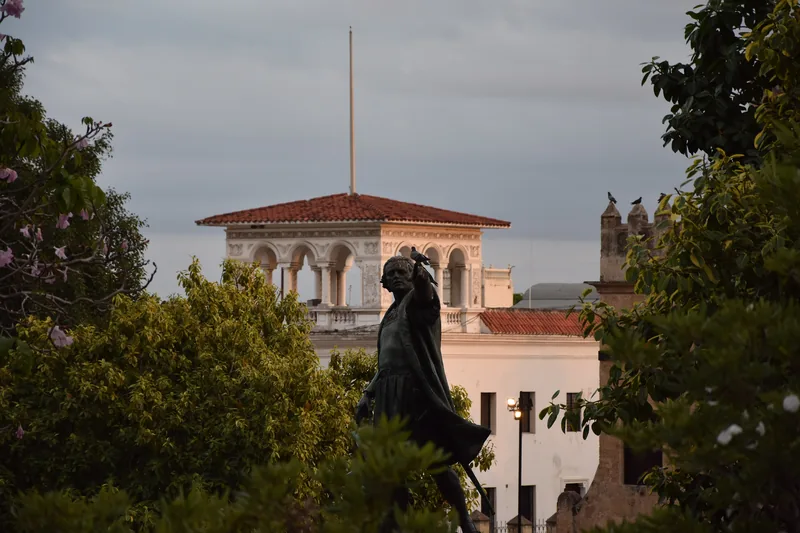
In the middle of the plaza stands a bronze statue of Nicolás de Ovando. Dominican tourism pages, including the Ministry of Tourism's site and the online encyclopedia entry, describe it as honoring the governor who ruled the island from 1502 to 1509 and who oversaw the relocation and rebuilding of Santo Domingo. A local guide puts the arrival more precisely and says the move of the settlement to the west bank of the Ozama came after a major hurricane in 1502. The local history adds that he arrived on 15 April 1502 with 32 ships and about 1,500 colonists, though that number is given as a teaser line, not a full account, so treat it as approximate.
The statue is a monument to a founder, and that is how the plaza presents him. The record of his governorship is harder. The local guide, which compiles several accounts, says King Ferdinand recalled him to Spain in 1509 because of his brutal treatment of the Indigenous people. It says he ordered the arrest of the Taíno queen Anacaona early in his governorship and that she was executed by hanging, and it describes massacres at Jaragua and Higüey and forced labor in mines and on farms. The same guide credits him with founding 17 towns and creating the first town councils. All of this is in one reference page, and historians weigh these events differently, so if the subject matters to you, read the longer histories before you form a view.
What can be said for sure is that both things are true of the plaza: it honors the man who laid out the city, and he is also the governor whose rule was condemned by his own king. The plaza does not explain this, and the Taíno side of the story is told on the page about the Taíno of Hispaniola. Another statue, of Anacaona, stands in Parque Colón, according to the same guide, which gives the two figures a kind of dialogue across the district if you know to look for it.
The Alcázar and the Casas Reales
The two great buildings of the plaza have their own pages, so this section is brief. The Alcázar de Colón was begun in the 1510s as the palace of Diego Colón and María de Toledo and reopened in September 2026 after a three-year restoration. The Museo de las Casas Reales, ordered in 1511, held the first appeals court in the New World and the governors' residence.
What matters for the plaza is how these buildings frame the space. The Alcázar's arcaded galleries look over the square, and the Ministry of Tourism says the 2026 renovation added heritage lighting for the building and the patio, and a visual projection facing Plaza de España. In front of the Casas Reales stands the Reloj de Sol, the sundial dated 1753. The online encyclopedia calls the little space around it the Plazoleta del Reloj del Sol, at the end of Calle Las Damas and before Plaza España. So the plaza is really a sequence: the street arrives at the sundial, the sundial opens onto the square, and the square is held between the palace and the warehouses.
What an Atarazana Was
An atarazana is a shipyard and storehouse. In Santo Domingo, La Atarazana is the name of the street on the north side of the plaza and of the group of buildings along it. The Reales Atarazanas, the Royal Shipyards, were Crown property.
El Día describes them as built on the west bank of the Ozama under a royal order issued to Governor Frey Nicolás de Ovando, with construction starting around 1507, and says the building is made entirely of brick. Its first job was to repair and caulk wooden ships and to load merchandise. Other accounts place the start a couple of years later, and tourism material gives the loose range of the fifteenth and sixteenth centuries. The early 1500s is the safe statement.
The architecture is plain and clever. El Día says the building has three naves with barrel vaults. The central nave was taller than the side naves, and the side naves worked as buttresses that held the center up. One nave stayed unvaulted until a twentieth-century restoration covered it. The article credits this balance with the building's survival for about five centuries through earthquakes and hurricanes.
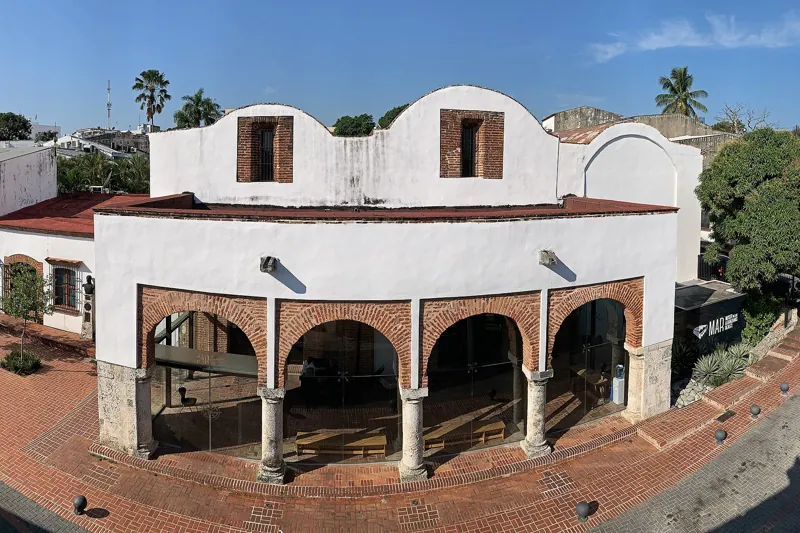
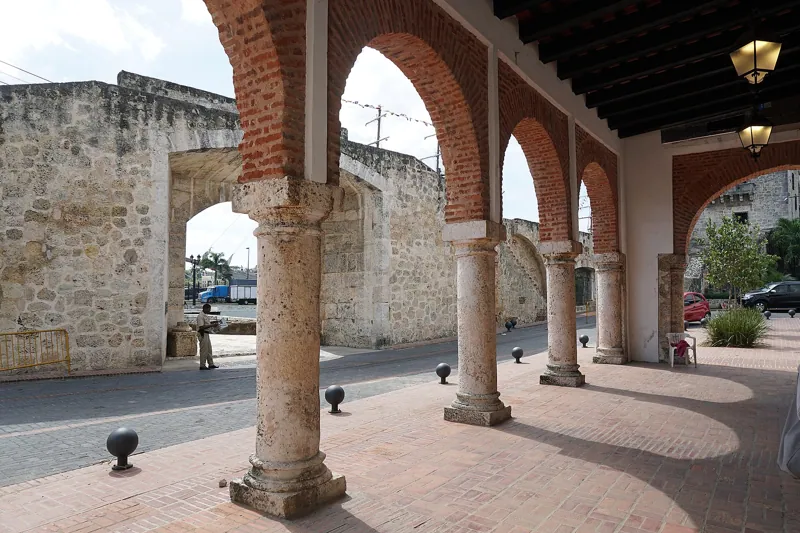
In the eighteenth century a portico on columns and arches was added in front. El Día notes that the stone columns are the only non-brick material in the building, and that the portico covers only the central and south naves. In that century the building also became a warehouse and a customs house for imported goods, mainly from Europe. For that century as a whole, see Santo Domingo in the 1700s.
Why the Shipyard Mattered
El Día makes a point worth repeating. Ships were repaired and provisioned here before they sailed out to explore, conquer and colonize the rest of the Americas. That is the same role the Alcázar played at the level of government. If the palace is where the decisions were made, the Atarazana is where the supplies were loaded. The article also says that German bankers who backed Emperor Charles V requested and received the administration of the building, and credits them with conquests in what is now Venezuela and Colombia. This is a rough summary of an episode that other histories tell in more detail, and it is the kind of point where it pays to read a specialist. It is included because it shows how far the building's reach went. A storehouse in a small colonial town was entangled with the finances of the Holy Roman Empire.
The sea itself is the other thread. The city sits on the Ozama because the river made a harbor, and a harbor needs yards, storehouses and customs. The page about the Río Ozama and the old port tells that story from the water side. From the plaza you are standing at the edge of it.
From Ruin to Museum
By the time of its latest restoration the building was in an advanced state of deterioration, according to a news report. A twentieth-century restoration had covered the last unvaulted nave, but the work that made it a museum came later. The project was part of the Programa de Fomento al Turismo Ciudad Colonial de Santo Domingo, financed by the Inter-American Development Bank, and it took four years and about 2.6 million dollars, per El Nuevo Diario. The restoration team was led by the architect Esteban Prieto, with museography by the Spanish firms Hidria Reina de Corazones and Avanzia.
The Museo de las Atarazanas Reales, known as MAR, was inaugurated on 12 December 2019 by President Danilo Medina, with the ministers of culture and tourism present. It displays 1,200 pieces of the country's underwater cultural heritage. El Nuevo Diario says the objects range from the Nao Santa María, the ship Columbus sailed in, to 74-gun warships sunk in nineteenth-century conflicts, and that they belonged to Spanish, French, English and Dutch sailors over roughly five centuries. The national collection exceeds 50,000 items recovered since the 1970s by the Oficina Nacional de Patrimonio Cultural Subacuático.
One local guide says more than 1,400 pieces were restored for the display. The two counts differ (1,200 pieces in the opening reports, more than 1,400 in that guide), and the museum's own explanation for the gap is not published.
What the Museum Shows
An Arquitexto article on the museum says it tells the story of 12 shipwrecks. The first is the Santa María, which the article describes as running aground in the fifteenth century. The most important display comes from the 1724 wreck of the silver-carrying ships Nuestra Señora de Guadalupe y San Antonio and Conde de Tolosa. Visitors can walk through a full-scale recreation of part of the interior of the Guadalupe, including its artillery batteries, built by Cruz Apestegui and Carlos Barrot. The same article says the Laboratory of Underwater Cultural Heritage of the Ministry of Culture holds more than 100,000 objects from these wrecks, with some shown here and some at the Faro a Colón, and that formal rescue work began in 1979, when the Presidency created a commission for underwater archaeological rescue.
The design of the exhibition was meant to respect the building. According to Arquitexto, it uses freestanding panels at a height that keeps the space visible, and information comes on three levels: large general panels, screens and tablets with more detail, and small labels inside the cases. If you have looked at the vaults on the way in, you will notice that the exhibition keeps out of their way.
Visiting the Museum
Hours depend on the source. One local guide lists Tuesday to Sunday from 10 a.m. to 6 p.m., closed Monday. El Nuevo Diario's 2019 opening report gave Tuesday to Friday 9 a.m. to 5 p.m. and Saturday 10 a.m. to 4 p.m., so the hours may have changed since then. Prices vary even more. That guide says only that admission is affordable and that children get discounts, and it points to the museum's social media, @museodelmarrd, for current rates. Check before you go. The museum's phone number on that page is +1 809-508-8717.
Plan an hour. If you only want the building, the facade and the portico are visible from the street at any time, and the Atarazanas street is pleasant to walk by day.
Calle La Atarazana Today
Most of the rest of the Atarazanas buildings kept their outer shell and now hold restaurants, bars and art galleries. A tourism listing says they house restaurants, nightclubs, galleries and other uses, and the ministry page says restaurants, discos and art galleries. Neither source names particular places, and businesses change, so none are named here. What you can rely on is the setup: a row of old brick vaults facing a plaza, with tables outside at dusk.
This is also where the plaza becomes what its supporters call the most typical Dominican evening. The same tourism pages say bars and restaurants set out terraces on the square at dusk and describe a lively atmosphere. The local history adds that the plaza hosts concerts, festivals and cultural shows, and that it is a place for sunset dinners and for family walks or bike rides. The plaza is bordered, according to the ministry page, by La Atarazana, Restauración and Paseo del Presidente Billini streets.
If you want a meal after the museums, the eating and drinking guide covers the choices, and the evening mood of the district is described in the Colonial Zone at night.
The River Gate
A short walk from the plaza's east side is the Puerta de San Diego, also called the Puerta de la Mar, the gate to the sea. A tourism listing says it was built in 1576 and served as the main entrance to the colonial city from the sea. It is the only one of the three surviving gates in the wall that is decorated, in Plateresque style, with columns set against the wall on either side. The listing says it bears the coats of arms of the king, of the island of La Española and of the city of Santo Domingo, and that the Fuerte de San Diego protected it.
Dates for this gate are not settled. Other accounts place it in 1540 or 1549, and give different dates for its restoration, in the 1880s or 1980. All that can be said is that the gate is sixteenth-century and that the listing ties its restoration to the building of the Avenida del Puerto. The longer story of the port and the river is on the page about the Río Ozama and the old port.
For the visitor, the point is simple. Walk to the east edge of the plaza, pass through the gate, and you are on the road beside the river, looking at the water that this whole corner of the city was built to use.
How the Square Works Today
A good way to use the plaza is to treat it as a hinge between the museums and the evening. Come once to look at the buildings, and again after dark when the terraces fill and the square becomes an open-air room.
One practical note. Public events happen here, according to the local history, so you may find stages or crowds on festival days. The carnival and festivals guide says more about when those fall.
The district around the plaza is also in the middle of a public renewal program. Infobae's September 2026 report says more than 100 homes in the Ciudad Colonial have been recovered, with a goal of 140, and more than 130 facades are being painted. You may see scaffolding or fresh paint as you walk. That is a sign the work is still going, and the program is expected to finish some of its pieces in December, according to the president's remarks quoted in Diario Libre.
A Route Through the Square
If you have an hour, try this order. Start at the Reloj de Sol and read the time against your phone. Cross the plaza to the Ovando statue and look back at the Alcázar's galleries. Walk north along Calle La Atarazana as far as the museum entrance and look at the brick vaults and the eighteenth-century portico. Return and go through the Puerta de San Diego to the river road. Then sit down.
If you have half a day, add the Alcázar and the Casas Reales, and finish with the museum of the shipwrecks. That sequence follows the colony's own logic: the court, the palace and the supply yard, all within a few hundred meters. The landmarks guide places them in the larger walking route, and the Zona Colonial guide covers the plazas and the streets between them.
Getting there from the penthouse
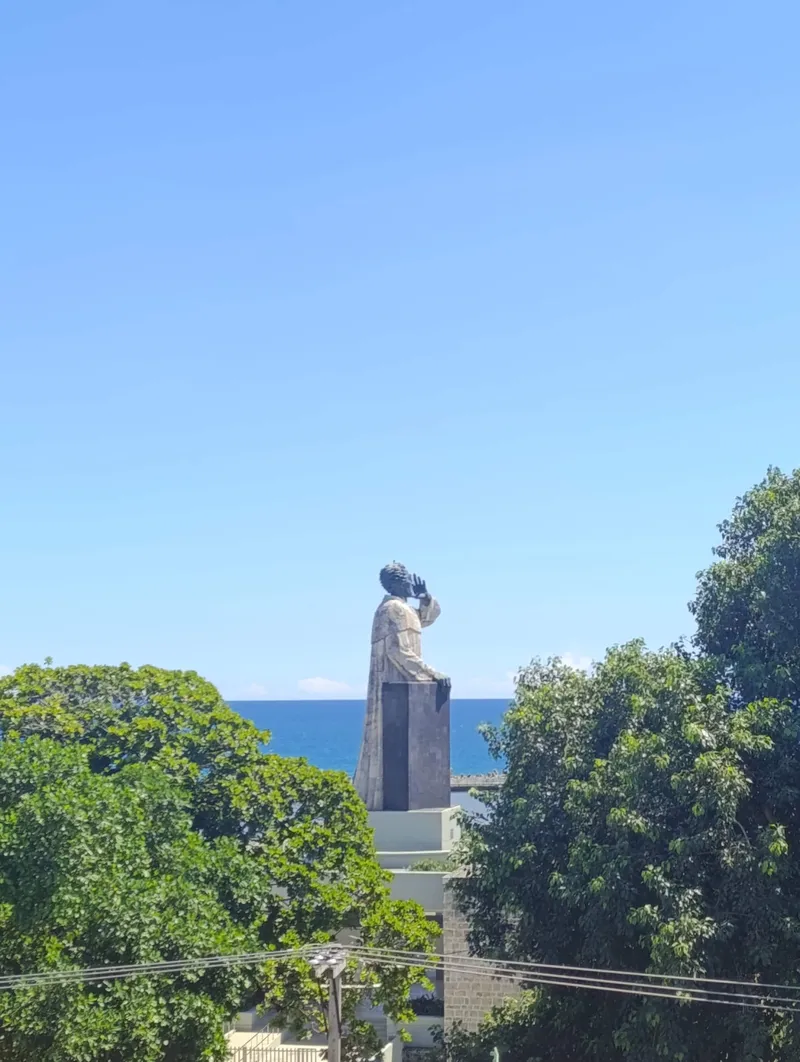
Penthouse Pallazzo is about 150 meters north of Playa Montesinos, facing the Montesinos monument. Plaza de España is to the north and a little east, roughly 860 meters in a straight line from the house, which works out to about 15 minutes on foot once you follow the streets. A simple way to do it is to walk toward the river and the Fortaleza Ozama, join Calle Las Damas and follow it north until it opens onto the plaza at the sundial.
Go in the morning for the quietest square, or in the early evening if you want the terraces. If you would rather ride, a short taxi or ride-hailing trip gets you to the plaza in a few minutes.
Frequently asked questions
What is La Atarazana?
It is the name of the street on the north side of Plaza de España and of the long brick buildings along it, the Reales Atarazanas, or Royal Shipyards. They were Crown property used for repairing ships and storing and loading goods, and later as a warehouse and customs house.
Who is the statue in Plaza de España?
Nicolás de Ovando, governor of Hispaniola from 1502 to 1509, who oversaw the move and rebuilding of the city on the west bank of the Ozama. Sources on his governorship also record the execution of the Taíno queen Anacaona and his recall to Spain in 1509.
What is inside the Atarazanas now?
The Museo de las Atarazanas Reales, opened on 12 December 2019, shows about 1,200 pieces from shipwrecks in Dominican waters, including a full-scale recreation of part of a galleon's gun decks. Other parts of the buildings hold restaurants, bars and galleries.
When was Plaza de España named?
A presidential decree of 3 January 1974, number 4217, gave it the name, according to the local history. It is also called Plaza de la Hispanidad.
Is the plaza good in the evening?
Many sources describe the terraces filling at dusk, and the square hosts concerts and festivals. Times and events change, so check what is on if you are planning around one.
Sources
- https://gustavosilvagarcia.com/plaza-de-espana-de-la-ciudad-colonial-de-santo-domingo
- https://www.ecured.cu/Plaza_Espa%C3%B1a_(Rep%C3%BAblica_Dominicana
- https://www.visitdominicanrepublic.org/plaza-espana-square-santo-domingo
- https://www.visitarepublicadominicana.org/plaza-espana-santo-domingo
- https://www.visitarepublicadominicana.org/puerta-san-diego-santo-domingo
- https://eldia.com.do/reales-atarazanas-orgullo-que-acrecienta-legado-cultural-rd/
- https://elnuevodiario.com.do/que-novedades-ofrece-el-recien-inaugurado-museo-de-las-atarazanas-reales/
- https://diariodigitalrd.com/2019/12/13/el-tesoro-subacuatico-es-expuesto-en-el-museo-de-las-atarazanas-reales.html
- https://arquitexto.com/2020/05/museo-las-atarazanas-reales/
- https://zonacolonial.org/museos-zona-colonial/museo-de-las-atarazanas-reales
- https://www.colonialzone-dr.com/nicolas-ovando/
- https://www.ecured.cu/Reloj_de_Sol_(Rep%C3%BAblica_Dominicana
- https://www.infobae.com/republica-dominicana/2026/09/29/la-ciudad-colonial-se-renueva-restauracion-historica-y-movilidad-sostenible-para-santo-domingo/
- https://noticias.mitur.gob.do/ministro-noticias/inauguran-remozamiento-museo-diego-colon-palacio-virreinal/
- https://nominatim.openstreetmap.org/search?q=Plaza+de+Espa%C3%B1a+Santo+Domingo&format=json&limit=3