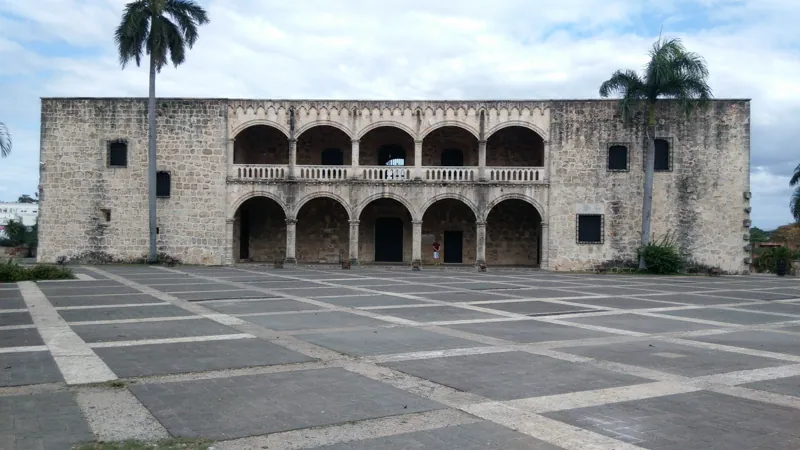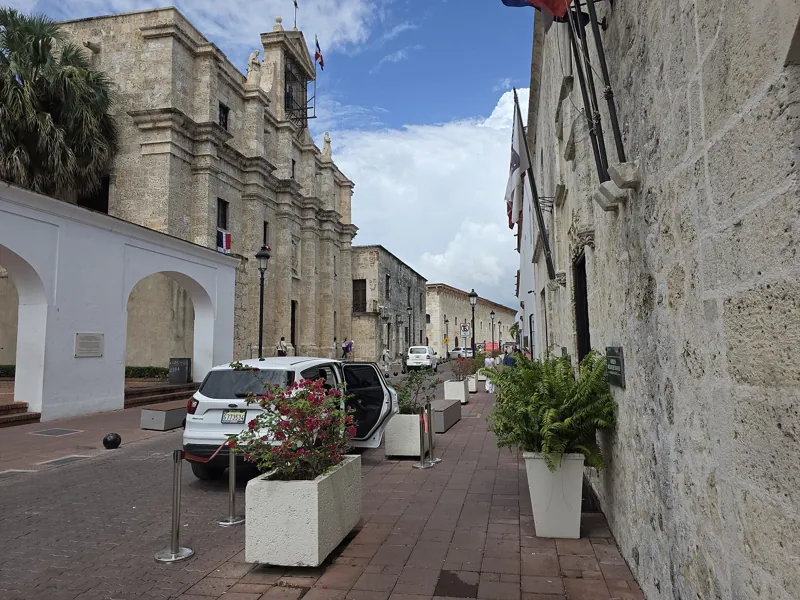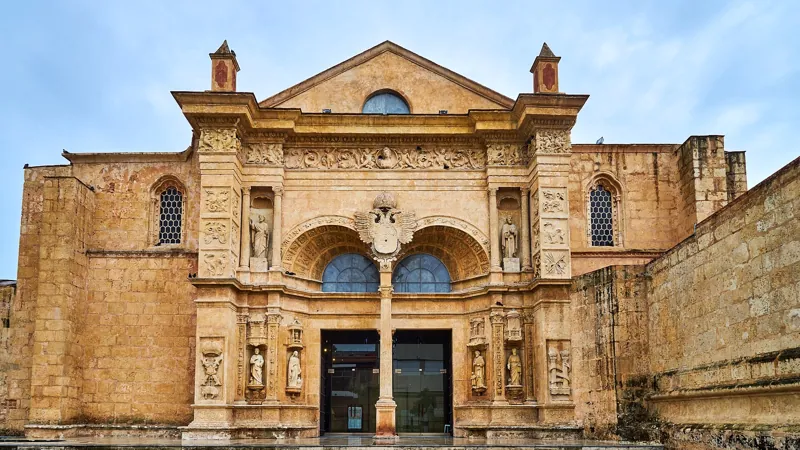
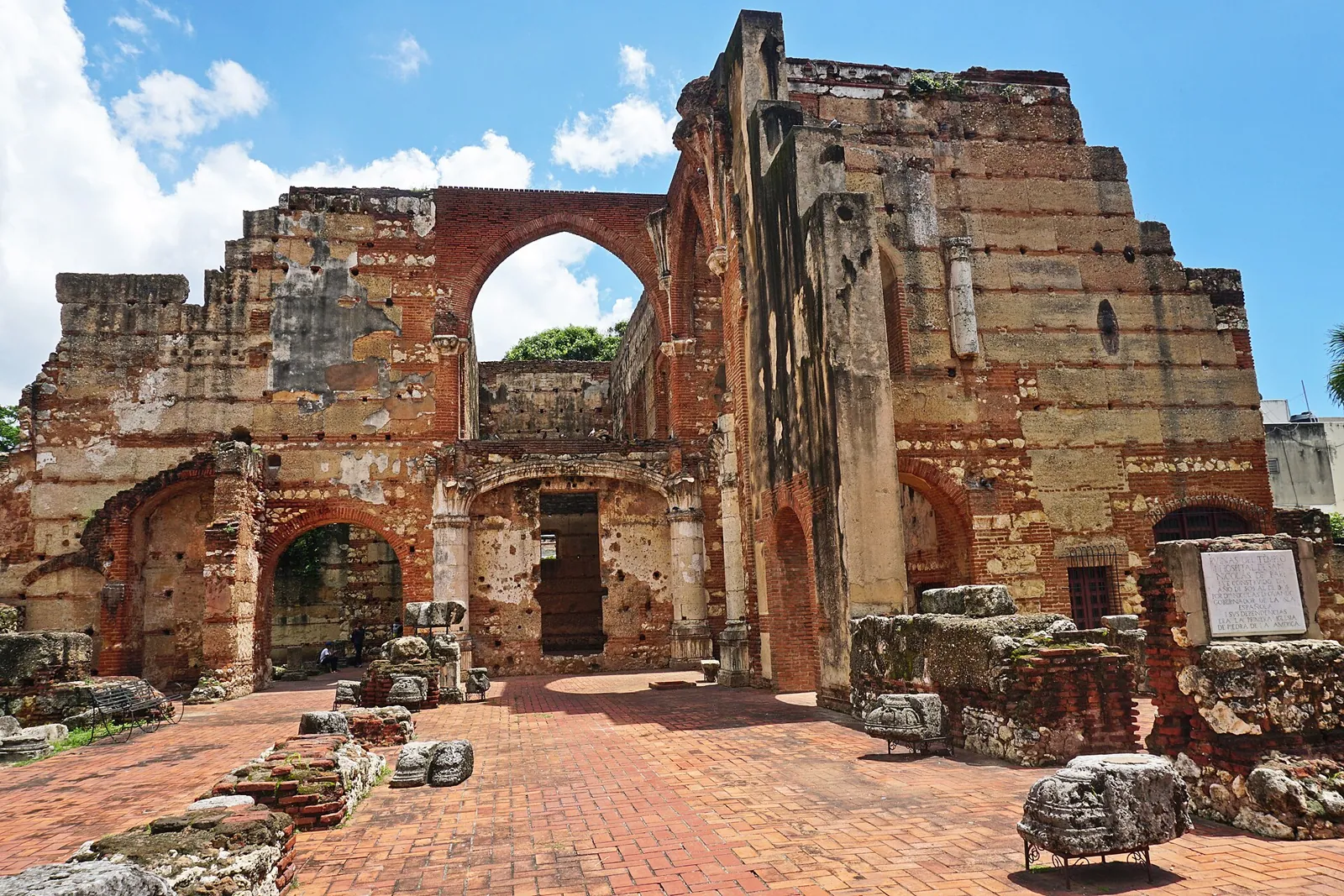
On Calle Hostos, a few blocks uphill from the river, a row of tall stone arches stands against the sky with nothing above them. There is no roof, no floor in most places, and no ceiling to hold up the ribs of the vaults that once crossed these walls. What stands is the Hospital San Nicolás de Bari, begun in 1503 by Governor Nicolás de Ovando and widely described as the first hospital built in the Americas. It served the colony for more than two centuries, burned in 1586, and then wore away until a few walls and two chapels were left.
You can walk past it in a minute, and many visitors do. That would be a mistake, because the ruin answers a question that most of the Zona Colonial's monuments do not: what did it mean to live in this city in the 1500s, when it was new, when people got sick, and when no one knew how to cure most of what made them ill? This article follows the hospital through its three buildings, explains what the architecture tells you, looks at the "first hospital" claim and the dates that conflict, and ends with the ruin as it stands and the museum plan that wants to put it back to use. The hospital's neighbors have their own pages: the 16th-century church ruins nearby are in Colonial Churches of the Zona Colonial, and the larger monastery ruin is in The Ruins of the Monasterio de San Francisco.
Why Ovando Built a Hospital
Ovando reached Santo Domingo in April 1502 as the crown's new governor. A reference biography says he arrived with about 2,500 colonists, among them the young Bartolomé de Las Casas, and that he founded towns on a gridiron plan. It says Santo Domingo itself was refounded on the opposite bank of the Ozama River. Diario Libre gives the arrival date as 15 April 1502 and says the fleet had about thirty ships. The article on the hospital in El Día, written by María Cristina de Carías, César Iván Feris Iglesias and César Langa Ferrer, adds that the new street grid was modeled on Santa Fe, the camp built near Granada during the siege of that city, and on the Roman military camp.
The same article ties the hospital to Ovando's own history. He had fought in the conquest of Granada and knew the health institutions the Moors had built there, which Christians later imitated. In the authors' view the hospital was meant to treat wounds from the conquest and pacification of the island and the illnesses of the town's residents, and Santo Domingo's role as the seat of government made a civic institution of this kind necessary.
The word pacification needs a plain translation. A reference entry says Ovando used heavy force to subdue the island's indigenous peoples and Spanish malcontents, and a royal decree of 20 December 1503 created the repartimiento of Indians, the system that became the encomienda. The Taíno were the people on the other end of that policy, and their story is told in The Taíno of Hispaniola. When a hospital is built to treat the wounds of a conquest, the people who were wounded are only half the story.
A local visitor guide gives a second reason. It says Ovando ordered the hospital rebuilt quickly because illness was widespread, and it names the causes as heat, insects, and a lack of medicine and knowledge of treatment. Wealthier colonists paid for the hospital and for the church beside it, the Iglesia Altagracia. The guide says the stone building replaced an earlier hospital on the east side of the river, which brings us to the first of the three buildings.
Three Buildings on One Site
One local guide is the most detailed source on the building phases. It describes three. The other sources agree on the general pattern and differ on the dates, so each source's version is given.
The First Hospital, 1503
The guide says the first hospital was built in November 1503 in the original settlement across the river. It was a palm hut that held about six patients, and women of the colony cared for the sick as charity. When the settlement moved to the west bank, the hospital was rebuilt on the site where its ruins stand today. The same guide says the site had belonged to a Black woman who had nursed the sick. That detail comes from a visitor guide and is not confirmed in a historical source, so it is the guide's account.
The Stone Hospital, 1519 to 1527
A stone and brick building replaced the hut. One local guide dates it to 1519 and says construction was complete in 1527. The El Día article says the first stage of the building formed the core and that it was continued in 1519 with donations from residents. A third source, the tourism listing, says the hospital began operating in 1522 and was helped along by the Cofradía de Nuestra Señora de la Concepción, a lay brotherhood, which paid to replace the thatch and wood with masonry and brick. Another article, from El Nuevo Diario in 2021, says the hospital was still standing in 1522 and treating more than 60 people a day.
These accounts are not the same date, but they can all describe one process: a building that began in 1503, was carried forward in stages, and was working by the early 1520s. The guide says only a small chapel survives from this second building. If that is right, the chapels you can see in the ruin are among the oldest parts of it.
The Larger Hospital, 1533 to 1556
A third and much bigger hospital was built from 1533. One local guide gives the end date as 1556 and says it could hold about fifty patients. The El Día article gives the third stage as about 1533 to 1552, funded partly by residents and partly by a donation from the Church. It adds that the hospital was then incorporated into the Hospital del Espíritu Santo in Rome, a link the article does not explain. A scholar's list says the first hospital was built between 1503 and 1508, with a staff of a medical director, an agent, an internist, a chaplain and six servants.
So the range of dates you will meet runs from 1503 to 1508 for the first phase, 1519 to 1527 for the second and 1533 to 1556 for the third, with 1552 as an alternative end date. A sign at the ruin may use any of them. All of them agree on the main point, which is that the building took half a century and was funded by public subscription as much as by the governor.
What the Building Looked Like
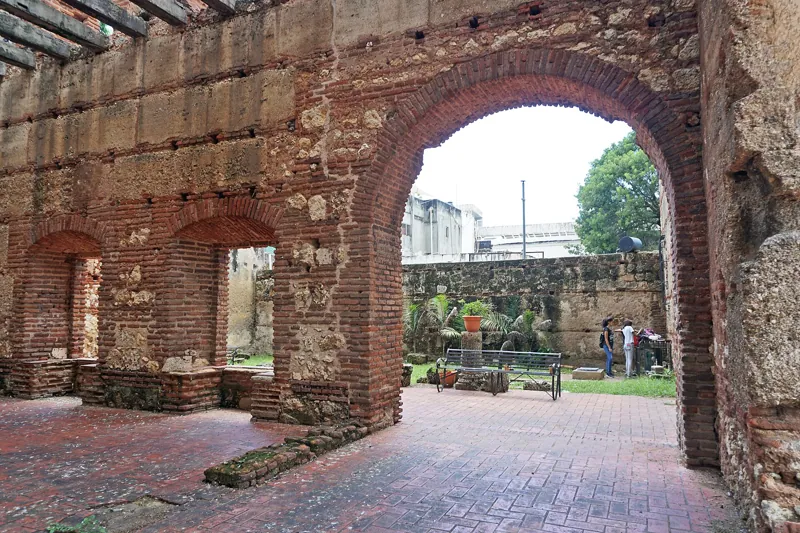
The El Día authors describe the plan in detail, and they are the fullest source for it. The hospital was cruciform, in the shape of a Latin cross, and held up to 60 patients. It had three naves, a central one for worship and two on the sides for the sick, so that patients were close to the chapel. The article says it began around an original chapel dedicated to Nuestra Señora de la Concepción, a dedication the cathedral took up later. Wards were arranged by need: wards for tuberculosis patients, a women's ward, a ward for the sacrament of the sick, a room for treating wounds and broken bones, a linen room and a pharmacy.
That list suggests how care was organized: by condition and by sex, with a chapel at the center of the plan. One local guide says wealthier colonists paid for the hospital and its church, and the tourism listing names a lay brotherhood, the Cofradía de Nuestra Señora de la Concepción, as a backer. The El Día authors also say that in the middle of the 16th century the hospital was one reason Santo Domingo was compared with Florence and Barcelona. The comparison is theirs and is not checked against a period source, but it shows how the city's own historians feel about the building.
The Stonework
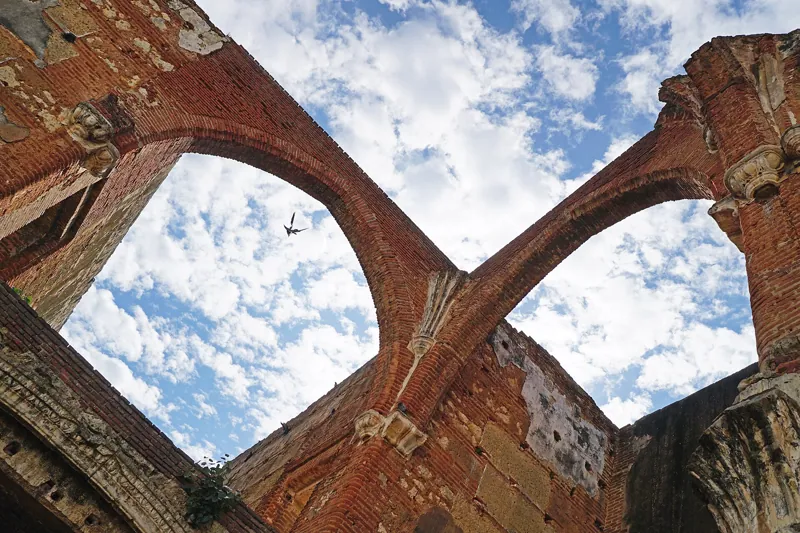
The same article describes the materials as dressed stone and brick masonry, with the corners and ends reinforced in stone. The styles are mixed. Gothic pointed arches appear alongside Romanesque round arches and Renaissance details, and segmental arches, which are flatter curves, appear in the large halls. There are plateresque details, the fine carved ornament of early Spanish Renaissance buildings, on both floors. Large pilasters with classical capitals support the ribs of stone or brick vaults. Some surviving capitals carry winged cherub heads on three of four sides. Brick ramped arches still mark the stairways to the second floor and keep the original tread and riser dimensions. Most roofs were flat, carried on wooden beams with clay-tile floors above, with some sloped roofs on the upper levels.
The two surviving chapels have ribbed, pointed brick vaults with stone springers, which the authors present as the clearest example of Gothic character in the building. A pointed arch is the Gothic signature, and a round arch is the Romanesque one. You can tell them apart in the ruin by looking at the top of any opening. If the top is a point, it is Gothic, and if it is a half circle, it is the older round form.
Photographs of the ruin show pointed arches among the standing walls, which agrees with the description.
The First Hospital in the Americas?
This is the claim that makes the ruin famous, and it is more complicated than the signs make it. The sources make three different statements.
The first is that San Nicolás de Bari was the first hospital in the Americas. El Día says so, and so does an El Nuevo Diario article about a museum plan for the ruins. An article by the scholar Marco Antonio Ayala-García lists the first ten hospitals on the American continent, and it names San Nicolás de Bari as Hospital I, built from 1503 to 1508.
The second is a narrower claim. A tourism listing calls it the first hospital in the Dominican Republic or, more exactly, on the island of La Española. That is the safest statement of what the evidence supports.
The third is a rival claim about a different building. The scholar's list puts the Hospital de Jesús Nazareno in Mexico City second, dated to 1524 and founded by Hernán Cortés, and notes that it is still operating. A Texas Standard radio story carries the headline "Nearly 500 Years Old, This Hospital Is the Oldest in the Americas" and describes the Mexican hospital, which opened in 1524. The two claims can both be true if you define the terms. San Nicolás de Bari was begun earlier, but only ruins remain. Jesús Nazareno was begun later, but it has been in use for five centuries. A fair summary is that Santo Domingo has the oldest hospital building and Mexico City has the oldest hospital that is still working. The Hektoen list also shows how quickly hospitals spread after 1503. It counts ten in about 31 years, with eight of the other nine in Mexico and one in Guatemala.
El Día and El Nuevo Diario also place the hospital in a trio. With the Catedral Santa María la Menor, which they say was founded in 1512, and the Universidad de Santo Tomás de Aquino, founded in 1538, the hospital is one of the New World's three firsts in Santo Domingo. A tourism listing calls them the three treasures of the colonial city. The cathedral is covered in Catedral Primada de América, and the university claim in Convento de los Dominicos.
The Long Decline
Hospitals of this kind do not close on a single day. The sources describe a slow loss.
In 1586 the English fleet of Francis Drake occupied the city for a month. One local guide says Drake's forces burned and destroyed the medical center and stole its contents, including documents and church treasures. The raid is told in Francis Drake's Raid on Santo Domingo in 1586. The hospital was repaired, but not fully. The guide says it later served as a military hospital and stayed in use despite its poor condition, with hurricanes and earthquakes causing continuous damage. A tourism listing says it served until the middle of the 18th century, when it was abandoned for good. One local guide says that after the Restoration of 1863 the building was abandoned and left to decay. These two dates fit together if the hospital's regular service ended in the 1700s and the building was used in some way for a century more before it was left to fall.
The last chapter was the removal of the dangerous walls. A tourism listing says some walls were demolished in 1911 because they threatened passersby. One local guide says that in the 1930s the adjoining Altagracia chapel was rebuilt and some hospital walls were knocked down because they were at risk of collapse. The authors of the El Día article say the building was demolished when it began to threaten collapse, to protect the nearby structures. The decade is not clear from these three accounts, so both dates are given here.
The Church Next Door
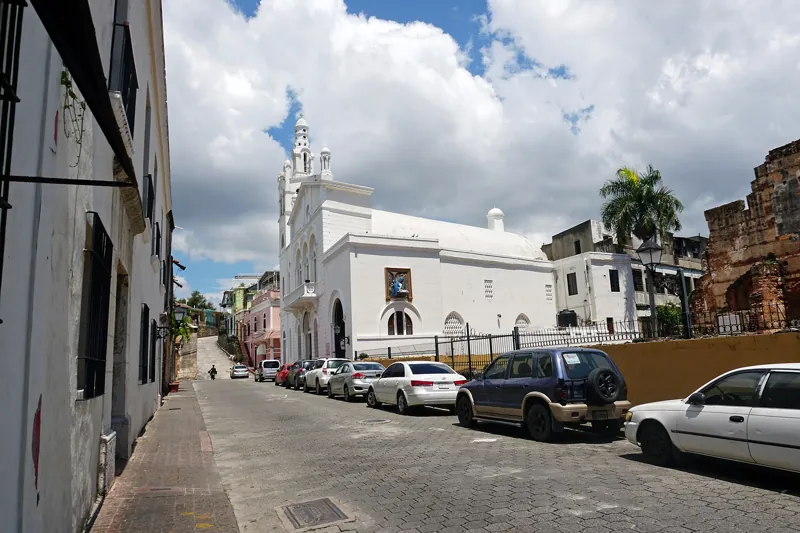
Beside the ruin stands a white church, the Iglesia Nuestra Señora de la Altagracia. It is not a survivor from the 1500s. The El Día article says it was designed by the engineer Oswaldo Báez in the first half of the 20th century and built over part of the hospital site. Two worship spaces from the original hospital chapel are built into it, and the tabernacle area holds a baroque altarpiece. One local guide says the original chapel was rebuilt in the 1930s. So the church is the hospital's modern neighbor and in part its heir. It deserves its own look, and the broader picture of the district's churches is in Colonial Churches of the Zona Colonial.
The Ruin Today
Standing in front of the ruin, here is what the sources tell you to look for. One local guide says a cross-shaped outline is still visible in the faded blue tile of the floor, which echoes the cruciform plan. Some original pillars are preserved inside the ruins, according to the same guide. Birds nest in the holes in the interior walls, and the guide says pigeons and parrots are loud during mating season. A large beehive hangs high on an exterior wall. A tourism listing says the ruins are lit at night. The El Día authors point to details a careful visitor can find: the cherub heads on the capitals, the ramped brick arches of the stairways and the ribbed vaults of the two chapels.
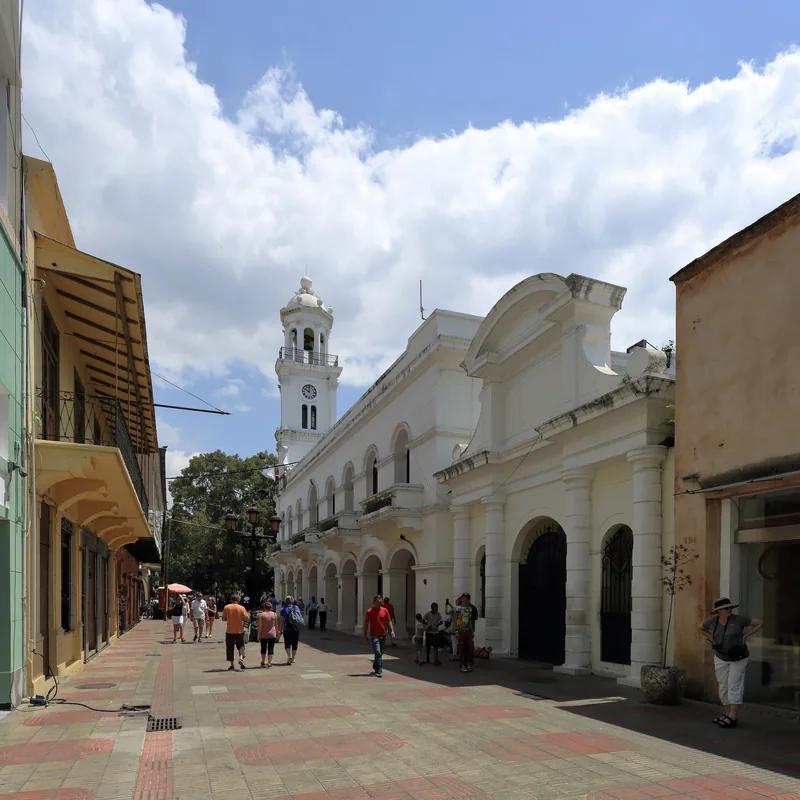
The location is Calle Hostos, between Calle Mercedes and Calle Luperón. From Calle El Conde you turn away from the sea onto Calle Hostos. The ruins and the Altagracia church sit between those two cross streets.
The sources used here give no opening hours or admission fee for the ruin, so none are quoted. It is possible to see most of it from the street. Check before you go if you hope to step inside.
A Museum for the Ruins
In February 2021 a group formed to give the ruins a new use. El Nuevo Diario reports that on 4 February 2021 the Comité Permanente Centro Cultural y Museo Panamericano de las Ciencias Médicas was created, led by UNPHU and the Alcaldía de Santo Domingo. Its initial members include the coordinator of the project, Dr. Amado Alejandro Báez; the director general of the Oficina Nacional de Patrimonio Monumental, Juan Mubarak; and the dean of UNPHU's architecture faculty, Omar Rancier. The plan is to create a permanent museum in spaces associated with the hospital's ruins, with permanent and temporary exhibitions and cultural exchanges with the Americas. Early activities were to include photography and painting contests and digital reproductions of the site. Dr. Báez told the newspaper that the ruins show the origins of medicine in Santo Domingo, which he described as a source of pride.
No later report on whether the museum was built is cited here, so treat the plan as a plan until you see otherwise. If it happens, it will answer the question of what to do with a ruin that is too important to fix and too fragile to leave.
Getting there from the penthouse
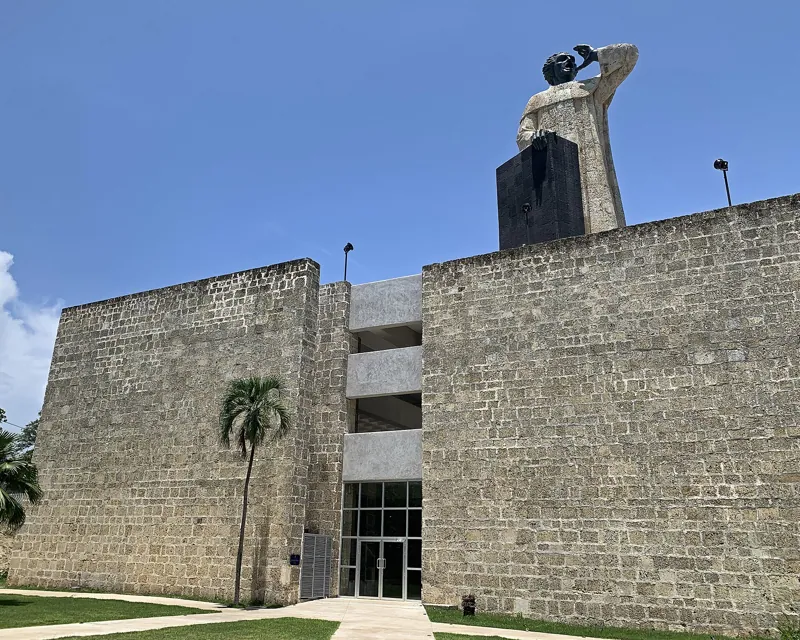
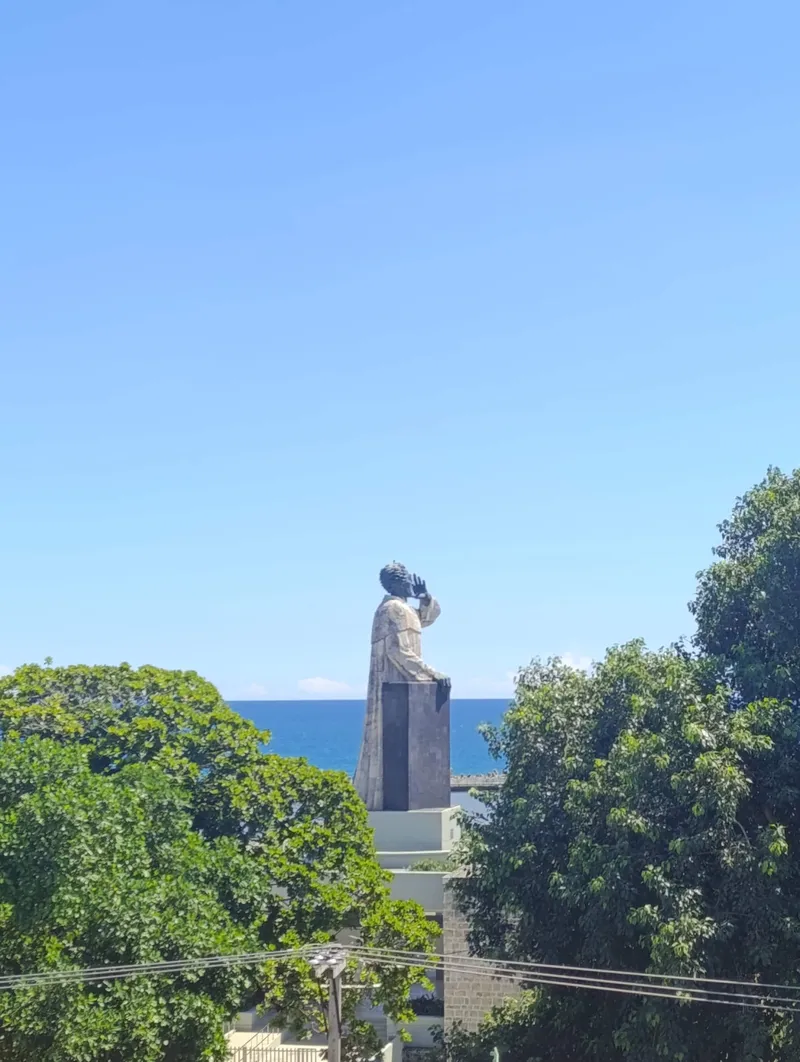
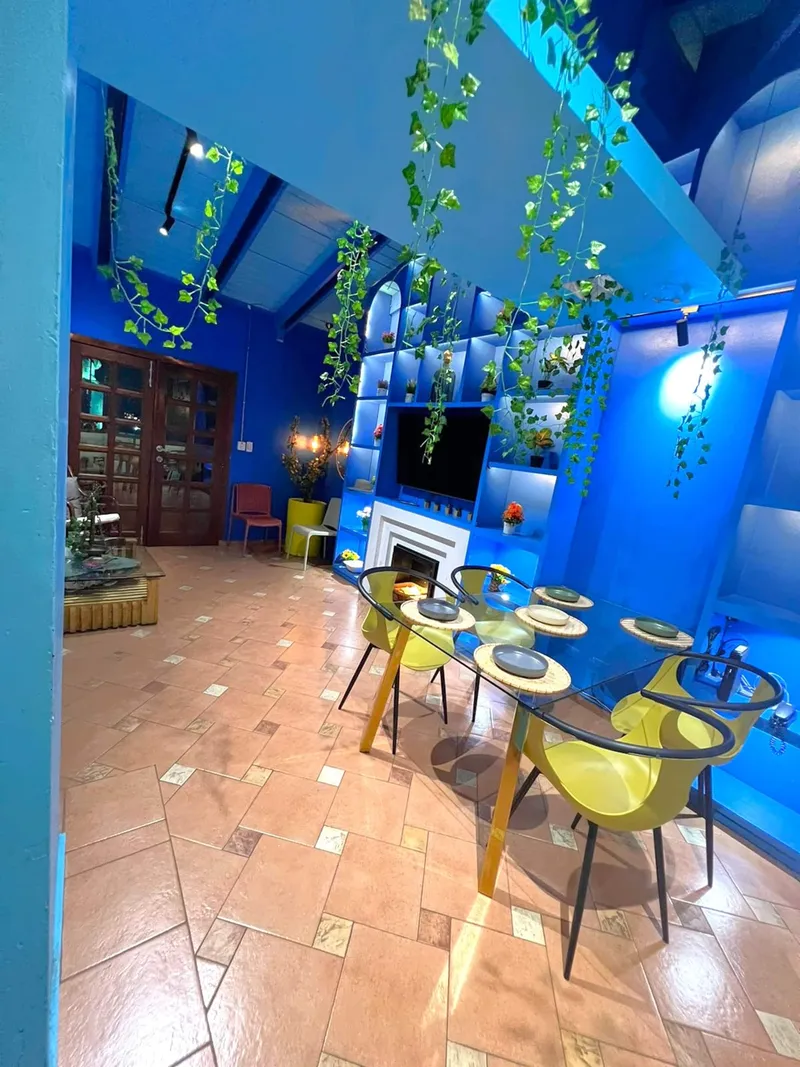
Penthouse Pallazzo sits on the sea edge of the Zona Colonial, facing the Montesinos monument, and the hospital ruins are inland and uphill from it. The straight-line distance is about 590 meters, which is about 10 minutes on foot, a little more if you stop. Calle Hostos runs away from the sea off Calle El Conde, and the white Altagracia church is the landmark to look for. The ruins are beside it. A walk that links the ruins to the monastery ruin and the cathedral is described in the Santo Domingo landmarks guide, and the neighborhood around them is in the Zona Colonial guide. The hospital, the fort and the river are close enough to see in one morning, as in Fortaleza Ozama.
Frequently asked questions
Was this really the first hospital in the Americas?
Several Dominican and international sources say so, including a scholar's list that numbers it Hospital I. A narrower and safer claim is that it was the first on the island of La Española. Mexico City's Hospital de Jesús Nazareno, begun in 1524, is the oldest hospital in the Americas still in service.
When was it built?
It was begun in 1503 under Governor Nicolás de Ovando. The sources divide the work into stages, with a stone building in the 1510s and 1520s and a larger one from about 1533 to 1552 or 1556. The dates differ by source, and a sign on site may use any of them.
Why is there no roof?
The hospital burned in 1586, was repaired and served for generations in poor condition, and was then abandoned. One local guide says that in the 1930s some walls were knocked down because they were at risk of collapse, and the tourism listing says some were demolished in 1911. What stands is the remaining stone.
What is the white church next to it?
It is the Iglesia Nuestra Señora de la Altagracia, designed in the first half of the 20th century by the engineer Oswaldo Báez, with two worship spaces from the original hospital chapel built into it.
Can you go inside?
The sources used here give no hours or fee. Much of the ruin can be seen from the street. Check before you go, because access can change.
Is there a museum?
A committee was formed in February 2021 to plan a permanent museum of medical sciences in spaces associated with the ruins. Whether it has opened is not confirmed.
Sources
- https://www.colonialzone-dr.com/san-nicolas-de-bari/
- https://eldia.com.do/san-nicolas-de-bari-fue-el-primer-hospital-de-america/
- https://elnuevodiario.com.do/conforman-comite-permanente-del-centro-cultural-museo-panamericano-de-las-ciencias-medicas/
- https://www.visitarepublicadominicana.org/ruinas-hospital-san-nicolas-bari-santo-domingo
- https://hekint.org/2017/02/23/the-first-ten-hospitals-on-the-american-continent/
- https://texasstandard.org/stories/listen-nearly-500-years-old-this-hospital-is-the-oldest-in-the-americas/
- https://encyclopedia.com/humanities/encyclopedias-almanacs-transcripts-and-maps/ovando-nicolasde-1451-1518
- https://www.diariolibre.com/portada/reportaje/la-ciudad-de-santo-domingo-y-sus-invaluables-tesoros-coloniales-BP27939181
- https://commons.wikimedia.org/wiki/File:Fachada_Ruinas_Hospital_San_Nicolas_de_Bari_CCSD_09_2018_1419.jpg
- https://commons.wikimedia.org/wiki/File:Arcos_Ruinas_Hospital_de_Bari_CCSD_03_2020_4774.jpg
- https://commons.wikimedia.org/wiki/File:Interior_Ruinas_San_Nicolas_de_Bari_CCSD_09_2018_1384.jpg
- https://nominatim.openstreetmap.org/search?q=Ruinas+Hospital+San+Nicol%C3%A1s+de+Bari+Santo+Domingo&format=json&limit=3