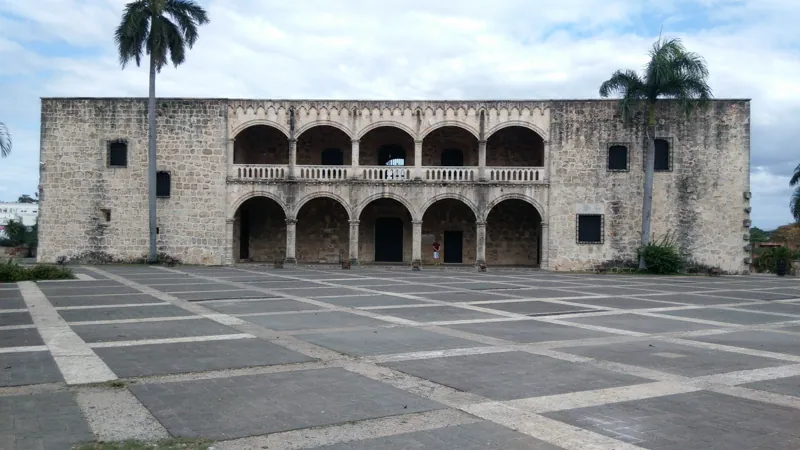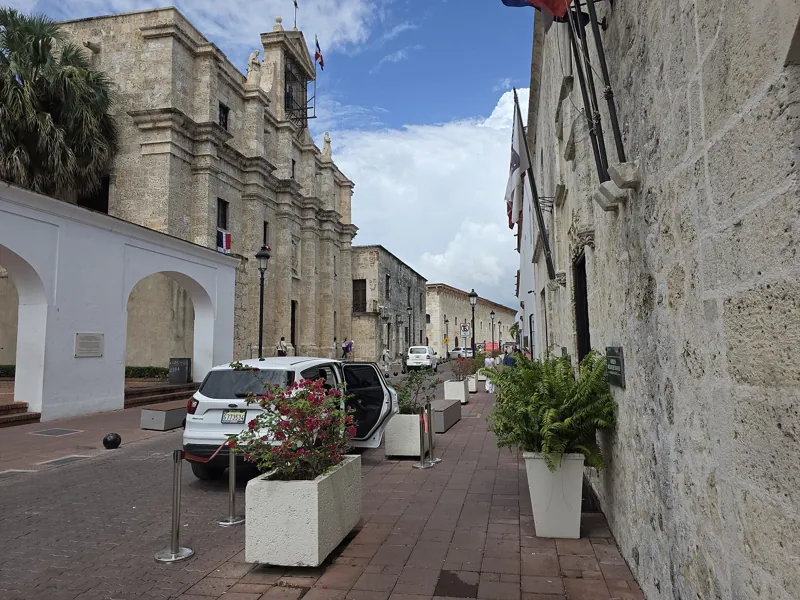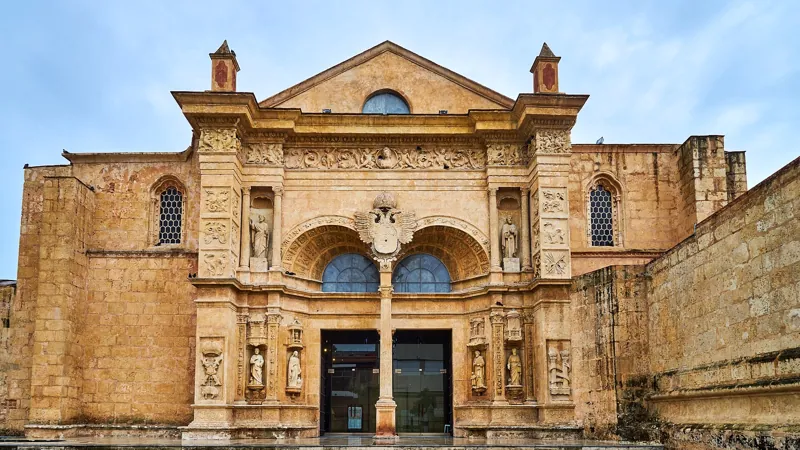
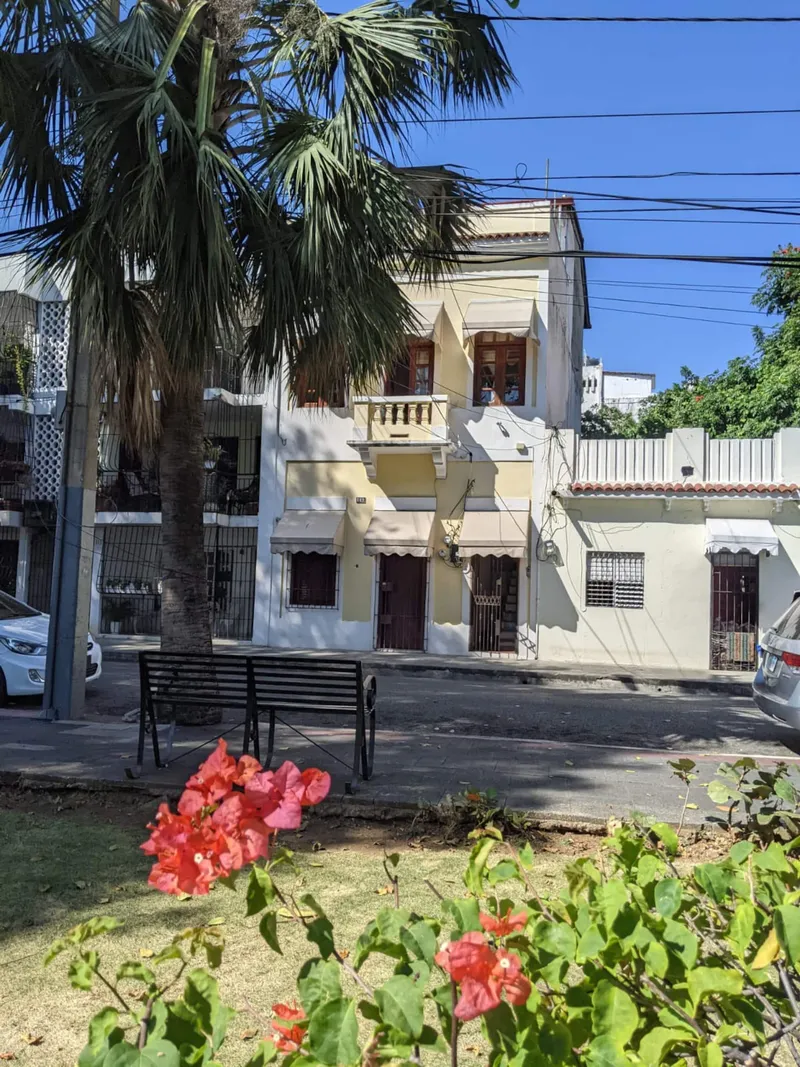
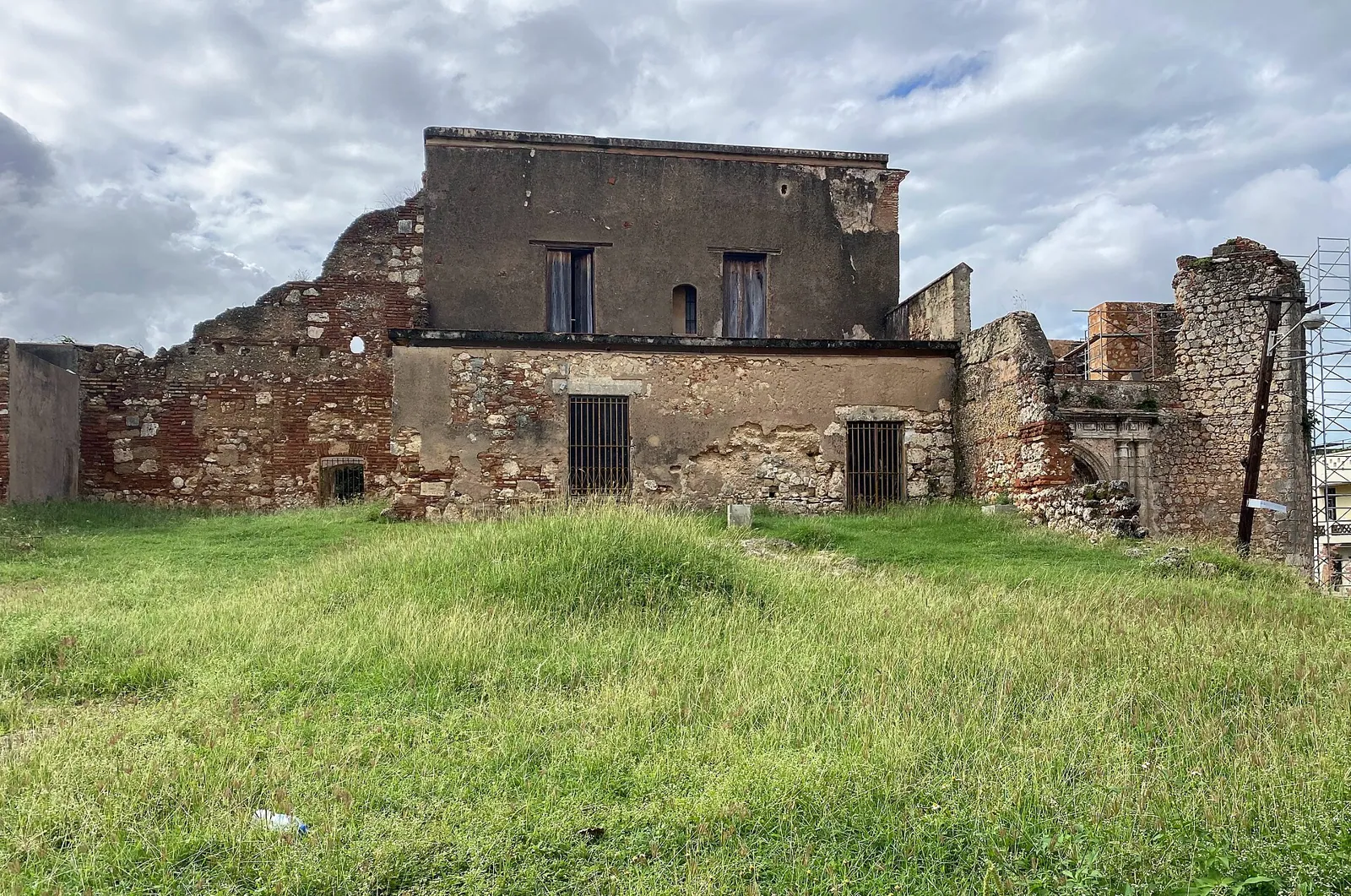
Up the hill from the river end of the Zona Colonial, past the pastel houses of Calle Hostos, a long run of roofless stone walls opens out. Arches frame the sky. Ferns grow out of the masonry. This is the Monasterio de San Francisco, the Franciscan house that Dominican writers call the first monastery in the Americas, and it is the district's most photographed ruin. On Sunday evenings it is also where the old city goes to dance.
Almost nothing about the ruin is simple. Sources disagree about when the Franciscans arrived, whether the building was wrecked by Drake or by an earthquake, and who is buried here. The building spent more than half a century as an asylum. In 2015 a plan to restore it set architects, the government and the heritage community against one another. This page tells the story in order, says where the sources split, and ends with what you can do there today.
The Franciscans and the New City
The Franciscans were one of the religious orders that came with the first waves of colonists. Diario Libre, in a 2015 feature on the ruins, says the Franciscans' first monastery on the island arrived with Nicolás de Ovando in 1502 and was originally built of wood. A local guide gives a different start: it says the monastery was begun in 1509 by Ovando and completed in 1560. The difference may be a matter of what is counted: the earlier date can mark the order's arrival, and the later one the start of the main building campaign, though the sources do not say so.
Ovando was the governor who moved the city to the west bank of the Ozama and laid out its grid, and a monastery was part of the plan from the start. The same is true of the cathedral, the hospital and the Dominican convent, which you can read about in A History of the Zona Colonial. Monasteries did more than pray. They ran schools and hospitals, took in the poor and set the rhythm of a neighborhood through their bells.
Dominican writers describe the Franciscan house as the first monastery in the New World, and the claim appears in a local guide and in a column in the newspaper Acento. Treat it as their claim. It fits the dates for the order's arrival, but the sources here do not compare it with other houses, and a few other early buildings in the city make "first" claims of their own. The Colonial Churches of the Zona Colonial page looks at some of them.
Building in Stone
Diario Libre says the stone construction took place between 1523 and 1664, and that the structure that survives reflects modifications made in 1772. So the building was never finished in a single campaign. It grew, was damaged, was rebuilt and was altered, over a stretch of about 250 years. The local guide gives the shorter version, with completion in 1560.
According to that guide, the complex had three parts: the convent, the chapel of the Franciscan Third Order, and San Francisco el Viejo. The Third Order is the lay branch of the Franciscans, made up of people who live in the world but follow the order's rule. Its chapel was a place for that community, and the guide also names a Capilla de Garay, which it says is also called the Chapel of María de Toledo, the wife of Diego Colón. You can read about her husband's palace in the same series, at Alcázar de Colón.
The guide describes the style as Renaissance on the outside and Gothic inside. It says the Franciscan coat of arms, the knotted cord of the order, is carved into the stone around the main arched doorway, along with a cross and a bust of Padre Billini. That last detail is a clue to the building's later life, which comes below.
One more note from Acento: the writer Ylonka Nacidit Perdomo, in a 2015 article, calls the complex the largest colonial monumental complex in the old city. She cites the historian Bernardo Pichardo, who wrote about the site in his book Reliquias Históricas de La Española, published in 1920, which she calls the first book on the monumental art of Santo Domingo. A third edition appeared in 1982. If you want to read an early description of the walls before the worst of the later damage, that is the place to start, although it is in Spanish.
Drake, Earthquakes and a Hurricane
The ruin is the result of several blows, and the sources order them differently.
The first is the English raid. The same guide says the pirate Francis Drake took the monastery during his raids on the city in 1586. The 1586 raid is told in full at Francis Drake's Raid on Santo Domingo in 1586, but the pattern is familiar from other churches in the city: the invaders plundered, burned parts of the settlement to press for a ransom, and left the buildings to be repaired. A research summary says the Spanish agreed to pay 25,000 ducats by January 30, 1586 after Drake ordered parts of the settlement burned. The monastery was one of many places that suffered.
Earthquakes followed. The same local guide lists quakes in 1673 and 1751 that damaged the building further. Accounts differ on how much each blow did. The most careful reading from these sources is that the monastery was repaired after 1586, damaged again in 1673 and 1751, and lost its roofs over time.
The last great blow came in 1930. The local guide says a hurricane that year destroyed the vaulted roof of the Third Order chapel. That is the storm Dominicans call San Zenón, which the newspaper El Día also names as the storm that destroyed the nearby hermitage of San Antón. The chapel is why only its facade and some interior arches survive today, according to the guide.
The Asylum Years
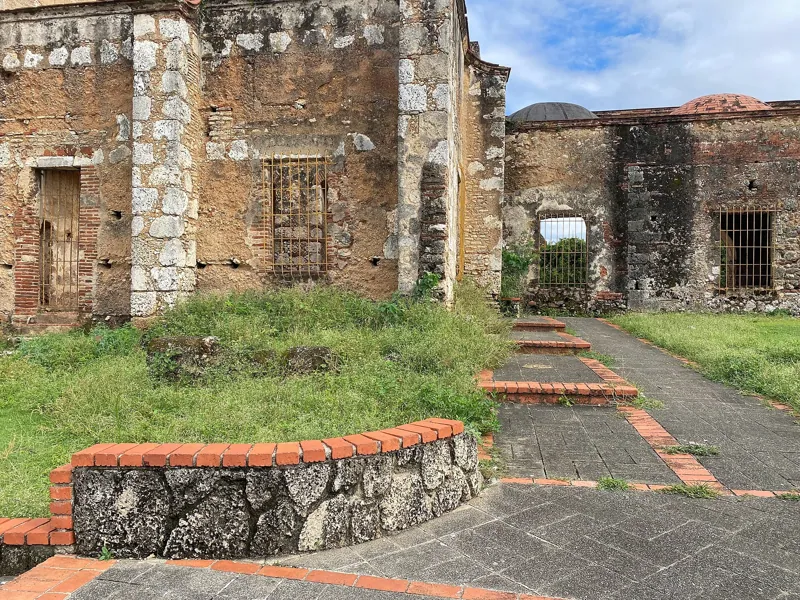
For about six decades the ruins were not empty. Diario Libre, citing the historian José Luis Sáez, says that in November 1881 Padre Billini asked President Fernando Arturo de Meriño for permission to found a "Casa de Salud," a house of health, at the site. The sources name the priest differently, Gregorio Billini in the newspaper and Francisco Billini in the local guide, so the safest reference is Padre Billini. In 1885, after fundraising through bazaars and advertisements in the weekly La Crónica, the country's first mental asylum opened there. In 1940 the dictator Rafael Leónidas Trujillo ordered the asylum moved to Nigua, in San Cristóbal province.
The local guide adds that remnants of chains bolted to the walls can still be seen, and notes holes in the surrounding land that are said to have held prisoners or to be the sites of excavations. The guide does not settle which. Those details are the kind that make visitors uneasy, and it is worth saying that they are described as stories about the site, not as findings from a historian. What the sources document is the asylum itself: a charitable project led by a priest, fundraised by public bazaars and run in a damaged colonial building because there was no other place.
The asylum years explain why the building has not been rebuilt in the way other colonial monasteries were. It was used, and used hard, and nobody had the money to restore it. They also explain the bust of Padre Billini on the doorway. He belongs to the building's later story as much as the friars do.
What Survives
It is easy to take the ruin in as one big picture and leave, and that loses most of what is there. The walls are a record of several periods stacked on top of one another, from the first Franciscan work to the asylum fittings and the repairs of the last century, and the pleasure of the place is in reading them slowly. Walk around the ruin and you can find the layers.
- The main doorway. The carved Franciscan arms, the cross and the bust of Padre Billini frame the arch, according to the local guide.
- The Third Order chapel. Only the facade and some interior arches remain, after the 1930 hurricane took the vaults.
- The well. The guide mentions a deep well on the site, covered by a grate.
- The fence. The site is a UNESCO World Heritage property, surrounded by an iron fence, as the guide notes.
- The hill. The ruins sit on rising ground and cover almost two city blocks.
The guide also says Bartholomew Columbus, Christopher's brother, may be buried here, though it notes this is not certain. A claim like that is worth holding loosely. The sources do not document a tomb, and the wider Columbus family story, including the long dispute over the admiral's own remains, is told at Catedral Primada de América.
Another point to make is that the Taíno and enslaved workers who built the city's stone buildings appear in few of the records. Nacidit Perdomo writes that Taíno people and enslaved workers worked alongside Castilian builders on this monastery, and she presents it as her own claim, not a documented detail. It is a reminder to look at the walls and think about who cut and lifted every block. The people who lived on the island before 1492 have their own page at The Taíno of Hispaniola.
The Restoration Fight
In 2015 the ruins became the center of a national argument. The Ministry of Tourism, through its tourism development program for the Colonial City, announced a restoration led by the Spanish architect Rafael Moneo, who won a competition among 42 firms. Financing came from the Inter-American Development Bank, with a disbursement of US$7 million, Diario Libre reported in July 2015. Acento reported that the master plan and design contract carried a budget of US$1,250,000, and that the project was described as a "Centro San Francisco," a convention and events center with an archaeological park.
Opposition came quickly. The architect Omar Rancier, a professor at the Universidad Pedro Henríquez Ureña, called the proposal questionable because it made the ruins secondary to the new work. Architecture guilds and intellectuals objected to its modernist look. The Dominican committee of ICOMOS, the international heritage council, wrote to the Ministry of Culture on July 1, 2015, warning that the project would build new structures and remove much of the green space, and that it would be obligated to ask for the site to go on the World Heritage in Danger list if the damage went ahead. Rancier backed that position, and so did the Dominican College of Architects. He proposed that a commission of ministries, academies and universities set rules for working on such structures, and that any new work be lightweight, preferably metal, and removable. In the Acento column of July 2015, the author Ylonka Nacidit Perdomo argued strongly against the plan, saying it would turn a heritage site into a commercial venue.
What did UNESCO say? In February 2016 Diario Libre published a letter from Mauro Rossi, head of UNESCO's Latin America and Caribbean unit at the World Heritage Centre. It said UNESCO had made no decision on the project, which had not even been discussed, and that the issue would go to the 40th session of the World Heritage Committee in Istanbul on July 10 to 20, 2016. UNESCO had only monitored the site, with the Dominican state and ICOMOS International. The paper noted that the Dominican ICOMOS note of February 2 had claimed UNESCO recommended disapproving the project. That claim and Rossi's letter did not match.
By October 2016 Acento reported that the restoration was not included in a new US$90 million loan requested from the Inter-American Development Bank for the Colonial City program, and that the project had been stalled since July 2015. No later source says the Moneo design was built, formally canceled or replaced. The practical answer for a visitor is that the ruin you see is a ruin. Hold the question of what comes next loosely, and check recent news before you plan around any construction.
Sunday Evenings
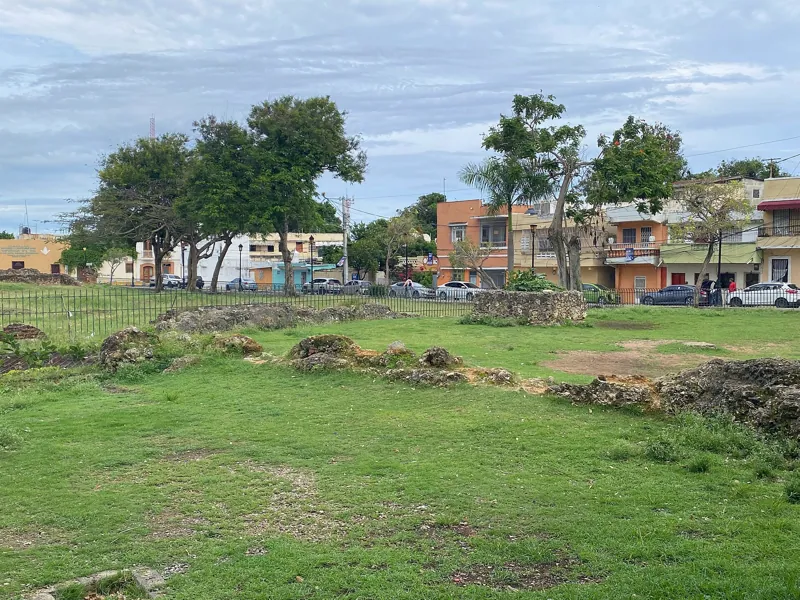
The ruins are protected by law and still used for social and cultural events, according to the local guide, which says the plaza hosts events from time to time, that the site is popular for wedding photos, and that on Sundays there is often a free concert with dancing.
The Sunday event is Bonyé. In a 2012 Acento article, Teresa Guerrero describes Los Bonyé as a group of musicians who play son and traditional merengue at the ruins, on the Calle Hostos side. Crowds gather on Sunday afternoons from around 4:00 p.m. People eat grilled meats and traditional dishes such as pasteles en hojas, sit at tables or chairs set up for the event and dance. Guerrero describes the performances as organic, spontaneous and above all authentic, and says the audience ranges widely in age, social class and interests. The organizers called it a space of tolerance and faced some opposition from neighbors, but reached an agreement with the neighborhood board through persistence and diplomacy.
More recently, a 2025 report from the news service DR1 says Bonyé performs merengue and tropical music at sunset outside the ruins "as every Sunday," as part of a weekend program run between February 14 and June 29, 2025. The report gives no calendar for later dates. So the safest summary is that the Sunday concert has been a recurring event for more than a decade, that it is free, and that you should confirm it before you plan an evening around it. The carnival and festivals guide and the guide to the colonial zone at night cover more of what the old city does after dark.
Visiting the Ruins
The local guide's directions are the clearest: from Calle El Conde, turn north onto Calle Hostos and climb about five blocks. You can also come in from Calle Restauración, Calle Duarte or Calle Juan Isidro Pérez. The site covers almost two city blocks and is enclosed by an iron fence.
The guide recommends going in the evening, when lighting heightens the atmosphere, and sitting on the steps. It also says that events are sometimes held in the plaza. No source gives opening hours or an entry fee, so assume the ruins are best seen from the fence and the plaza, and check locally if you want to go inside. Ask on the day, since access can change for events and repairs.
If you can, go twice. In daylight you see the stone itself: the tool marks, the arch shapes, the places where later builders patched an opening. At dusk the floodlights and the music change the mood completely, and the same walls read as a stage set. Seeing both is the quickest way to understand why the ruin matters to people in the neighborhood, who use it as a gathering place and not only as a monument. A few practical thoughts.
- Come once in daylight to see the stonework and the carved doorway, and once on a Sunday evening for the music.
- Wear shoes you can walk uphill in. The streets that climb to the ruins are paved but uneven.
- Keep a hand on your phone in the crowd on Bonyé nights, as you would at any public event.
- Take water. The site has little shade.
The ruins sit between two other stops on a walking day. The Hospital San Nicolás de Bari is downhill and is covered at Hospital San Nicolás de Bari, and the Dominican convent, with its zodiac ceiling, is at Convento de los Dominicos. For a route that strings together the major landmarks, use the Santo Domingo landmarks guide.
Getting there from the penthouse
OpenStreetMap places the ruins on Calle Hostos at about 18.4770, -69.8858. Penthouse Pallazzo sits at roughly 18.4697, -69.8851, 150 meters north of Playa Montesinos, which puts the ruins about 810 meters away in a straight line. Multiply by 1.3 for the real streets and divide by 80 meters a minute, and you get about 15 minutes on foot. The walk goes uphill and inland, away from the sea, so it is a gentle climb in the morning and a cooler one at dusk.
If you are going for Bonyé, plan your walk home as well. The streets around the plaza fill with people on Sunday evenings, and the route back toward the sea wall is downhill and easy.
Frequently asked questions
Is this really the first monastery in the Americas?
Dominican sources, including a local guide and a newspaper column, call it the first monastery in the New World. That is their claim and it rests on the Franciscans' early arrival, which one source dates to 1502 and another to 1509. The sources do not compare it with other early houses.
What happened to the monastery?
It was damaged by Drake's raid in 1586, by earthquakes in 1673 and 1751 and by a 1930 hurricane that destroyed the vaulted roof of the Third Order chapel. Sources vary on which event did the most harm.
Was the monastery an asylum?
Yes. Padre Billini asked for permission to found a house of health there in November 1881, and the country's first mental asylum opened in 1885. In 1940 Trujillo ordered it moved to Nigua, in San Cristóbal.
Is the restoration project going ahead?
In 2015 the Ministry of Tourism chose a design by Rafael Moneo, and heritage groups objected. A 2016 report said the project was stalled and not included in a new loan. No later source says what was built, so check recent news.
Can I go to Bonyé on Sunday?
A 2025 DR1 report describes Bonyé playing at sunset outside the ruins every Sunday, and a 2012 article describes it as a free event with food and dancing. Confirm the current schedule locally before you go.
Can I walk inside the ruins?
A local guide describes the site as surrounded by an iron fence, and no official opening hours are listed. Look from the fence and the plaza, and ask on the day about access.
Sources
- https://www.diariolibre.com/actualidad/ruinas-de-san-francisco-un-patrimonio-cultural-en-peligroa-CXDL1246501
- https://www.colonialzone-dr.com/ruins-of-the-san-francisco-monastery/
- https://acento.com.do/cultura/de-ruinas-a-elefante-blanco-8268588.html
- https://acento.com.do/cultura/la-rehabilitacion-de-las-ruinas-de-san-francisco-8265661.html
- https://www.diariolibre.com/revista/cultura/unesco-no-ha-tomado-decision-sobre-proyecto-ruinas-san-francisco-de-asis-YD2713980
- https://acento.com.do/2016/cultura/8387972-ruinas-san-francisco-no-estan-incluidas-nuevo-proyecto-fondos-del-bid/
- https://acento.com.do/cultura/los-bonye-en-las-ruinas-de-san-francisco-un-domingo-mas-que-caribeno-20856.html
- https://dr1.com/news/?p=231474
- https://www.ebsco.com/research-starters/history/francis-drakes-expedition-west-indies
- https://eldia.com.do/la-ermita-y-la-plazoleta-de-san-anton-legado-religioso-colonial/
- https://nominatim.openstreetmap.org/search?q=Ruinas+de+San+Francisco+Santo+Domingo&format=json&limit=2